Foojay Podcast #100: Java Podcasters on Why They Started, What Broke, and What They Learned



 2 min read
503 views
2 min read
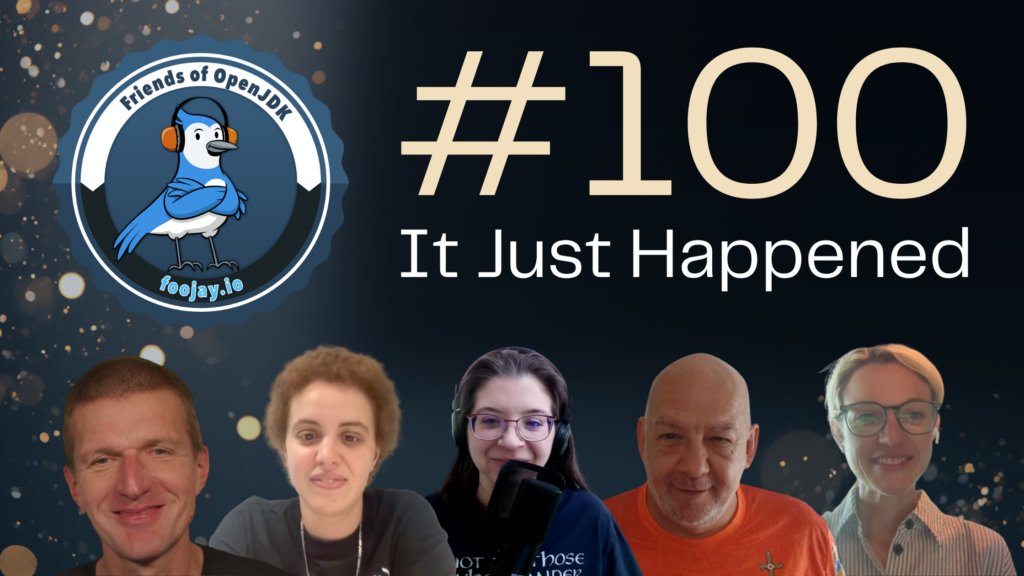
503 viewsFoojay Podcast hits episode 100. No plan, no roadmap. It just happened. To mark the occasion, Frank turned the microphone around and invited other podcasters: Adam Bien (airhacks.fm), Jennifer Reif (Breaktime Tech Talks), Kadi McKean and Steve Pool (10xInsights), and Oumaima Zerouali (JCast). Same three questions for each: why did you start, what broke, and what did you learn?
YouTube
Podcast Apps
You can listen and subscribe to the Foojay Podcast on:
- Spotify
- Apple Podcasts
- And most others…
Guests
- Adam Bien — airhacks.fm | LinkedIn
- Jennifer Reif — Breaktime Tech Talks | LinkedIn
- Kadi McKean — 10xInsights | LinkedIn
- Steve Pool — 10xInsights | LinkedIn
- Oumaima Zerouali — JCast | LinkedIn
Links
- airhacks.fm on Spotify
- Breaktime Tech Talks on Spotify
- 10xInsights | 10xInsights on Spotify
- JCast
- Foojay Podcast #67: Writing a book. Does it make you rich and famous?
- Foojay Podcast #71: 30 Years of Java with James Gosling
- Foojay Podcast #99: Testing the Untestable: LLM Security for Java Developers with Tiberius
- Frank on JCast
- Other podcasts mentioned:
- Spring Documentary
Content
- 00:00 Introduction
- 01:00 Adam Bien (airhacks.fm)
- 12:52 Jennifer Reif (Breaktime Tech Talks)
- 26:25 Kadi McKean and Steve Pool (10xInsights)
- 38:43 Quote by James Gosling
- 39:46 Oumaima Zerouali (JCast)
- 48:01 Conclusion
Transcript
Automatically generated from the audio, so it can contain errors in names and technical terms. Suggest a correction.
[0:00] This is Foojay podcast episode 100. I didn’t plan it, it just happened.
[0:05] Welcome to the Foojay podcast. All your news about OpenJDK.
[0:11] A few weeks ago, I published episode 99 about Tiberius and LLM testing library. And while I was scheduling the next recording, it hit me that makes 100. I didn’t build towards this. I just took over the Foojay podcast when I joined Azul 4 years ago. Eric Koslo started it the year before. Creating content for Foojay is part of my job. So the podcast was a perfect fit. I picked it up and I just kept going. There was no plan to reach 100. It’s a number I just noticed. So for this episode, I thought let’s do something different. I invited other podcasters, different formats, different audiences. One of them is even in Dutch. But I gave them all the same three questions. Why did you start? What broke and what did you learn? My first guest is Adam Bean. Adam runs Air Hacks FM, one of the longest running Java podcasts out there. And if you ever have seen a Java short on YouTube that explains exactly one concept very clearly in under a minute, there’s a good chance it was Adam.
[1:18] Thanks for joining. Can you explain what you’re creating?
[1:22] Usually creating a lots of Java code. This is what I’m creating. preferably Java 25 right now and lots of Quarkus agents LLM related stuff. This is what I’m creating
[1:36] And I’m also just for fun I have a podcast if this is the question.
[1:41] Yeah indeed the podcast already running for a long time. You also have these short videos on YouTube where you explain actually short snippets of code but very clear clearly explained. why do you do this? What is your drive to keep doing this? The answer to the shorts is the very first short and you will find the very first short was an ad or a pre-announcement for a conference and back then shorts were very new
[2:12] And a conference organizer asked me to announce my own talk and I don’t like it because I don’t know what to my talks are spontaneous and it’s really hard to pre-announce this the stuff and this is like you know I didn’t felt comfortable with it but then the shots happened. I said this is actually cool because I can speak for 30 seconds and this is I don’t have you know to spend lots of time of preparing so I did it. So this was the very first shot and then on Twitter someone posted like exaggerated Java code and says Java is verbose and say who writes such a code and then another time they said Python is very concise. This was another tweet and the Python was actually longer than Java. And I say this is strange. And I don’t want to argue with people. They say okay maybe this is your point of view. I would like to show how I see this. And I started to record more or less indirect answers to this what I saw. And then I got more and more ideas. And now it is like u a cool actually exercise for me just to come up with extracting you know very specific pieces of Java
[3:25] Code and make it explainable and more generic. So what you whatever you see in the shorts usually it is from my projects sometimes from an open source project this is what happens but for me it’s more or less fun and takes no time. One shot is like one minute of recording. I have not a huge preparation. They can record, I don’t know, 10 shots a day if you like.
[3:44] Mhm. And you learned a lot. You combined it into into conference talks I’ve seen. I just checked your website. You have over 400 podcasts also already. Very hard to summarize, but what do you learn from these podcasts by creating them?
[4:01] This is like egoistic point of view. I just invite people like you right to my podcast and to just because I have never I have never time at interestingly at conferences to meet people and talk to people. Usually I speak at conferences or before my talk I like to prepare. So usually I always late I do know the slides and preparation sometimes even in the never on time. So never time before and afterwards I usually also have no time because I’m not a speaker I’m I’m actually a consultant. So conferences I cannot explain to my clients why I go to conferences and freelancers I like they will say okay what you’re doing there you have to work here right so this is the attitude so but there are lots of interesting people at conferences and what I thought is if I invite them to my podcast then I can learn from them a lot or at least you know different point of view before this I had a nice recording with Johan Hannib about event sourcing so we arked you know Kafka or not Kafka events sourcing this was just interesting discussion or with you about Raspberry Pis remember
[5:09] And it’s maybe not necessarily learning more like validating my point of views or getting a different point of view or challenging myself and the next problem I got is you know I don’t have the time for preparations like how I can
[5:26] How to structure the podcasts with zero preparation and then I got the idea Then I ask the guest what was your first computer and then see how it goes. So there at the end of the podcast without any preparation we have already a chat until something interesting happened. So this was the entire history of the podcast and now I get so many requests for the podcast. So I have to deny most of them and now the guest queue is full. So if I would stop recording I think until end end of the year would be everything you know I only have to edit editing. So lots of fun but it somehow exploded. So it was it is what actually not anticipated this way.
[6:08] Mhm. Actually, I have to confirm I crossed you a few times at the conference and we actually never talked [laughter] at the conference in real person because I was probably doing interviews for the Foojay podcast or something else and I saw you passing and then I missed you and never saw you again at that conference. So indeed I can confirm you’re there regularly but yeah, you don’t have time to do that. And I like your idea of not needing to prepare. What I do with the interviews at the conference is from time to time I get people on the microphone who are sent by someone else and I don’t know them. So my question is just what’s your name and what you’re doing here? And
[6:50] And this is actually my short introduction. [laughter] They stole it from me. So this is what are you doing here? and [laughter] some people say this is really offensive. It’s like this is fun, you know. Is this not
[7:02] Yeah. I had several guests which returning guests and I keep asking the same question. When do you know me? [laughter]
[7:08] Yeah.
[7:08] Even my colleague Garrett Grunwald, he’s a regular guest and I ask him each time the question, who are you? I’m your colleague. [laughter] it’s a long history. do you have time to listen to other podcasts yourself?
[7:24] Yeah, I listen podcast if there’s nothing to do in the car or that time. yeah. a lots of podcasts actually as much as possible. So not my own podcast. I only listen once episode to you know for editing because what I do actually only I cut the
[7:45] Silence.
[7:46] Mhm.
[7:46] And for I have to relisten this and this also good to recap the idea. So for me, but I plan to relisten my own podcast in order to remember because it runs for seven years or something what happened at the beginning, you know, because I forgot sometimes what we exactly said in a podcast. Podcast is actually good. Yeah. some some names you can recommend that people should start following.
[8:10] It is a wild mix of everything. I think I have like hundreds of podcasts, different podcasts, and I just pick everything in the queue. And this is from tech news to whatever and there’s not unfortunately not a much Java podcast. So
[8:27] But it’s not developer related. I would say this is I remember maybe one I remember was software engineering daily. I think this is what I remember but otherwise I have to look it up because I set up everything long times ago and now I try to keep up with the episodes and I never [laughter] so I did I set up on my first I did this actually. I had my iPod
[8:51] IPod, right? So, the original machine before iPhone, but it was with the hard disk.
[8:56] And then I synced the podcast with iTunes. It was in [clears throat] 2006, I think. And since then, I try to keep up with the subscription list. And oh, one podcast I remember back then was IT conversations. It died. For this is one of the first
[9:09] Software engineering daily, I think. And then I don’t do a lot. I try to keep up with the stream of podcasts and this is but it never is impossible.
[9:19] Mhm. Yeah. It’s it’s a bit a problem indeed. There are so many I also have a long list of what podcasts that I’m subscribed to. I work at home. I’m not a consultant like you. I don’t have to go to customers. So I’m not enough in the car to keep up with my list and have to just keep them. what I like combining is yeah tech news of course but also some comedy if that’s
[9:44] I don’t have the just have a tech news and I cannot keep up this IT conversation I remember they saw the engineering daily then there was a confluent confluence from the Kafka podcast back then so lots of whatever I see you know this could be interesting and I listen entire thing and then we keep moving so it’s not not not a stable list of podcasts.
[10:03] Mhm. from your podcasts, is there one or two that I should definitely listen to, but you have over 400, so it’s probably hard to remember which are the remarkable ones.
[10:14] One with you with Frank. This was the most most remarkable one or two maybe [laughter] even
[10:22] It’s some time ago already. I think we should do
[10:24] James Gosling on the podcast. Scott McNeely for instance, if you’re interested in Java, so this could be interesting. and
[10:31] I also had James Gosling for 30 years of Java. He’s a really nice person to talk with.
[10:37] Yeah. And son of Scott McNeely does an interesting project. But this is like I have to say it is hard to find episode which I don’t like didn’t like because I know the people sometimes are surprised what they actually doing. Sometimes really crazy stuff. Actually I wanted to talk in one episode about Jikes, the old IBM JVM and the guy who created Jikes. It turned out that it also was almost the guy who created Android. So I didn’t knew that, right? So we had an entire conversation about that. and this is what I appreciate. So I would say I like the episodes where the guests surprise me what they actually do. And maybe what I also interested in all the podcast stuff is are the people out there they are just smart without being you know how to call it without working hard
[11:34] On their talent. So is there someone who really just knows stuff because he’s talented? She or he is talented and there is no work, no effort included. And so far I have to say no, you have to work you know talent is one but you have to keep doing and keep learning.
[11:54] So this is also interesting which I try to find you know how they got there and what they did and I have to say regardless how talented they are they spend a lot of time of learning and training. So this is also one of my missions to find out you know how the people became successful.
[12:10] Adam said something I’ve thought about too. Nobody got good at something without doing the work. Talent is only the starting point. It’s not the destination. His no preparation trick is very clever. But that only works because he knows Java deeply enough to go anywhere from any answer. The preparation is actually 20 years of experience. And the reason for starting the podcast is different than mine. I’ve been lucky. I’ve had the time at conferences to actually sit down and record interviews on the spot, but that’s a different thing than what Adam describes. You’re still in conference mode running between sessions. The podcast is where the real and longer conversations can happen. My next guest is Jennifer Refe. Jennifer is a developer advocate and hosts Breaktime Tech Talks. my name is Jennifer Refe and I started Breaktime Tech Talks I guess almost two years ago now, maybe a year ago, two years, something like that. And it’s it’s been a lot of fun. I really enjoy it. I’m a developer advocate at Neo4j and have been for several years. And I was I as I’m learning and growing and kind of expanding into advocacy, I’ve
[13:23] Just kind of dabbled in a few different areas. I started with tech blogging probably sometime around the pandemic I guess it was and really enjoyed that and in the back of my head I always kind of thought podcasting was really cool but I was like not yet I’ve got a few things on my plate and I was really enjoying the tech blogging anyway and so I just kept charging down the road at that and I thought well you know maybe sometime down the road I’ll I’ll have a chance to do that
[13:48] And I don’t remember it’s probably been well a year or two ago now and it started to kind of pop up a little bit more and I thought Well, you know, maybe, but I have a lot on my plate and I’d have to make sure, you know, I could have a regular cadence. And we were still running graph stuff.fm, which is Neo4j’s podcast
[14:06] That was run by our devril and dev advocates mostly
[14:11] And we’d had that for a while off and on and that kind of closed down and I thought, you know, I really want want something in this space. I kind of wanted to try and experiment with a few things. And so the other thing that frustrated me was I was every podcast or tech podcast I would try to get into, they’re they’re typically very long or at least for me I guess an hour to an hour and a half
[14:37] And I have typically a very busy work week. I travel. I have little kids at home and so it’s I don’t have an hour hour and a half to sit down and listen to a podcast as much as I would love to. I have like small splices. So, I would end up listening to these long podcasts in 10 or 15 minute slices. Like, okay, I can cram a little bit in while I’m eating lunch or checking email or, you know, responding to somebody and then turn it off and get busy on my other work. And so, I thought, well, I don’t see any other tech podcast that’s doing this and I really feel like that’s a gap and something that I could possibly fill and how hard would it be to create, you know, 10 15 minutes of content [laughter] on stuff that I’m already doing, right? which is kind of a dangerous game we play I’m sure in this a lot of us in this space right it’s like oh it can’t be that much more work and it’s it’s a ton of fun I love it
[15:29] And it’s it’s been good learning for me but it is sometimes some weeks are harder than others to come up with content and put things together and the recording and the post-processing and get it out
[15:40] But you’re indeed having a very regular schedule of publishing podcasts they are short. it’s not only about Neo4j of course, but you’re way broader.
[15:51] Yes.
[15:52] Still orienting on Java or broader even. What is your Yeah, you have a wide range of topics. Can you summarize them?
[16:00] I focus as a developer advocate at Neo4j. I focus on the Java ecosystem. So, Java technologies, Java ecosystem, language, how whatever goes along with that. and of course, a lot of my work is going to be centered around Neo4j and Java. However, like many of us, we dabble and explore lots of different things, you know, technologies with the rise of AI. We’re dabbling in Python or other languages as well. And so, I really just focus my content on things that I happen to be doing or learning at the time. Again, a lot of that ends up being Java based, but it doesn’t all have to be that way. If I’m playing with something new or I’m exploring something or even just reading something or content or whatever else is out there, that can be a variety of different topics, career or otherwise. And I include that as well because I find that it’s all part of my learning journey and hopefully somebody else can get some benefit out of that as well. M if you have written an article about a specific topic is it then easy to create a podcast or do you start with I want to talk about this and convert it into a
[17:07] Blog. Is this some kind of combination that you do with writing and podcasting?
[17:12] Yeah, that’s a good question. I find it has kind of gone a little bit both directions. there have been a few things that I’ve written about that podcast and tech blog for me at least is a slightly different medium.
[17:28] Like I will talk about certain things in a tech podcast
[17:32] That I wouldn’t necessarily focus on in a technical blog. The technical blog I find I more focus on step by step. Here’s how I did this. Here’s the problem that I had. where in the podcast I feel like I go through a little bit more of my mental process I guess
[17:53] Or the things that I might have thought and the research tactics that I went down first.
[17:59] So I guess it’s more of like the internals.
[18:01] Yeah,
[18:01] I guess in the technical podcast. So it’s slightly different approach but I have had some content that I’ve done technical blog and I feel like I want to not recreate that but talk about it from a different perspective in the technical podcast. So, I will revive that content from the podcast. And then there’s also been a couple of other things where I’ve talked about the general topic in a in my podcast, but then wanted to write a more detailed technical blog because obviously talking code and technical things doesn’t always come across well in audio. So, actually being able to step by step, here’s the code, here’s what I did, here’s why it went wrong is much clearer in a technical blog.
[18:42] So, it has gone both directions.
[18:44] Yeah. Some of my recent podcasts for Foojay, they were really about a new author that’s that wrote someone who wrote for Foojay and then interviewed them and indeed then you get some insight. Why was this like like Tiberius a testing framework for AI systems?
[19:01] Okay.
[19:02] In the podcast you learn more about why and then some frightening stories about what can go wrong with AI based systems.
[19:10] Yes. While while the blog post was really this is a code example,
[19:15] Which yeah is very hard to do in a podcast.
[19:18] Yes.
[19:19] Yeah. Both super interesting perspectives.
[19:21] Mhm.
[19:22] But definitely need both of those channels to be able to bring those into life.
[19:27] What are some of the most important things you learned while creating the podcast? One is that it’s challenging [laughter] to do it
[19:36] Regularly. But did you also learn from Yeah. talking about something that you already have written?
[19:44] I constantly learn.
[19:46] The biggest things I will say is just the amount of learning that I myself do in creating the content. Mhm.
[19:57] So, some weeks I have content, you know, out out my ears to give to bring to the podcast and it’s very easy and sometimes I have to really dig for it and so I will do some searching or think back through what are the tasks that I accomplished this week.
[20:16] It’s healthy for me also to realize what I’ve actually done and what was productive and maybe not quite as productive. And then I try to do some reading which is something that I really enjoy but not something I always devote a lot of time to.
[20:31] So, it’s good habit for me to get into that I’m doing a little bit of content production as well as a little bit of dedicated reading or soaking up other content as well.
[20:43] So, that has been a good practice for me. of course, the tools and the post-processing, I have a good system and a good flow now. not all of it’s automated. I’m working on a few little things to maybe try to automate little bits and pieces so that it’s less manual, but I have a good rhythm now. And so that has that was challenging at first and much easier now.
[21:05] There’s a lot of really good content out there. And so it’s hard to pick and choose and not feel like you’re one of the many voices out there. I mean, there’s some great Java podcasts out there
[21:18] And other content and so it’s it’s easy to get into the well, why would anybody listen to me? But your perspective is valuable as well, each individual person’s. And so you have to remember, okay, what is my unique voice bringing to the rest of the audience that maybe somebody else doesn’t provide. It’s not about necessarily providing more content or doing the same things.
[21:39] It’s well, what’s my perspective on this? What’s my take?
[21:42] That’s also something we say to Foojay authors. They say, “Yeah, but there is already content about that.” Yeah, but it’s not written with your problem in mind or what the specific solution that you found for a problem. Right.
[21:54] There’s always a different angle to something.
[21:57] Yeah.
[21:57] Are there other podcasts that you listen to yourself?
[22:00] A few. Yeah. I actually have a long list of podcasts I subscribe to,
[22:05] And I find that I only get to little snippets here and thereum [laughter] of everything. So, I’ll mention I’ll mention a few, but I’m not like a regular listener of any particular one. I’ve listened to a few episodes of Lenny’s podcast and how I AI and a beautiful podcast by Josh Long and I think there’s a few other Java community ones I’ve listened to in the past. Some of them I don’t think have been updated in just a little bit. but yeah, that’s that’s I guess that’s three or four of like the main ones that I have going.
[22:40] Okay, perfect. But I will add the links to them in the show notes for people who want
[22:44] And I know the problem can be subscribed to a lot of podcasts but then you have to go a step further and listen to them. Okay.
[22:50] Yeah. I feel like I subscribe to a podcast for every particular area of my life. I end up doing a lot more reading than I do listening because I love to read.
[23:00] Yeah. For me the podcast is ideal when I am the car, but yeah. Working from home that doesn’t happen that much.
[23:05] Yes. Right. [laughter] Yeah. If I have a really short flight and I can’t get a lot of work done, a lot of times I’ll listen to a podcast then, but that’s not terribly often.
[23:14] Okay. What are the next topics you will be talking about in the podcast?
[23:18] Oh, that’s that’s a really good question. Well, I am working on writing a book right now. And so that’s been a lot of my content the last several weeks is just little snippets about things that I’m learning through that. how I’m going about researching what it’s like going from someone who has been a short form content writer, author, podcaster to something that’s much more long form
[23:44] And has to have somewhat of a longer story arc, right? It’s not just a chapter, it’s an it’s an entire book you’re trying to weave together.
[23:52] So that has been quite an adventure. And through that, I’m also learning a lot of internals and details about the Java language that I didn’t learn super well when I learned it in school. So, it’s much different approach, much more valuable now, but it’s really interesting to go back to some of those basics and really understand what I was actually learning from the academic setting and just never really soaked up. So, that’s been a lot of content right now. my travels. Anytime I go to a technical conference or tech event, I learn a lot by connecting with people, seeing the technologies that they’re doing. I have presentations and content that I prep. So, I’m learning and researching a little bit through that.
[24:32] And so that’s just kind of natural content that kind of pops up, things that I learn through that those experiences. Other than that, things that I’m reading, other people I might run into or connect with over, you know, virtual community, problems that, you know, pop up through our own Neo4j internal products, you know, things that, oh, I didn’t realize there was this bug here. This is kind of frustrating. You know, talk to my content or the product team and figure out, well, why is this there? And so, they explain it and here’s the workarounds. And so, then I’ll kind of step through those problems that I surface throughout the week. So, it’s just everyday little things that pop up.
[25:09] That you pick up. By the way, for people who are interested in writing a book, we also have a Foojay podcast about that about the process of writing a book and even becoming a self-publishing author like through Lean Pup and stuff like that. So, there’s a podcast about that. So, a link to this in the show notes.
[25:24] Well, there’s a new one for me to subscribe to [laughter] and listen on. Now,
[25:28] I like Jennifer’s distinction between a blog post and a podcast. A blog is a step by step, while a podcast is the thinking behind the steps. That’s what I try to do in interviews more lately. I invite Foojay authors to talk about why did you build it? What went wrong first and what did you learn? She also mentioned self-doubt. Why would anyone listen to me on a topic that already has coverage? I hear this from Foojay authors too. But the answer is the same. It’s not about covering the topic again. It’s about your specific problem, your specific solution and your angle to it. That’s what makes it worth publishing. And she also mentioned writing a book. it’s actually a very good way to force you to find out how things work.
[26:15] Something I also learned while working on my own book. And we also have a Foojay podcast about that. So check the show notes for the links to that podcast and many others. I also invited the hosts of the 10 times Insight podcast, Caddy and Steve.
[26:32] My name is Katie McKeen. and I love working with the fabulous Steve Pool who is like my life mentor, in all things Devril. But I, you know, we started Wicked Good Development like several years ago and we just love that journey of just talking to different developers and people who are in the open source space to really share their expertise and their story. and out of that actually spun 10x insight. So, this is really embarrassing for me to admit, but I just got a little burnt out between starting a new job and, you know, trying to keep up with everything. And really, it was the editing, but we’ve been on pause for a couple months. And, I think this is like the kick in the pants I need, though. So, thank you, Frank. to get started again because I’ve had several people reach out and be like, we’d love to give an update, you know, on like quantum computing with Jules and some other folks because they’re just doing some really cool stuff, especially in the AI space that I think it shouldn’t be hidden secret. So, you know, that’s kind of my two cents.
[27:34] Yes. So, my name is Steve Paul. Like Katie, we both worked at the same company, Sona Type, and we had this fabulous podcast there, which Katie just
[27:46] Got from zero to working in and it became amazing and we just carried it on. but obviously we started a we re we created a new brand for it. And what I wanted to do with the new one, the 10X insights, was like, well, let’s just look at anything that makes a difference and help developers whatever whatever job you have. It’s just like what can we do to make you better at that and also just give you interesting information. You need to know so much. So, we’ll help you distill some of it down and get some cool guests because we have had some amazing people on and I’m sure that as we pick it up now that you know we’re all once we get over this heat wave then yeah, let’s get some more people. As Katie says, the hard bit for us is not the talking. That bit’s easy. It’s the editing and production and stuff like that. So what we did do which we just we agreed what we would do but we haven’t really done enough episodes to prove that it works was we would rely on the AI tech that came with what we were using to do all the editing and the uring removing. So maybe we’ll carry on doing that to see how it goes
[29:02] Because obviously AI is a hot topic.
[29:06] And you know, I’m like a little OCD. because when I was editing it took like a couple hours because I wanted to make sure it was like a good story and AI wasn’t getting all of it or wanted to like change my voice. All of a sudden I sound like Batman for certain words [laughter] where it like you know what I mean? Wanted to make the story more like whole I guess and not use like how I’m naturally speaking. So, that’s where I had like some of the issues with it and it just took a while. So, I’m excited. I’ve started getting back into some of the editing stuff just to see how far that software has come really in like the past six months. And
[29:40] Already I’ve noticed like a big difference in some of that. So, I’m like, okay, maybe maybe it’s come farther along in the past six months where it won’t burn me out, you know?
[29:50] Yeah. Maybe maybe that’s one of the episodes we do. It’s like, so what has AI really done for you? It’s it’s not Java focused only because you’re both in the Java space and a lot of other things. It’s really about Yeah. 10 times insights. It’s about tools for developers. What can we use? What should I use? What did I learn? Things like that.
[30:12] Yeah. Well, I think it’s it’s insight. That’s the good thing. It’s like what should you know or what that’s either just cool or that helps you do your job better. whatever the tech is because we can’t say, “Oh, it’s a Java thing because the world is not just Java.” So, if we restrained it to talking about Java bits and pieces, we would be missing out on a whole bunch of stuff. And honestly, I’m really selfish about this. I like talking to people who wow me with the tech they’re doing. So, I want to get that wow and share it. And I think what’s great like is learning about like not only a little bit of career development and how to like move along with that, but just hearing the stories people share about how they’re using the tech nowadays.
[30:59] Like we had Bruno on who was talking about how he threw together an app and then somehow what happened at his children’s school and found like a Vibe coding app. So you’re just like kind of learning along with some of these folks of like how people are actually realistically using the tech today and like kind of the blocks they’re stumbling upon or just kind of more
[31:19] Forward thinking stuff that’s just cool too like having Jules May on to talk about quantum kind of really blew my mind for a little bit where I was like I think I need to like
[31:30] Watch a documentary or some YouTubes and then take a class but it you know what I mean like that’s stuff I don’t normally deal with but you hear about it a So you’re curious.
[31:40] So that’s been my favorite part is being able to ask those questions where you can kind of
[31:45] Get the 101 level, but then you also have Steve who’s like, let’s peel the onion back a little bit further and dig into it.
[31:52] Yeah. And I’m not even concerned about whether this stuff is commercial or not.
[31:58] And which is to say if somebody has a great commercial product that we should share, we should share. It’s it’s it’s of use. We all buy stuff. We all use stuff. So why should we just limit it
[32:13] To free or open source stuff? I mean
[32:15] That’s always been the traditional thing. I would say we would not make this a product pitch. But if somebody has a great product that does a great thing, why would we not want to let people know? It’s their choice of buy it. We’re just being the, you know, broker.
[32:31] Yeah. that that’s one of those things I learned from these podcasts and making these podcast and talking to a lot of people is it’s amazing that some people are able to build an open source project and then still make a profit out of it. So they found this nice
[32:45] Touch point where this is something that the community can use and some people are willing to pay because they get something additional and that’s also something yeah a lot of people are looking for that yeah can I do pet project and have a little bit of a side income so I think there are a lot of that kind of topics that still can be handled. Yeah, exactly. I mean, it’d be great to have somebody who could tell us how they’ve done that, you know, some people who are more business oriented techniques.
[33:14] And I think it’s funny, too, because the fact that you bring that up is I’m actually at an event right now called Deepac Dojo Day. So, that’s a OAS project that started out and then Matt Tasauro actually like build a company off of it for like premium [clears throat] features. So, it’s definitely an interesting like his story is very interesting and he would be someone that you would you should probably reach out to, Frank, where he could give you that story. so I can connect you later. But yeah, no, I love hearing that where it starts out open source and then kind of grows from there where you can see that growth and journey really
[33:49] Because people just love it.
[33:51] You cannot promise what the next episode will be. You need to pick it up again. So the list is available with all the podcasts that you already have published. can you pick one of them which you learned from? You already mentioned a few. Are there a few others that we should start listening to? So the Trisha Gee one was my absolute favorite and that was talking about like work life balance
[34:18] And that’s something where I think depending upon where you are in your career, you’re going to have a different perspective based [snorts] off your needs and what’s going on at home. But she really just made me think about things in a different way. And it was kind of grounding for me were some of the feedback she gave where I was like this is really going to change my mantra I think and outlook on life. And so I would definitely recommend going back and listening to that one where she talks about her own story with burnout and what she learned from working with folks like Dave Farley and other places. And it’s just some really great advice and she definitely talks about the differences between being like starting out early where it’s you know grind grind grind but you don’t have a family so how does that change as as you know you age or have different needs. So that personally was my favorite.
[35:12] Okay Steve one for you.
[35:14] Oh well so actually it was episode two or three when we had Tracy and Nathan talking about dorometrics. Yeah, that was
[35:22] Amazing. Ma, what I loved was that they we had two great people who explained something that developers might go, “Oh, this stuff is really boring, but explained it in an insightful way and explained why sharing this getting your companies to share these metrics was so important.” So they took something that most developers would say would go oh this is really boring but they make it made it interesting compelling and I hope people walked away going actually I need to look at this in more detail. So that was for me was one of those sort of like insight things I was looking for this let’s look at the object from a different angle and take some take something away.
[36:06] Okay. so this is my promotion for your podcast. What other podcasts would you promote? What do you listen to yourself being developer related or whatever?
[36:19] So, I listen to yours. I’m going to be honest.
[36:22] And then I listen
[36:23] I listen to what’s in the sauce from Open SSF. Mhm.
[36:28] They’ve had some good ones some good episodes out there where it was just you know learning about different projects and hearing from like the maintainer themselves which
[36:37] You don’t I think putting a voice to the maintainer or projects you actively use is like a really unique experience because not everybody gets that opportunity. So, the way what’s in the sauce is working is it kind of gives you that more intimate feeling of a relationship with these maintainers for projects that you know and love.
[36:59] Okay, Steve.
[37:01] Honestly, I rarely listen to podcasts. I mean, as bad as that may sound, I do listen to the Foojay one. I’m selective. I don’t go here’s my favorite channel. I just look for things. So, I will listen to I will often listen to a YouTube video without watching air,
[37:23] You [clears throat] know, looking for those sorts of things. So, I’m an audio consumer, but I’m not necessarily a podcast consumer.
[37:28] Okay.
[37:29] I’ve also gotten into it has nothing to do with tech, but British scandal, you learn a lot, man. There’s been like the post office scandal like with the tech company of New Horizon and all that. Wasn’t usually it’s like, you know, [clears throat] someone cheated on someone or someone died, but this one was a tech scandal. like there are a few episodes in there and I was I had never heard of it and
[37:51] It didn’t happen that long ago. So
[37:54] I would check out that episode too. It’s it’s entertaining. The people tell bad jokes. I like it.
[37:59] Cool. Well, if if you want to see me in a documentary, I’m in a documentary. there was this recently there’s the spring
[38:08] Oh, yes.
[38:09] Spring documentary and Hey, I’m in it. Which is just fascinating. I could do a whole podcast on what it’s like to be the person who does in front of the camera at a on a documentary. It was quite interesting.
[38:24] Yeah.
[38:25] Did you have to wear makeup? [laughter]
[38:27] No. There was a there is a related funny story which is not safe for work. So, we’ll carry on.
[38:33] Burnout from editing is real. I also had weeks where the edit felt heavier than the recording. It doesn’t go away, but it does get faster with practice and better tools. James Gosling said something similar in episode 71 that fits here when he was talking about engineering.
[38:50] One of the difficulties with being an engineer is that the absolute best case for your job is that nobody notices.
[39:02] Yeah.
[39:03] Right. If you do [clears throat] something, if something exciting happens, you have probably failed, right? If you’re the kind of person who lives on, you know, agilation and adrenaline, maybe engineering is not for you.
[39:25] Mhm. I think this applies just as well to podcast editing. If the listener never thinks about the production, I think you did it right. And there was another important point from both of them. If something is really good and useful to developers, talk about it. Open source or not. That’s a useful instinct. Not everything worth knowing is free. My last guest is Umaima. She co-hosts JCost, a Dutch podcast about Java development and specifically about the human side of it. I was a guest on Jcast recently myself, which made this interview a nice role reversal. Oma, thanks for joining. can you explain what Jcast is about?
[40:06] Jcast is a Dutch podcast about Java development and I actually am a co-host. The others two are Martin and Victor and we talk about the daily life of a developer and the people around us.
[40:21] It’s about the life around Java development. It’s not about specific language features.
[40:28] No. so if there is something cool happening in the Java world then of course we will talk about it but Jcast is also the platform for the people that are also important in the development world but they don’t get the rec recognition. so we want to give them a podium to also talk about what they do and how that how important they are for us. Mhm. [clears throat] How did it start? Who came up with the idea?
[41:01] So if you tell if you ask us separately, we will have three other studies. but how I remember it is I always wanted a podcast. I even talked with some friends, but no one wanted in on it. And then I talked with Victor and he had a similar idea, but we didn’t know what, how, or even are we really sure about this. And then we talked to our manager, which happens to be Martin. And he said, “Let’s book a meeting tomorrow and we will discuss it.” And that’s how it started.
[41:36] And that first meeting, was that also the first podcast or it was just the start of it? It was just a brainstorm. That’s where we decided that it’s jcast Java and podcast and we talked about what we wanted to do and how we wanted and then came a microphone a cheap one and then some takes and that’s how Jcast became Jcast.
[42:02] Isn’t that how old podcasts grow? They start with one microphone then are disappointed with the quality and then suddenly you start investing.
[42:10] Of course. Yeah. I think it’s every podcast story but yeah we didn’t think it will I really want to listen to us so we didn’t want to invest at first but then people said oh it’s great and we love it and then we said yeah know now we can do it with that cheap microphone we need to invest. So yeah,
[42:32] It’s fun. The most famous podcast in Fllanders, Nerland, also started with one microphone and very bad quality and then they decided, yeah, we need to do this differently. you had already I think you are in the second season, so about 10 podcasts, a bit more. can you highlight some of the most important things that you learned
[42:55] Generally about the whole podcast? I’m quite a shy person. I can’t really talk in a group in front of a group. So for me it was just the talking and knowing that behind it will be posted so a lot of people are going to listen to it. I learned how to, yeah, go about that. And also, I think the coolest episode was maybe the one with Tesa about UIU weeks because as a developer, I don’t know, I just program what
[43:29] What is in the ticket, but the UIUS has also a lot of impact about of our work. So, that was a very interesting podcast.
[43:40] Mhm. Are there other podcasts that you would recommend? Where are you listening to?
[43:44] I don’t really listen to podcasts. It’s only one I occasionally listen and it’s the standup. It’s a more a podcast. So it’s on YouTube too. It’s of three developers, three YouTubers that talk about yeah the same Java but also AI and yeah how everything is going on. I going with entropic I think the last episode was so yeah but I don’t really listen to podcasts. It is funny that you mentioned in your own podcast that you don’t listen to your own podcast.
[44:16] Yeah. Yeah. No. No. I can’t listen to my own voice. So
[44:21] So you won’t listen to this one either?
[44:24] I really don’t know. I can say I never listened to our own podcasts. So I can’t tell you if it’s good or bad.
[44:32] [laughter]
[44:34] I can say it’s good. I have listened to quite a few of them. I’ve been a guest. So thank you for that. We talked about Yeah. old things, how I went into Java and my history. you have very different kinds of guests like just about someone talked about all the hobby projects, all the pet projects they had. Is it important as a developer to step back from time to time?
[44:59] Yes, it is. that’s that’s why Jcast is more than Java. We want to show the human side of a developer. Not only the tickets, the story points, the deadlines, but also yeah the human side. it’s very important to take a step back and also live and with that episode with secret it showed that you can also be a developer but in your free time can do nothing about development and just still be okay. I think with everything in development of AI and the rush to get three side project look at what I did with Anthropic or with cloud that you feel the pressure to also do it but sometimes it’s also good to just go and play some Pokémon Go or something.
[45:52] So you’re doing this with two colleagues. I think in your company working time your manager is part of the team. Is this supported by the broader management team within the company?
[46:05] So it’s not exactly in the company time. So we do it on our breaks and we watch the difference later on. But I say I can say that Sopra has fully accepted and also made some noise for us and supported us. So yeah, thank you to Sophra because a lot of colleagues are telling us to go on and even reposting on LinkedIn and everything. So yeah, it’s been good.
[46:34] Yeah. Is this a message for other people with the same ID is actually talk to the company you work for because you’re not you’re not talking as Supra employees in the podcast but still somehow this influences how you your job how your career how the company where you work for how they get into the picture.h Yeah, it was easy for us. Like I said, man, Martin is our manager. So, it was already talking with the company, but I think every company know it would be smart for them to invest in something like this because it will only be positive.
[47:12] Mhm. Can you already share a bit about the next episodes of JCost?
[47:18] It’s AI related. That’s that’s what I can say. [laughter] on how you can use AI and how to not lose track of yourself in that world.
[47:30] Mhm. By the way, are you already using AI for the editing or somehow in the process of the podcast?
[47:37] Yeah. Yeah. Yeah. So, Victor, I think, is using AI to filter out thems, recordings and, yeah, Martin created a whole J studio AI powered that helps us with, transcription, creating the show notes and everything. and he’s very proud of his tool. So, yeah. [laughter]
[47:59] Okay. Shout out to him for the tools. Five guests today from different podcasts, different stories about starting it, breaking it, fixing it, and continuing. Nobody planned their way to where they are now. Adam started YouTube shorts because a conference organizer asked him to do something he didn’t do yet, and he just continued. Jennifer built the podcast she couldn’t find. Caddy and Steve carried something they loved into a new format and Umaima booked a meeting and it became episode one. That’s how things go. Let me go back to episode 71 of this podcast with James Gosling. Yes, I’m proud of that one. He’s the person who created Java. And at the end of that conversation, I asked if he had a last message for the Java community. And this is what he said.
[48:49] Have fun. Keep building.
[48:51] Mhm. Can we all agree that’s still the right answer? 100 episodes is not the point. The conversations are the point. James Gosling, Simon Ritter, every 6 months when a new Java release lands, and all those other researchers, framework authors, open-source maintainers, community builders, block writers, defels, every one of them said yes when I asked them to block their agenda for some interview time. The AI question came up in every recording today. Developer life is more uncertain than it was a year ago. Which means there is more to talk about, not less. If you’re thinking about starting something, a podcast, a blog, a channel, anything, don’t wait until it’s planned. Just start with episode number one. Ping me if you need any guidance, assistance, or whatever. If you want to join Foojay as an author, for instance. Thank you for listening. Links to all the podcasts and other topics we talked about are in the show notes. And please subscribe on YouTube, in your podcast app, and on social media. I’m taking a summer break now, and we’ll be back in September with the Java 27 release, and whatever else
[50:02] Turns out to be worth talking about. See you at episode 101, 101. Be the friends of OpenJDK.
Found a mistake, or something to add? Edit this page on GitHub

Frank Delporte
Frank Delporte is a Java Champion, Java Developer, Senior Technical Writer at Azul, Blogger, Author of "Java Programming for Raspberry Pi - A Hands-On Guide to Electronics and IoT Projects", and Open-Source Contributor for Pi4J, Lottie4J, Sheetmusic4J, …



Oumaima Zerouali
Java developer with a passion for building clean, smart, and fun tech solutions. Co-host of JCast, a podcast where we geek out about development, soft skills, and everything nerdy in between. It’s a space where we share ideas, have fun, and connect with the …

Steve Poole
Java Champion | Oracle ACE | AI and Software Supply Chain Security Consultant | Developer Advocate | DevOps Geek | HeroDevs