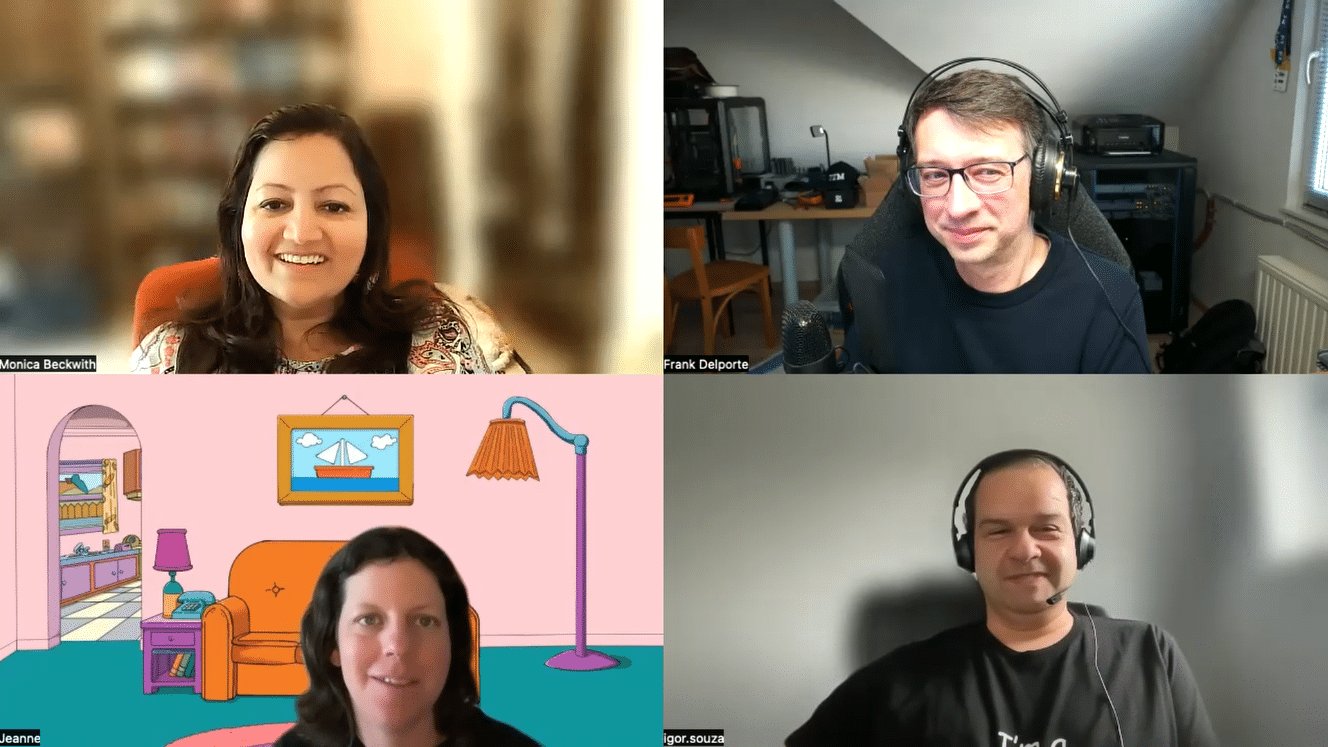
Foojay Podcast #22: When Profession and Fun Overlap

 2 min read
4,930 views
2 min read
4,930 viewsLet’s talk about programming for fun. Grab your Lego and robots, and let’s talk about STEM and STEAM!
As a developer, we all get frustrated occasionally when a bug messes up our schedule, and we have to dive deep into the code to find a solution.
But still, many of us keep coding in our free time as we love to do it and want to create amazing stuff.
In this episode of the Foojay Podcast, we talk to volunteers from different organizations where coding is used to inspire children to become engineers or at least learn to make good use of computers and the tools around them.
Podcast Apps
You can listen and subscribe to the Foojay Podcast on:
- Spotify
- Apple Podcasts
- And most others…
Guests
- Jeanne Boyarsky
- Monica Beckwith
- Igor De Souza
Content
- 00'00 Intro
- 00'43 Introduction of the guests
- 03'00 What is First?
- 06'43 What is CoderDojo?
- 07'46 Impact on your career by volunteering
- 09'00 Impact of these organizations on STEM education
- 14'00 The rule of three
- 16'48 Girls-only events
- 24'13 What we learn from volunteering for our job
- 28'16 Technology that can inspire the most
- 36'09 Participants becoming coach
- 37'58 Java on small platforms like Raspberry Pi
- 43'39 Java in education
- 47'15 STEM versus STEAM
- 53'37 Other interesting STEAM topics
- 59'45 Outro
Transcript
Automatically generated from the audio, so it can contain errors in names and technical terms. Suggest a correction.
[0:00] Hello and welcome to this new edition of the Foojay podcast we’ll talk about programming for fun grab your Lego and robots and let’s talk about stem and steam podcast all your news about OpenJDK as a developer we all get frustrated occasionally when a bug messes up our schedule and we have to dive deep into the code to find a solution but still many of us keep coding in our free time as we just love to do it and we want to create amazing stuff today we talked to volunteers from different organizations where coding is used to inspire children to become engineers or at least learn to make good use of computers and the tools around them hi my name is shin burski I work as a developer in New York City I mainly do Java I also volunteer with first robotics in my free time and write books hey I’m Monica Beckwith I work with Microsoft I am the Java virtual machine performance architect so basically any workloads you know internal workloads at Microsoft or Azure what first party third-party workloads if they are Java based or if they run on the JVM then I will help you I have kids and families so spare time is kind of
[1:21] Like non-existent in my life but I love to spend as much time as I can in propagating stem technology and techniques and programming so I volunteer for first but at a smaller scale than Gene and I also try to volunteer for different organizations like teals program which we can talk about later hi I’m a good soldier I have around 20 years experience in developer I work with different language my challenge of the time was Java I had the opportunity to work with Hadoop when the Hadoop started like and kind of in the Big Data area couldn’t I work as a soft developer in a data engineer team I work with kotlin couldn’t in my spare time I joined the things with respiratory and Arduino I kind of do a lot of making stuff like cleaning and make a community it’s when I joke like when the fun starts and I have a patch project I always have a different pets approached but they couldn’t one it’s I’m trying to using a let’s try to create things to teach basic concepts of data structure data streams and things like that and of course I enjoy as a volunteer or as a content creator in several coded JoJo’s as well
[2:47] Thank you for joining I’m Frank Laporte I’m technical writer at Azul and I’m also a coded Dojo coach since 2013 and also participated a few times in the first Lego League competition Gene and Monica so you’re both volunteers for first can you explain a bit what this organization tries to achieve yeah I can start and then follow because I work at the for middle school and high school kids and she is primarily focused in high school and about the first the whole concept of first is they want to recognize science and technology and I think that’s what if you look at the acronym first I think it’s like recognition of Science and Technology in this space and the way I work with first is I work for something called FLL NFL Junior although most of my time is spent in FLL which is for the middle school kids what that means is that it just stands the FLL stands for first Lego league so they build on the concepts of Lego and they actually work with a robot right now I think Prime spike is the newest introduction which is pretty cool compared to what we still have so we call them bricks so the previous one was
[4:07] Literally a second brick and it was not very fancy looking but Prime Spike crime is really really nice it has this kind of a friendly face and it it’s colorful so it’s really enticing to kids to be able to work and understand the concepts of programming and these kind of sympathizing with Hardware because you work with sensors you work with all these concepts of how to train your robot to do the stuff that you want so it’s kind of like a robot game and there’s other things which I want to talk about more details but I want to give the floor to Jean so that she can talk about the more interesting stuff as you graduate to high school while I judge the Lego program that Monica described most of my time is spent with high school students for high school there’s two programs there’s FTC first check challenge where they build 18 inch robots this is one you could feasibly do in your basement or your community also volunteer with FRC first robotics challenge where the robots are five feet tall and weigh it almost as much as I do for FTC they’re using Android which means they do get to do wrong Java
[5:15] Programming via Android and for FRC they have a choice of robot C Java labview or student python our team uses Java it’s a lot of fun I think I ended up at the sources of that project because I was looking for a Java implementation of controlling a LED strip so we come back to Igor with that ID and I think I found something which is part of the of FRC library that is shared a few years ago as I mentioned I also participated on the first Lego league with a group of teenagers and those were children of my colleagues when I was working for talavik that was really fun everyone has the same table with a lot of challenges and you have to program your robot we even achieved to get in the semi-finals in the Netherlands I will add a link to the video in the show notes of the podcast because it was it’s really a great event it’s it’s like the robot wars that you see on television but then the friendly Edition yeah you don’t break apart the robot of your competitors yeah these are really nice and very well organized events so I think first is really it the big company behind there it’s a non-profit organization
[6:31] There are a good number of employees in Manchester New Hampshire in the United States but most of it is volunteer run I’m on the volunteer planning committee for the New York City Regional and I can tell you that the volunteers do a lot of work Igor as you said you’re also doing coder dojos can you tell them a bit about that organization is kind of a community a global Community a place where you can feed see and find like fee program workshops and for younger people and steam you can volunteer in different ways you can volunteer for teaching you can volunteer for helping for mining you don’t even need it no programming excuse to volunteer so it’s kind of a website or an organization or a global place that you can have find you can share and find information and some kind of guides workshops for teaching young people I started nine years ago with the two quarter Dojo clubs in Belgium I think that what organization four and five on the list and now we have over 100 locations in Belgium it’s really growing and I think it’s for engineers I team-minded people also a great opportunity to join such an organization
[7:45] And become a volunteer did you see an impact on your career for instance Igor by joining Coda Dojo yeah that is a fun fact I’m originally from Brazil but I Basin in Dublin Ireland for a long time more than 10 years and colder Dojo was found here and grows a lot actually the fun stuff Barnes are an island but Groves body and UK and then conquers the world if you’re outside the Europe there is a code.org that is kind of a similar for U.S version South America as well Brazil follows a lot of those but it’s the same thing it’s a nice experience going see what the kids can do it learning as I said like you grow and you learn in lots of things like creativity how amazing the kids are you can see like a 12 11 12 doing programming doing websites or doing Hardware blinking alert with Raspberry Park and Venus and then you can help like mining creating content or just teaching or be kind of inspiration for the kids right that’s nice yeah we’re all involved as Volunteers in these organizations but do you think that these have an impact really on the number of students which end up in a
[9:08] Stem oriented study I don’t think so yeah but it also depends on the student and the family and how they continue down that path you know for example my own kids one is in high school one is in middle school now but I started the FLL working for you know volunteering for the FLL program when my kid was in the primary both my kids were in the primary and then the one that moved to middle school is when we started she’s a girl and her all her girlfriends were so excited to take part and they were just being kids and you know sometimes they just did not want to pay attention or whatever but it was fun to see their brains click on ideas one part of the fell program is to do research sometimes you know people and it doesn’t have to be gender-based or whatever but people tend to be very task oriented and people tend tend to be this like I you know kind of approach oriented and people tend to be just wanting to do coding that’s all they want to do I just want to quote I don’t want to worry about how to get through or how to follow a line I just want to see this robot do dance or whatever but the opportunities that this
[10:25] These programs and I’m sure coded and I want to talk about that because my daughter you know I encouraged participation in this code or code chica program that was local and so I saw that happen and the teacher was not conversant in the programming languages but she learned and she learned along with the kids and everything and I saw the girls go from not talking at all like no communication at all no questions asked nothing just do this do this follow through two at the end give a presentation where they were talking about their Inspirations and they’re talking about how they benefited from the program so I hope they follow through because I you know I can only influence a small pond you know and then everybody else he needs to just go swim you know either if you have anything else like I have so many good positive experiences that I’m just touched by being a small part of it so because I’m dealing with the high schoolers I’m a little bit closer to seeing what they ultimately do and what’s really cool about FRC is the teams are much larger than a fellow it could be 20 kids to 100 kids or more and
[11:34] That lets us specialize for example in my team we have a business department a software engineering department an engineering department and there’s sub-specialties within them and kids will learn about Vision or they’ll learn electronics and what’s nice about that is they can try a lot of different things and before they even apply to a college they know what they’re interested in so they can apply to a college that specializes in the thing they’re interested in so I think it helps them choose we definitely have kids who it’s like oh I tried software and learned that wasn’t for me the next year I’m going to try out business or engineering but I mean talk about a low risk way of doing it you’re not spending thousands of dollars in a year of your life to find out that oh I studied this and I don’t like it and I’ve been doing this for 14 years so I see what kids have done after they’ve graduated college a lot of them have gone into technology I will grant you a lot of them probably would have anyway I understand the difference between correlation and causation here but I think it helps them figure out
[12:30] What they want to do and get to making a meaningful impact faster and it also helps the kids learn about what things are like a lot of our kids are first generation and US mentors are the first people they’ve ever met who work in office building right I had kids ask me about jury duty and learn about that so it’s not just the technology it’s making that networking and connections that they might not necessarily be able to we are kind of Vegeta right the kids already born they have like touch screens and tablets and things so they get excited they get the curious to know like can I build my program can I do something just blink the screen or just turn on turn off something they get excited so I think we already mentioned scratch which is one of these tools that are often using these these clubs I think that’s an amazing tool it looks like Lego bricks you stick pieces of code together by just dragging and dropping them but you can actually build amazing things like our looking at my generation our first games like Pac-Man and all these games exist in scratch so you can even see how
[13:38] Someone else made it you can that’s the thing my son did to learn scratch he just took fancy animations and then changed them that his name was in the animation instead of something else and that’s how kids really learn these tools they are so great it’s playing with code and that’s I think a great thing one of the things you mentioned about how these clubs work you have the rule of three included Dojo first you try it yourself then you ask it to your neighbor and if that doesn’t work out you ask it to a coach and I think that’s indeed one of the reasons how kids start interacting and learning from each other yeah no I agree absolutely like I said and people from different parts of the world too like some of these programs they’re of course they’re time bound and so it depends on what zone or what continent you can participate in what programs but the code chica program for example reaches out and it was in UK and we had kids from UK we had kids from South America and then we had kids of course from the most majority from the US but different time zones across the U.S and we meet on Saturday so sometimes
[14:52] It’s evening for some people it’s morning for some people but the adjustment just knowing they’re they’re girls out there this is just wearing girls a specific program but knowing that girls out there in different countries wanting to learn and getting together reaching out and sometimes the conversations are just like hey like how’s school you know so you could just get to know each other and you know the environment and you feel the camaraderie you know so I really appreciate these kind of the coder Georgia Line programs where the Outreach is a fine like here with FLL like we do in person because that kind of helps you know the people know that everybody is contributing so we like Gene mentioned she has a big team we try to keep in FLL you know we try to keep teams of four to six maximum eight because then the attention span tries to like float away so by doing that they all become knowledgeable and responsible to each other and that is something that these programs bring and I was talking about the research program that they do so it’s like find a world problem and try to make it better or try to provide a
[16:06] Good new solution so you know I see people going and researching and talking about solar panels and how solar panels and efficiency especially in Texas right I live in Texas so in Texas you know you have you can harness the power of Sun so well so these sixth graders seventh graders are thinking about these world problems that they can solve unless prior to this it was like ocean with respect to oceans and stuff like that so there’s so many things that people discuss and all we have to do is sit and encourage them it’s like have you thought about this what about this and that’s and then you just sit back and enjoy this holistic development of those kids involved in Belgium we have seen with code Dojo it exists 10 years that there are more girls in stem education more girls choose for an engineering or a computer education we think or we hope that godaddojo had some impact there we even have code dojo for girls which is an annual event with girls only do you think that’s a good idea to really focus on attracting more goals into it there’s different schools
[17:21] Attacks here I also volunteer for Tales or actually you know this was prior to covet and I kind of took a break and I’m gonna go back into it until there’s something it’s like education and kind of supporting people in learning especially with respect to Science and Technology and Engineering and the focus is programming languages but also there’s like now ai and data engineering and all those things there’s so this is such a cool thing and like you mentioned Frank like you know we didn’t have these things you know so for us for me to see this the access that deals and other programs provide to high school kids is really really interesting but going back to just focusing on girls I think High School the transition I think and Gene touched on it a little bit like the transition from middle school to high school is very it’s a big hump because at that time you know girls do tend to feel the pressures the social pressures and then you know I’m not gonna do this because if my girlfriend is not doing this or my girlfriend thinks this is really tough or math is hard so and I hear these things
[18:37] Because and of course it has anecdotal evidence right but I have so many anecdotal evidences that they seem to form a pattern where I hear the friends and my you know fellow this person that I met at a conference from Australia talking about this so girls do need that extra push that extra encroachment that extra helping hand you know and that just based on my various conversations that I’ve had you know it’s all over the world it’s not something of your specific problem but we do have these opportunities and why not you know why not extend they spend that one extra day just making something special for girls and then they see and then they learn and then they’re like oh I am not bad it was just probably I was either you know my you know health issues or just that one wrong teacher you know it could be this one or one bad day the teacher had a bad day whatever but you don’t base your entire disagreement towards science or engineering based on that one bad day that may or you know maybe your friend had a bad day or whatever so but if you sit you know if you just have a little
[19:48] Bit of hand holding I think you can go a long way I wish that girls only programs weren’t necessary but I think that they are and I like that there’s a choice of programs you can choose what you fit in but there’s different reasons for it right I remember when I was in 10th Grade and boys had goodies right I wasn’t going to go into a program where I was the only girl at that point so having the option to do something with other girls is nice and there’s also the aspect of it’s awkward being the only girl doing something and it’s awkward when you’re an adult you know adding that pressure to a little kid is going to be like you know what forget it I’m going to go do something else so I think it’s nice to be able to do that but I think it’s important to have a mix of programs because it’s important to know how to interact with all types of people and I think having that mix helps because then you have the network of other girls from your girls only thing and if you go on something else and you are the only girl it’s okay because you have that strength of you know I know what I’m doing I know how to interact
[20:44] But I think if you have it go on for too long then you get into the real world and all of a sudden there are boys and what do you do right you have to learn how to deal with the personalities of the boys there are times at work where I’m like raising my hand like crazy person because I can’t chat over people but it’s you know it’s a skill and it’s a tech technique and I learned that from being in an environment that was a lot more like the real world so I know that answer sort of sits me on the fence but I do think both matter indeed it would be nice if you don’t need these events but I agree with Gene like I grew up which kind of felt like a solo environment and my dad was a mechanical engineer so you know and my family chemical engineers and all this so it was not new to me from my background but I went into the world and you know it was just really challenging to not find people like me and then you know I was asked questions did you go to all girls school and stuff like that just because I just could not communicate because I went to an engineering school where there are very few girls you know
[21:48] It seems like it did affect me in my communication style and everything because I tend to wear be very quiet like a mouse and then it took me years I used to take notes the copious amounts of notes and that’s how I kind of learned and thinking about it but I hope it’s not another girl that has to be has to go through these things you know and that’s why I think they’re needed until there’s a point where they’re not needed anymore you know the world is equal in it’s not about providing opportunities because I know there are opportunities but in providing that going over that hump you know that’s that’s what we need and that’s all it’s needed maybe just check-ins you know maybe just check in with the girls and say Hey you know I see that you may be feeling this or that and then you know and just check in with them and see that how you can help at the same time I think it’s important for there to be mixed gender things starting from a young age as well so we don’t develop another generation of boys that think girls can’t do technology you know separating has a cost as well let’s also do a call to coach as female coaches
[22:55] Because that’s a problem I see in the code of dojo we are all my coaches are males so I don’t know Igor the go to Dojo you attend if there are female coaches but that’s also an issue we don’t have Role Models there for the girls we have I think one third of the participants or girls so that’s okay but they don’t have a role model I don’t know if you are Role Models but actually that’s what we I think a bit Miss as coaches is female coaches do you have female coaches in the code of Dojo yes yes one of the places that I use literally participated was loads of rumors as a volunteer so they kind of can be like inspirational and provide as a woman but normally it’s a man who is the kind of the responsible and the teacher and that is a fun part here in Ireland anyway history stuff they normally do some schools just for boys just schools just for girls one of the place that I usually to go was high school just for girls but Dakota JoJo was open for any sex so what’s funny to see the school was just for work for girls but Dakota Dodge was open like it should be for everyone how did participating in the
[24:16] First encoder Dojo influence your job for me it got me into contact with Raspberry Pi with Arduino I started writing about Raspberry Pi now writing has become my job so for me because the dojo changed my career definitely because it brought me into contact with other people and other technology it does the same apply to you I know I knew Raspberry Pi and I’ve been before I discovered a dojo but I guess was kind of a experience it should be inspiration creativity like to show your how they can do it to kind of Mentor kids and see what they can do and how they think and I guess that’s more the thing a kind of a show then like how you can use this and blink a lad and see this parking there I was like I can’t blink and let or anyway I learned a about scratch as you said like my first contact with scratch was in accord dojo and how they can use that sipo drag and drop stuff then generate code and things that works another thing that’s big here in Ireland I guess came from case the micro Beach the same it’s like the Raspberry Pi Foundation they provide lots of course lots of
[25:35] Content you can connect microbitch with almost everything even with Lego and scratch and you drag and drop and you have kind of LCD or Lance Let’s Matrix you can create some animations that ends it’s fun to see what they can do I have a few areas where it helped me one of them is the technical tools I learned slack I learned or scored I learned Desmos which is a graphing calculator I wouldn’t have been exposed to some of them at all or at least not as soon if it wasn’t for the robotics team the second area is teaching skills it helps me connect when we have entry-level people or new people I’m better able to explain things because I send so much of my free time doing it and the third one is soft skills learning how to Mentor better and recognizing that people change and you know they evolve over time and just because you had an interaction with someone three years ago it doesn’t mean they’re the same person anymore how to teach like a try to explain what is I don’t know if you get something crazy how will explain kubernetes for someone who doesn’t know what is so I guess I
[26:44] Learned a lot like how to create a simple or a faster way to explain difficult Concepts I so many places why to write a well-documented code or why to have a good project plan or a you know statement of work and all those things and I can explain that better because when I’m interacting with kids they asked you questions they make you think about it in a way that oh let’s have a plan let’s have this what are we trying to so you break it down and it’s kind of like comes naturally now to me because of my interaction with everybody that’s just one aspect of it there is the other aspect of when I’m doing interviews it’s really helpful for me to Now understand that I mean I was always at the mindset that you don’t have to really like write 10 lines or 25 lines of code just to prove that you know a concept but now I can think of in terms of you know object-oriented programming and trying to tell them like hey you just tell me algorithmically or in an object-oriented concept or just tell me how you think and that’s how I want to understand you know if you’re a good fit for it because it changes
[28:08] Because they will teach you how they want to learn and that then I can bring it to different aspects of it you mentioned Igor having the first blinking lead it’s like the hello world of programming so if you go to electronics if you can blink a lot you can do anything but also yeah there are so many amazing Technologies at a very low price I think we live in a good time for that like the macro bit I’m not sure I think it’s about 10 dollars something like that and you have let’s on it you have buttons on it you have sensors on it so you have very amazing devices for a low price like Arduino boards that’s also what we use Lego is a bit more expensive but having a Lego robot that follows a black line and then solves riddles on this game table that’s really amazing what is the kind of technology that you think that children can Inspire the most we came from the era that we learned virtual right like I remember doing microcontrollers in a virtual program and simulating everything without seeing so nowadays five euros you can buy a Raspberry Pi Pico you can have some ESP boards or
[29:27] Micro bit micro bits or Arduino so it’s kind of a really easy to get one play with without the fear of breaking or no understanding so you’re having freedom to do whatever you want and like broke burn it put fire do everything so I guess that’s brings the joy right you can play with you don’t without knowing what’s going to happen combines with the three rules like it try first see what’s happening there and ask Health it’s fun yeah I mean there’s one of the things in high school this is a 10th grade project you have your passion projects and I see so many girls and boys doing engineering but talking specifically of enablement and tools in computers and programming there is this whole concept of i o devices right particle i o so this kid actually did this project where he would have his own garden a smaller scale but it was enabling watering and enabling like you know timed distribution of nutrients checking for nutrients you can do that it’s just like the whole concept of edge is right at your you know with the i o devices these kind of small boards and small sensors
[30:47] You can do all that and he actually finished that entire thing and it was pretty it’s pretty phenomenal to do that like you know I my background is embedded devices actually started when I started in doing my project it was I started with heartbeat monitoring systems you measure your heartbeat through a sensor and everything so I went we used to guys to go and shop for parts so we did microcontrollers and timers and sensors and everything and it was like it was a big deal like you have the parts you didn’t have this you didn’t have that and nobody’s selling it just one thing you know you have to buy more and then maybe you know work with your school to enable that and all those things but now you know getting this particle IO boards and all these things just at your doorstep and having the program you don’t even I mean some of them just encourage the free development and stuff like that because it’s all about learning and people can just get it done within this passion project time frame I am so amazed it’s just lovely to be alive and see kids thrive in this era the one thing we are
[31:49] Struggling with is we also want to show them 3D printing but that takes so much time so we have a code of Dojo takes three hours so if they design something in one hour that means we have two hours left and only one printer and so that’s that’s actually a hard thing to teach to kids is the whole 3D involvement and what’s happening there I don’t know if you’ve tried that with in one of your clubs already we do we have two 3D printers we use on-shape online to teach the kids how to write CAD there’s a lot of good tutorials and trainings out there and then when they’re building something we have every year we have one or two kids who are in charge of the 3D printer and they set up the prints and take them off so that you don’t have to tie what you’re designing to actually time and come back for it later and at the first robotics World Championships they had a company that did that you could submit your CAD that you needed printed and they would print it for you and you know email you or text you when it was available we use that for a part that broke we submitted a slightly modified part
[32:57] And we were able to go pick it up in time for our next match it’s really an eye-opener for most of these kids is just drawing something and then yeah it takes an hour but then you have a very little thing that is actually made of plastic with your drawing becoming a real object the same thing with the robot following the black line stuff like that yeah no and in FLL too like again the project the research project and all the stuff it’s you have to make a prototype you know it’s kind of better to make important time because we can say everything but you know in particularly if some functional representation so for the solar thing you know for my son’s team you know he’s got himself and then there’s three other girls on the team and then this girl wanted to learn CAD right and she did and she learned CAD she designed the things and then they went and designed the tree we have the 3D printer at home so of course you know there was some involvement for my son and from the person and they were interacting back and forth and mindfulness is all over you know like through Zoom or some
[34:03] Other forms of communication because they don’t get to meet every day but then the 3D printer and the progress has to be you know it’s it’s incremental every day so that was just amazing for me to see how people communicate and use technology and can get work done so but just the whole concept of CAD you know CAD if anybody has used cat in their lives you know I used to be like oh my gosh and I have to do all these things and then block and I did orcad and you know did the bill of materials and everything and this girl just wanted to do it herself she’s like I just want to do it and she did it and she just did it beautifully so I’m just I’m Amazed by the enable again the enablement that this era has brought to the kids there’s also a lot of Open Source CAD designs you can build on so you don’t want to start from scratch I do that when I have a friend that’s having a kid I’ll start with this basic thing I made once of a baby bottle and I’m saying and then I put their name on it and then I print it so I’ve basically given the same gift out like 20 times and it was a bunch of work to do the first time but then after
[35:05] That it was easy and I think for the kids it’s nice to have that starting point right you can start with something that already exists and make it your own and then maybe eventually you got rid of the part that you started with and it’s fully your own maybe not but you have something that’s viable pretty fast but as you mentioned it’s good in clubs it’s not the Gooding which is the most important part it’s learning to use tools actually and how to present and to work together like in the dojo Club in Epic that we have there is one girl who came the first one and she’s still there after nine years she missed only one that’s fewer than I myself did and she’s now 18 plus but she keeps coming just for the friends that she made there and she didn’t do engineering but she still comes and is programming in JavaScript in Minecraft so she’s still doing that although it’s not part of her job and she’s outgrown the club actually but yeah she just wants to still be part of that community did you see many of your volunteers become coach in your clubs I had at some point a boy of 12 years was really good
[36:13] In Arduino so we just sat here from now on you’re a coach you know everything you should show it to the other kids does that happen a lot on your side we don’t call it that but the older kids absolutely teach the younger kids for us a coach has to be an adult it’s a defined role but yes the younger kids definitely learn from the kids who’d learned it right before them and they enjoy it also first is very big on mentoring so there’s a lot of mentoring of other clubs that goes on for our high school students they Mentor other high school students and also elementary and middle school students yeah same thing NFL too like you know my daughter was moved on to high school will come and mentor and sometimes coach as well the young the middle schoolers and because they’ve been to the part and sometimes you get into this funk of you know you have to you have to think Beyond like okay we are trying to solve something thing but is there something you know that you’re getting stuck at or whatever so having a fellow student come and tell you know and run ideas by that sometimes it’s easier because you
[37:17] Know the student as as as a senior or as a as as a just as a person that exists and has gone through the same problem as you so it kind of helps relax the initial you know the hurdle that you may have with respect to interactions so I think it’s just and people like giving back the whole concept of giving back is just so important in this in the generation no matter what kind of things you know so even giving back while coaching or mentoring and you know coming back even if it’s just one day a week or whatever I think I’ve seen kids and adults everybody just the whole concept of giving back is important to humans something else we are all Java lovers here I think in this podcast on Foojay you shared several posts about Java experiments that you did with Arduino and Raspberry Pi it’s somewhat a controversial subject using Java on these small embedded platforms why do you think it’s a good match why are you experimenting with this combination I normally do for fun it’s not something that I start like I have my blog I always do like something Java Raspberry Pi and Kafka every idea that I
[38:36] Saw something that is sparking my idea or something that I’ve I’ve I see I said can I do this with Java can I do this with job and run on Raspberry Pi or can I add the Kafka on the top of that somehow even doesn’t make sometimes doesn’t make sense but I do it so it’s more about the fun like for example I used to play a lot I have interesting server-side renting when you create kind of a Java application with the GUI itself as on Java so then I see boards or sensors can I create a good that controls that sensor like then I play like it I will do in Spring no I’m going to do a Micronaut no this time it’s going to be quarkozone any other vertex I try to different Frameworks because I have kind of a background in a data engineer area sometimes I try like adding Hadoop your spark or Kafka or even kubernetes greater cluster see what’s happening so it’s more about the fun I know it’s a controversial topic but I guess it’s not about they don’t like Java they don’t do its Java it’s like what happens on the colder dojo for example it’s it’s kind of they created this you start with scratch
[39:56] Then you try to learn some web HTML and JavaScript and if you use Hardware Python and then fix one of these four three or four options so you if you get the list of time 10 most used language it’s not only JavaScript but it’s not only Java kotlin whatever it’s color C C plus plus C sharp PHP they don’t they don’t focus on those you can do it with those yes you can but it’s not the focus I guess the Java is the same it’s not they dislike the Java they don’t watch out it’s it’s not the main thing and again there is opportunity here for Creative content and show this I usually joke like every time that you get any idea and you run that idea in Raspberry Pi it’s the idea that you already exists someone already did hundreds of times but just because you put on top of the Raspberry Pi people say no what’s amazing idea how nice is this man is the same thing it’s just running on the Raspberry Pi and for example with the grow VM now you can run native images so can I run a native image on the Raspberry Pi and people get crazy like no that’s amazing Creator native but it’s it’s the concept is the
[41:16] Same there is nothing new there so normally I do for the fun yeah it’s just a Linux PC like any other but a bit smaller and a bit less expensive when I discover Raspberry Pi was I don’t know eight nine years ago as I said majority of my work experience was Java but I was learning Python and I used Raspberry Pi for learning python that time so I kind of improve my python with but then after all I said can I try your for example I’m there is one year and a half more or less that I’m doing kotlin working with classical so I started doing can I install kotlin Raspberry Pi can I do some some small codes see what’s happening blink a land and things like that it’s a great combination of course I love it too because I’ve written a whole book about it but it’s a neat and amazing combination it’s the electronics that you can control with Raspberry Pi that makes it very interesting to me I think it’s the concept of object-oriented programming again like when you’re thinking about robotics or Electronics or any of these things it’s it’s the comfort of you know being able to manipulate data and have the logic
[42:26] Together that’s the whole concept of what you’re doing program second thing with Java it gives you a runtime you can reduce the runtime to whatever it is so you don’t have to worry about things and you just concentrate on the logic and the data manipulation so it doesn’t have to be just Java like you said python and other things you know I started with c and I used to like work with embedded programming and then I moved up the layers or levels or whatever but I still get giddy when I’m doing a microcontrol I’m looking at a microcontroller looking at a particle i o board and trying to figure out how to control so I think we’re comfortable with Java and we have seen the evolution of java and then you know nowadays people learn Java in an easier like scratch like environment too so it’s easier for me to teach Java because I know the concepts and then I can use an environment that is like Plug and Play It’s like oh you this is your coding block and now let’s talk about polymorphism or something like so just using Java is something that I am comfortable and conversant but it what I really am I think what it
[43:34] Really boils down to the entire concept of object oriented programming at least for me do you see Java being used a lot in education in the schools that you get into contact with yeah number one programming language I think python is catching up as well because it’s you know people use it for like for example FLL now also enables Python Programming and kids think it’s it’s better it’s used in you know Ai and everything like that and ml Technologies but I think number one so far you know I have my AP for the tools especially all the AP classes the compute programming is like Java it’s Java based and again I’m comfortable with that so I’m just gonna brag about it more but yeah that’s what it does yeah I was going to say because in the United States advanced placement classes which are college classes you take in high school are done in Java it’s in a lot of schools while python is becoming an official language Choice next year for the big robots I don’t think it’s good to use because the cost of testing on the robot is way higher and you do have the simulator but most teams aren’t writing the type of J
[44:42] Unit tests that we would write in the real world so I think they’re going to be wasting a lot of time on stupid compiler things that’s a great point you know and one of the things that Java again and it goes back to the runtime environment right you have the entire thing we recently and I was involved in enabling Java on Windows and arm so we actually wrote the port so people can now use these your tablets or whatever you know to then you can run Java and of course you can reduce and the modularity and there and the way you can make your JRE like really skinny right and then use it on a Raspberry Pi that’s available we’re moving forward with Java to enable each and every development platform even if it’s from your small tablet to servers you know in a javascales pretty well too think about you know the concepts of threads and everything that Java brings to it scales to 128 cores from four cores of your mobile tablet device alone so I am totally fascinated and again I am biased towards Java so okay and so I’m gonna rest my case here I think we’re all biased a bit but I think
[45:50] Yeah there are two Evolutions Java is improving and you can make it smaller if you want to although on the other side you have the Raspberry Pi 4 which is really performant thing there are some rumors about the Raspberry Pi 5 probably next year so again it will be more performant I’m really looking forward again to whatever that will be possible on these devices yeah I’m asking the question for Education because I see in Belgium but we’re a small country most of the high schools have chosen a C sharp I think because of industry in Belgium more asking for these kind of roles even within FRC it’s fairly Regional so I mentioned those three languages or Symphony four languages you have a choice of labview is not very common in New York City but it’s super common in other places where like the Midwest and a lot of it is you learn what you think you’re going to be able to use to get an internship or a job right if you put labview on your resume in New York City the financial companies are going to look at it and be like so what’s that right if you put jobs C plus plus it’s going to be like okay now we can talk
[46:55] About what you did and what you know right so it makes sense for the teams to choose that if you live in a place where labview is common like there’s a lot of electronics engineering stuff going on and you put labview on the resume it’s going to be like oh cool you did laughing right and the United States is a far bigger place than Belgium so we have that variety of things that happens within our own country there’s one more question I want to ask about stem and steam so you have science technology engineering and Mathematics but you also see the same but with an a in between and it’s Arts is added how important is the Arts thing for you in everything related to engineering and stem I think it’s very important to me I always like I don’t correct people but I myself make it a point that I write steam you know we can do a direct relationship like CAD right CAD is Art and we can do 3D printing that’s art there’s qriket you know there’s kind of like pre-formatted designs that people can do that’s but it’s using it’s using science and technology and these kind of like fabric Printing and other things so
[47:59] These are not but I think even just the concept of like like sports you know and understanding you know how to bring technology into sports like there’s like this Trace cameras now or I’m just name-dropping but that’s what it comes to my mind right now you have cameras that actually follow you know it’s like a smart sensor camera it follows kids and their patterns and then there’s record and then you improve you know there’s a feedback so technology drives on our Builds on Art and derives from art and vice versa so you cannot talk about stem without arts in it so I think it goes together very well it’s interesting I never thought of cat as art before I thought of art as more of the pure things one of the problems I see with art being included in Steam is how do you define art and then it’s like well what about language arts what about other language and now you have it’s like so almost everything is in Steam and at some point you’ve kind of steal the Thunder of it by making it everything so the pure art stuff and the cad that I consider engineering but I
[49:12] Could see as art makes sense to me to include but then when you start getting beyond that it turns into well you know we’re giving funding for everything now it doesn’t go to Science and Technology and math because it’s going to something that is completely different I see the Arches more like a imagination creativity like I can blink a LED but if I put on a cardboard then the and the children like do a cartoon around like I draw a hood off and the nose blink it’s kind of more creativity imagination you can play around you can kind of put in a face imitate kind of the mouth movement with metrics or something like that so I guess it’s more as we said you had more fun to the simple examples but even gay gaming if you think about it that’s also like you know you have this creative designers right and they actually literally fit into the game and then your backdrops and you know having Blinky lights like you said and then that’s like oh many times did it blink and you put it and that becomes a code and then you enter that so it I think it flows together as long as it
[50:22] Flows together with the technology engineering Concepts and encourages you again to feed off each other and anchor you know kind of build up each other and have strong engineering technology Science Foundation I think it’s it is in and I made sure that I enable and I enable the understanding you know when I’m talking about Arts I want to understand people understanding how they co-exist you know what’s interesting about those forms of art is they have a technical medium both the cad and the game design so it feels more connected whereas making a payment a painting feels less connected to me but making a painting on a tablet that then you can actually you know have mathematics involved you know if you do this kind of like orbits and stuff like that and movement like fluid movements or whatever you have to calculate the circumference and then you have to like think about the Shadows the way they fall and it’s just so fantastic to me how technology is so involved and maths are like they’re all tied together so much so yeah I just yeah you’re right it depends on how we’re weaving together
[51:32] Yes there is the controversial part coding is Art it is coding art so we’re always going to agree about like when you’re coding now you’re doing apps or not you’re right it’s it’s an expression right yeah it’s like you know it’s like art like language arts but like it’s coding art it’s another language and you’re expressing yourself in that language you’re right architecture is another thing that falls into that space like is it artists it’s science because that’s one where you can’t get away from the master the science in order to do it you know my bridge has to be functionalized sound I can’t say I’m going to ignore science because it looks pretty because you mentioned art and cats it reminds me of a talk I’ve seen many years ago of nervous Jessica I don’t know if you know her Jessica Rosencrantz she uses mats to Design interior objects lamps jewelry all inspired by mathematics and he made the whole dress out of 3D printed materials which all click together so she prints a folded sheet of 3D objects and when the print is finished you can just open it as a dress and she’s even in a museum with
[52:44] These designs so I will definitely add a link to her work in the show notes because indeed combining cuts and Mathematics and 3D printing that that’s really a steam example yeah and that talking about Gene mentioned that right architecture think about Gowdy right everything is all about science and math in every architectural aspect that Gowdy has I am so floored like you know such the upside down thinking and all those things you need to be scientifically aware and mathematically brilliant to be able to design an architectural multiple architectural pieces that Gary did so I agree I’m on board that’s what architecture in there too double A it would be a very long name in a short time okay something you want to add something you we didn’t talk about and you definitely want to have in the podcast I have four things project ideas that you can talk about one is the coolest project something that starts in Europe they get I think it’s open for everybody who follow any coded Dojo running code so we missed the project and they do kind of a context of the best projects around the world with Worldwide stuff
[54:04] And again it’s for kids it’s 16 anyone can join and participate there is two projects that is related but it’s more for maybe more old people or more majority people maybe not for kids the first one is Formula pie is kind of formula one but the card is a Raspberry Pi card and then he’s he goes in autonomous way controlled by the feeds of the camera you can even participate in remote because you send the code for them and then they do the race you just watch the race on the YouTube channel and this is kind of management Advantage you need to understand like image recognition and things like that but it’s really fun and it’s really nice to check around and then the other one is the pure Wars is kind of a battle of robots there is different of types of battles like you can just have a robot that follow the black lines or kind of Mario Karts your robot has a balloon and then the some spikes and then you control and you need to burst the balloons of the apple and things like that it’s it’s kind of nice as well and the last one is astropi astrophy is kind of a based on the
[55:22] Raspberry Pi Foundation is the European space stations and then they send the kind of some Raspberry Pi’s through the space and then the kids can apply the projects or schools or any colder Dojo related can apply projects and they’ll those projects goes through space and then you can play with things and it’s really nice ideas the son of one of my coaches is on the Astro pie so his project is running somewhere in space yeah really amazing that indeed you can just ask it’s program something and if it’s selected we will just put it somewhere in space so that’s really great Monica Jean something you want to add I want to do the commercial for volunteering all four of us have mentioned fairly time consuming things that we do in order to help young people with technology but it doesn’t have to be time consuming you could volunteer as a guest speaker at a dojo or as a one-day volunteer at a first event adults judge teenagers do all sorts of roles that’s a way that you can help out without having it to become this overarching thing that sounds overwhelming you might like it and do more or it might be I judge one day a
[56:37] Year and help out the youth that way the website for First is firstinspires.org I will add also the links for coder dojo and the other clubs Monica yeah I was going to say that too and the thing to keep in mind is that there is a lot of training available we’re not just throwing you into the pit and say go fish or go fed for yourself and you know may the best person win or something it’s we train every code of Dojo everything is available to learn and take you know incremental steps with what you’re comfortable with even in the teals program you may not be comfortable with co-teaching because you know it takes a lot of time and effort but you could help out with the labs you could help out which is the you know grading and it helps you being there and you enabling the teacher or the students and everything one person in life that you touch and enable and that just kind of has Monumental incremental effect so I totally agree please volunteer just to tap it online now everything is online you can do that online too so we look for experts but we also look for mentorship online so you
[57:48] Can if you give couple of hours a week or just maybe an hour or just check in just to check in also anything else thank you Monica you’ve talked about the teals program a few times as if everyone knows what it is I learned at a conference but could you do like the few sentence intros so that Frank can include that yeah yeah so it’s a Microsoft philanthropy program but anybody can participate and what they do is they kind of network with the schools in your area it’s mostly High School level teaching but these are like underprivileged underserved community is and especially schools that you go to select charter schools and other areas where we give a major focus is on computer science and technology so that’s I think that the teal is like kind of supporting education technology education and stuff so the volunteers it’s all volunteer around so they want volunteers actually go and help teachers support the teacher because these remember our computer science teachers in public schools in the US are not really somebody that just came out of like you know industry so they
[58:57] Learn with you so that they can teach the kids the way to do it so any industry experience that you have or even your own background you know you have been graded you have written tests and you have created you know you have been created so you just have to give it back and any help any little help kind of works out and going back to Frank’s a question of how are women important in places like that so and just knowing that even if you’re you know even if you’re not working in serious technology but just have have dabbed on it with it or whatever you just seeing you there just seeing that you’re supporting them the students the teachers I think it’s it’s being it’s just Monumental thank you sounds really great if you can add the link give me a link I will add it to the show notes that everyone can find back all these great initiatives okay I hope this podcast got you inspired to check out the coding clubs in your neighborhood as you heard we can all use extra volunteers and extra help all your kids and friends could also be interested in participating in the first robot challenge a lot of possibilities there I
[1:00:12] Can promise you already that’s a lot of fun if you participate thank you very much first of all the guests of this episode and you for listening keep an eye on Foojay for future articles about development and everything related to Java World thanks for listening your food give me a jake give me the friends of OpenJDK
Found a mistake, or something to add? Edit this page on GitHub

Frank Delporte
Frank Delporte is a Java Champion, Java Developer, Senior Technical Writer at Azul, Blogger, Author of "Java Programming for Raspberry Pi - A Hands-On Guide to Electronics and IoT Projects", and Open-Source Contributor for Pi4J, Lottie4J, Sheetmusic4J, …

Igor De Souza
Igor currently works as a Software Engineer in a Data Engineer team. With over 20 years of experience with Java and over 10 years in the Big Data world, Igor had the opportunity to work with Hadoop and its ecosystem right when Hadoop was created. In his spare …