Foojay Podcast #33: J-Fall Report, Part 1
 Frank Delporte
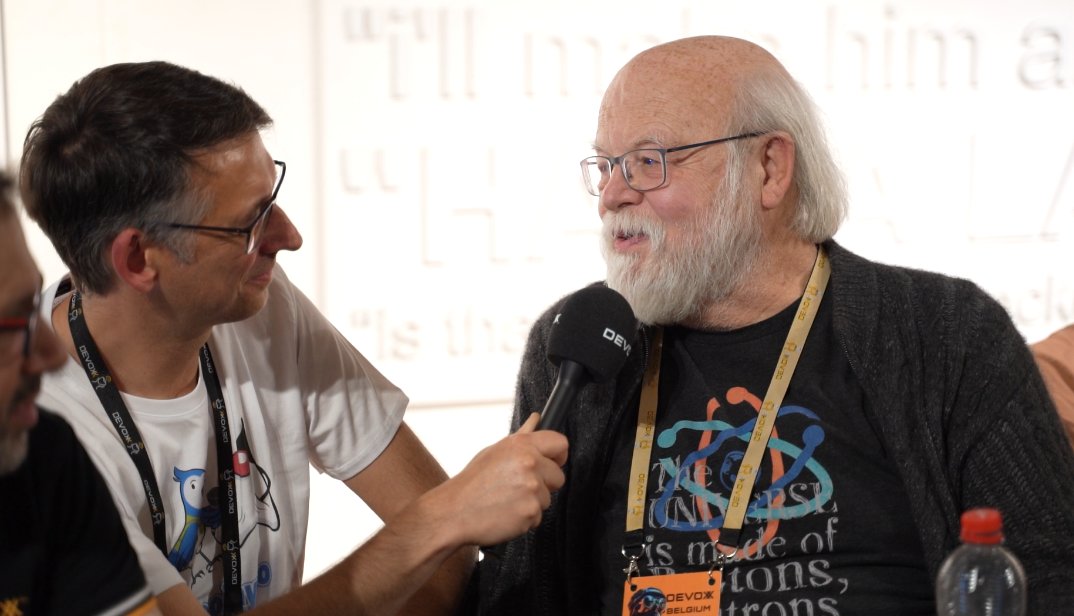
A few months ago, we asked the J-Fall team if a Foojay Broadcast Room would be a good idea. And they said yes, so suddenly we found ourselves in the middle of the entrance of the Pathé cinema in Ede in the Netherlands, with a camera and microphones.
During the day, we had a lot of exciting talks. There are way too many to fit in one podcast, so in the following weeks, you will get different episodes handling a lot of topics.
This is part 1, and we talk about J-Fall, of course. But also about the evolutions in Java and how it’s becoming the best cloud environment while keeping systems sustainable, and reducing the ecological, financial, and security impact of applications.
Video Report
Podcast Apps
You can listen and subscribe to the Foojay Podcast on:
- Spotify
- Apple Podcasts
- And most others…
Content
00:00 Intro
00:59 Brian Vermeer: About J-Fall
- https://twitter.com/BrianVerm
- https://www.linkedin.com/in/brianvermeer/
- https://mastodon.social/@brianverm
- https://jfall.nl
- https://nljug.org/
- https://foojay.io/today/author/bmvermeer/
03:50 Pratik Patel: Evolutions of Java
- https://twitter.com/prpatel
- https://www.linkedin.com/in/prpatel/
- https://mastodon.social/@prpatel
- State of Java Survey and Report 2023: https://www.azul.com/report/2023-state-of-java/
- OpenJDK Migration for Dummies: https://www.azul.com/openjdk-migration-for-dummies/
13:33 Grace Jansen: Cloud Java
20:22 Mark van der Walle: FinOps, EcoOps
25:56 Ko Turk: Sustainability
30:37 Ionut Balosin: Sustainability and Green Engineering
35:28 Deepu Sasidharan: Passkeys and Security
- https://twitter.com/deepu105
- https://www.linkedin.com/in/deepu05/
- https://mastodon.social/@deepu105
- https://foojay.io/today/author/deepu-sasidharan/
42:18 Outro
Host
Frank Delporte
- https://foojay.social/@frankdelporte
- https://www.linkedin.com/in/frankdelporte/
- https://foojay.io/today/author/frankdelporte/
Music
- Barbershop John
- Hermine Deurloo
- Synapse by Shane Ivers - https://www.silvermansound.com
Transcript
Automatically generated from the audio, so it can contain errors in names and technical terms. Suggest a correction.
[0:00] During the jall conference in the Netherlands we spoke to many speakers and guests this is part one of our review welcome to the FJ podcast all your news about OpenJDK a few months ago I asked the jall organization team if a Foojay broadcast room would be a good idea and they said yes so suddenly I found myself in the middle of the entrance of the P Cinema in a with a camera and microphone phones during the day I had a lot of exciting talks there are way too many to fit in one podcast so the following weeks you will get different episodes handling a lot of topics this is part one and we talk about jall of course but also about the evolutions in Java and how it’s becoming the best cloud environment while keeping systems sustainable and reducing the ecological financial and security impact of applications let’s start early in the morning with Brian one of the organizers good morning yes I’m doing doing great like I’m pumped up for jall this year so yeah good good early morning but yeah we’re we’re there but i’ I’ve got I’ve got my coffee right so yeah I need it sure you’re one of
[1:10] The organizers absolutely what’s your role in NL jerk JF with within the NL jug I am one of the board members like we have a board of six but for jall specifically I am co-leading together with bver we’re co-leading the program committee so pretty much me and joh are in charge of who’s coming into jall and making sure everything is reviewed for the speakers we had 455 cfp submissions and we only have like place for say 60 so that was our that was our job that’s why you also start very early because before the Keynotes there are already sessions going on yeah before the keino we have our early bird sessions and our early bird sessions are there for people that want to be in early because to be beat traffic or that’s that kind of stuff and we already can have some some some interesting talks for them and then at pretty much at 9:00 am we start with the official opening but yeah there are already sessions going on right now you’re in the Keynotes yes I am and it’s in 30 minutes it’s pretty much in 30 minutes yep bit nervous no no I’m not nervous because like I don’t have
[2:26] Anything useful to say which sounds weird but no I do I am there to do the opening to tell the things that people need to know for getting out and about here at jall and after that we have an ex exual technical keynote which I can do but we invited somebody somebody else to do that so I just say welcome to everybody and all the things that they need to know how jall works for first-time users or how to vote for the sessiones that kind of stuff yeah okay how many people will be here today that’s always a guess but we sold out that which means we have about 1,800 attendees whoa yeah for eight rooms in parallel yeah yeah so a lot of content to consume there’s a lot of content to consume it will also be that some rooms will be filled up and full if if people are not there in time but that is just what it is but we have like we have actually we have nine consecutive we have nine parallel tracks so yes there’s a lot of like there’s a lot of a lot of good topics a lot of good speakers so I’m I’m pretty Psych for today okay finish the coffee that
[3:32] You’re pumped up for the keynote have fun thanks Frank and yeah I think you will be walking around the whole day absolutely absolutely we will we will taking care we will be taking care of small things that the people around here won’t notice and then I did my job well right so all right see you later thanks cheers by prati Patel had a lot of info to share about how he looks at the evolutions of java and how it’s being used in all kinds of organizations my name is pratique Patel I lead the developer relations team at aul systems a company that you may know Frank is actually my coworker so there’s a lot of things happening in Java what’s the most important Evolution yeah it’s it’s a great question obviously Java 21 just came out right so JDK 21 and there’s loads of great language features in it and one of the thing that’s been really niced over the last few years in my opinion is that we have been more quickly adding language features to the Java language over the last three to five years because if you remember we made a gigantic leap when we went into Java 8 with lambdas right that was like
[4:39] A big big thing right and then of course there was some there wasn’t really great backward compa compatibility between 8 and 9 10 11 because there’s bunch of stuff that change but for me it’s the pace of the language getting new features you know nice things like records pattern matching Etc that help develop Vel opers write cleaner and better code because for me I don’t get paid by the number of lines of code I write I get paid for writing quality software just like everybody else so having that ability to have more expressive Java code in my opinion is the most important thing because less code means there’s less code to manage less code to maintain less code to migrate easier to understand you know all those kinds of things so you have this very fast Evolution a lot of new versions how fast are people moving to these new versions yeah that’s a great question so recently the company that we work at AOL systems we just released a state of java survey and Frank will drop a link in for everybody so you can grab it and what of the survey questions was what version of java are you currently using
[5:49] Right and what what’s interesting and I found a little bit surprising is the number of people that are on 11 Java 11 and 17 obviously the survey was just done very recently before the Java 21 came out but there are very few people using 1920 19 and 20 but I was actually impressed by the number of folks who are on 11 and 17 because the migration path from 11 to 17 is actually you know 1117 to 21 is actually very easy but of course it shouldn’t surprise me but it still does how many people are still using Java 8 or Java 6 are these yeah I know right it’s like I think Java 8 came out 15 years ago right so it’s a long time ago isn’t that also a quality thing for Java it’s 15 years old but it still runs yes absolutely this is one of the things when you talk to people in different developer communities whether it’s JavaScript or Elixir or python or whatever the fact that Java 8 code or even Java 6 code right we have some customers at is were still on older version they’re still running six and it you know they don’t really do much with those applications but it
[7:06] Still works it’s rock solid you know you would probably be surprised at who’s still running old software like that you know things that you rely on like your bank or your insurance company or whatever some of these companies are still running very old versions of java and you’re right it’s totally a testament to the deep thought that goes into the evolution of the Java language and ensuring backwards compatibility and like you know there’s still bug fixes and stuff that come out for mostly security things now for those older versions of java so definitely you said you are a bit surprised that not a lot of people are on 19 or 20 is that because most companies stick to these long-term support versions yeah I think you know when I think of a t typical Java shop right of course there are startups using Java to build stuff they’re medium-sized companies and then large companies and then very large companies like Enterprises that are you know using Java so I think for me you see a lot of the smaller companies startups to midsized companies are able to shift more quickly to newer versions
[8:11] Of java and when I talk to you know just Java developers in general orul customers what I find is that everyone has a certain level of risk that they’re willing to absorb because moving even moving from you know 11 to 12 or 17 to 19 or whatever 18 there there’s a certain amount of risk that’s involved there and on top of that there’s a lot of work that needs to go in right so and we’re we’re maturing in this universe in our Java Universe people are building stuff using CI and CD pipelines so you have continuous integration continuous testing we’re getting better every year in testing these different kinds of things and we have things tools that we didn’t have even five years ago like test containers right test containers is a great tool you can literally run integration type test you know yes you have your unit test but now you get a much more confidence and able to catch bugs with these test container you know semi integration test type of environments so everything is improving so I think the velocity at which people will upgrade from 17 to 18 or you know now
[9:19] From 20 or 17 to 21 whatever I think the velocity of that and the number of people do that will probably increase very quickly because we’re as a developer community we are getting better at automating a lot of the things that introduce that risk into doing a JDK upgrade right I mean for most Java devs it’s like you just flip from 17 to 18 or 21 and it just works right but you still want to be careful especially like oh I don’t know if you work for a large bank and you know you have these transactions going through it which you know it’s not it’s not just a the back end for Tik Tok or something right it’s like actually something that customers will care very much if it’s not correct kind of thing so and probably it’s a good idea for developers to really already start using newer versions even if they don’t use it in production yeah because they can experiment with new features they can see the benefits and maybe then decide still to bump their production to a newer version because they’re using some new methods which make their developer work easier yeah and then force it production yeah actually you
[10:30] Have a really good point there right so if I’m a developer and I’m running on Java 17 today I have two different options I can take right I can either go from 17 to 18 when 18 comes out and then 18 to 19 Etc or I can just say you know what I’m just going to wait until the next LTS version comes out so the question that I ask myself and I ask other developers is which path is more suited for your process because this is not a technology problem this is more a process and people problem right so if you have the CI pipeline built out and you have the ability to do these nice tests and you’re you’re doing those automated tests then maybe taking those baby steps to the next LTS release is the right thing to do okay or if you’re not so confident about you know do you have everything tested then you probably want to you know say okay let’s wait till the next LTS and really put some effort behind testing everything some of it has to be manual and things like that right so and of course there there’s other factors in there which is what’s what’s the licensing look like right if I go from 17 to 18 how long is
[11:41] That 18 version supported right is do I have to then you know do I need to pay for support if I stay on 18 once 19 comes out so there’s a lot of factors that come in and actually we at aou we have a book called help me out here dummy’s guide to OpenJDK migration which Frank will also drop a link in so that you can go have a look and it explains in more detail about that kind of stuff but the survey that I was referencing the state of java survey it’s also definitely worth looking at because it’s interesting to see the different versions that everyone’s using and it’s also interesting to see how many people are moving to the cloud or have moved their Java apps to the cloud what Big Data platforms are they using so one thing out of the Big Data thing that surprised me a little bit was I thought in my brain that like a lot more people were using Apache kka but actually it’s yes there are a lot of people using it but it’s not the number wasn’t nearly as high as I thought it was I think it was again this is from memory so I may be wrong but it was like 30 to 40 per. and you know by
[12:41] Now like every conference you go to everyone is just talking about Kafka and event streaming you know event sourcing and all that stuff so I was like oh of course at least half the companies out there are using it but that’s actually not the case so anyways the survey is well worth reading because I think from like from my own point of view as a developer it’s it’s nice to see what other people are using right now and like you know hey am I really far behind the curve or am I ahead of the curve right it helps me make decisions as a developer and a software architect that yeah you know what it’s it looks like a lot of people are like still using elastic and a lot of people still using CFA maybe I should put together a proposal for my own team and think about is there a fit for those products in what we’re trying to build especially if you’re building Next Generation based architectures based on event streaming like with CF so as we learned from pratique java is evolving fast for all kinds of use cases including Cloud applications with Grace Johnson I talked about the shift of java
[13:43] To become a full Cloud citizen my name is Grace Johanson and I’m presenting at JF and what are you presenting presenting on the challenges that we face as modern Cloud native Java developers and how things like platform engineering and internal developer platforms and portals can help with those challenges okay Cloud so is that something which matches with Java in terms of like the cloud infrastructure is Java a good language for the clouds I would say originally no no it was never designed with the cloud in mind java Cloud Cloud isn’t exist well exactly Java is older than I am so like there definitely wasn’t a cloud at this point you know what I mean so originally no but I would say thank to the continued efforts of the sort of stewards and community and contributors to the Java ecosystem it’s getting there I’m not going to say it’s perfect because I don’t think any language is perfect for the cloud because it’s continuously evolving but it’s definitely in a much better place and we have the tools and the infrastructure and the Technologies to be able to help more traditional jav wraps get to the Cloud and what has
[14:55] Changed in Java that made it better for the cloud CL I think the sort of the features within Java themselves firstly but secondly the supporting tools and Technologies and projects that enable those Java apps to be able to modernize to be able to migrate and to be able to be effectively deployed on the cloud so being able sort of it’s it’s not just a you know we fix the language and everything else falls into place it takes a whole ecosystem of projects and tools whether that be open source or propri to support those applications to be able to get them to the cloud so I think it’s a mixture of evolution in the language itself and evolution in the supporting ecosystem around it and there are more changes coming to Java yeah some specific things you’re looking forward to so I really want to try out more around project Loom I’m quite interested in sort of the threading there I haven’t had much of a chance to play around with it yet but hopefully maybe I’ll get to have a play around soon maybe make a demo or something that would be quite fun yeah yeah can you summarize your talk in two sentences for
[16:03] Us now okay we Face a lot of challenges as Cloud native developers and in order to support us going forward as we develop Cloud native apps we need to be considering how we can do a developer first infrastructure approach and idps internal developer platforms and platform engineering might just be something you’d want to consider for that and what is an internal platform what is it so the clues in the name so I say IDP we’re in technology we just love acronyms you might use IDP to describe internal developer portal which is sort of the face that you’d interact with the UI but internal developer platform is all about designing an internal so internally facing not anything like you might be familiar with external developer platforms like twilio’s developer platform we’re not talking about external facing mostly internal for the organization developer because we’re really focused on the devel velopment of the apps you know what are developers now responsible for and platform because this is really the approach we’re taking to be able to provide a single space a platform to
[17:09] Be able to utilize it to effectively build and deploy and maintain and manage our apps so you have this separation of development and then operation run it in the cloud then devops is the merge of it how responsible should the developer be about where his stuff is running so there’s always a balance right and that balance is I would say very specific to each organization because where I think platform engineering comes in is instead of having a Dev team and an Ops Team and you know you’re throwing stuff over the fence you don’t care about it or the opposite end where you’ve got Ops focusing on really Innovative you know kubernetes focused sort of responsibilities and development taking on more and more of the Ops starting to get more towards that devops we platform engineering comes in and enables you to have a team a platform engineering team to take responsibilities off both off Ops and off Dev to be able to provide a standardized set of tools of build scripts of code like infrastructure as as code for example so that your developers can focus on their applications your Ops can focus really
[18:19] On sort of the operation side of things so maybe billing for example or sort of the underlying Hardware as an example and your engineering can really do the stuff in between so it should hopefully be better for both okay and then you have we have already talked about this a few times is finops y the financial aspect and the Eco Ops yeah oh there’s so many mlops what is that ml for machine learning Ops they already have Ops okay there’s like an endless amount of Ops but how important is the cost in that thing so cost cost is always going to be a major factor I would say it’s not necessarily something that all developers think in the Forefront of their mind you know am I deploying in a cost-effective manner because we like to innovate we like to do fun stuff we’re not necessarily thinking about what some consider the boring price aspect but at the end of the day most of us work for organizations that need to reach a bottom line and so cost is a major factor even if you’re working for something like a charity or an NGO cost is still a factor because you have a limited budget to be able to get stuff
[19:29] Done so it really plays a key role in terms of what we should be thinking about going forward and I think there’s a lot that we can do in development that we don’t necessarily think of to be able to reduce those costs like tweaking the way that we’re running our jbm for example or are we enabling as as effective as we can in our code in terms of the number of lines that we’re running or the way in which we’re building our application so I think there’s lots of steps we can take it’s just about bringing that to the Forefront of developers awareness and Minds so that they’re thinking about that as they develop the application yeah something we already discussed currently there’s no way to know how much energy your application is consuming yeah which is also a critical factor in cost and profitability okay very interesting topic i’ like to invite you for one of the next podcasts for a long that would be great fun I would love it okay thanks a lot thanks so much fun here at J thank you sustainability and cost management are Hot Topics nowadays and it’s a topic I also discussed with the following guests
[20:29] Mark fala CK and Eon Balin my name is Mark fala I’m a software architect at so Netherlands so what brings me to jall well I’ve been here for many years and it’s not only about sessions but it’s meeting people I’ve met every year at clients at other conferences so it’s the jav community Vibe yeah learning new things and meeting all colleagues and Friends okay and what is your expertise in Java so mostly I do Java modernization on cloud native platforms and I’m what I’m trying to do mostly is being more efficient so we tend to as an industry well just scale it up more hardware and that costs a lot of money and it’s also not that good for our environment so I’m trying to actually bring that down so more efficient Java but also doing smarter things doing using less resources and thus well benefiting the planet people call it finops people also call it Echo Ops I’ve heard yeah so I think the most of the time if you reduce your Cloud spend or do Le with less resources so it’s either good for your wallet and for the environment so it’s sort of a well benefits both ways there’s a
[21:56] Story I think of base camp an American company who moved everything away from the cloud and went to their own Hardware is that more efficient does it cost less more do you think it’s okay then I will give my architect answer and I will say it depends I don’t know the exact case and I think every company needs to make that choice for themselves but what you get is I’m not sure if they do they use green energy in their own environments and do they have the ability to let’s say use less Hardware because that’s what you get you have to use your own hardware and with Cloud you you’re not using your own hardware and if you use less that Hardware can be used by someone else so yeah I’m not sure if that’s I think it’s financially perhaps a better move but environmentally not sure if that’s right right choice to do and I think it’s as you said it depends yeah if you need to be able to scale up very fast then you need Hardware you if you then scale down you have that Hardware in abundance that’s yours H you have to sell it or something or and that’s that’s the I think the benefit of the cloud if you’re
[23:14] Careful with it and you okay I need to scale up fast then it’s there and if you don’t need it anymore you’re not sort of owning Hardware that you don’t use yeah H there was a talk at J Spring by hly yeah she had some very good arguments that I think 25% of cloud servers is doing nothing or not enough even worse so I think the reports sort of it was 21% last year and the forecast for this year is so Cloud spend has risen by well a lot and but also the waste has has risen to 28% so we’re doing more but also we’re not still not doing it more efficiently and as actually coined a very interesting phrase that I love which is light switch operations is that so if you’re not afraid to turn it off or because you turn turning it on is easy yeah then you’re not too much afraid to turn it off and I really like that and I’m a real big fan of that movement is that they make it easy to turn it on so you’re actually going to turn it off yeah yeah because I know the feeling it’s very easy to start up an extra server and make it big enough yeah you don’t want to be the person that kills an application or your company
[24:33] Because the server is not big enough or not well dimensioned yeah indeed so take also the next one yeah indeed and that’s a difficult decision I think it’s really difficult but we as an industry needs to start moving in that direction and Java well let’s say big Java applications notoriously are sort of okay we’re keeping our fingers crossed if it starts up with the big application servers and all the Enterprise Java beans on that and right now with cloud and smaller Services yeah if one service fails okay most of the services are running and we can make it smaller and so yeah the architecture of that is also something that we need to keep in mind and a challenge and a real real big and complex challenge you’re not speaking no today but what sessions are you looking forward to so I haven’t looked at the timetable that much I usually do it not last minute but I’m looking roughly so I’m now going to the next one is by gra Jer so it is about the complexity of cloud native development so we need to know well way more than we needed five years ago yeah and I think she’s going into that well
[25:49] That conundrum okay thanks for this small talk and have fun today yeah thank you hi my name is KK I’m Jaffa developer at Blue f t h in blue now and I have an assignment at rabber bank developing there transferring money and that kind of thing so I really love it also there and why what brings me to Jaa I’m going to speak about sustainability that’s one and I think Jon also conference and everybody should go there I think every developer job for developer yeah you’re talking about sustainability yeah how in what matter the amount of servers that you’re using the code that you’re producing what is important in your talk yeah we have four F so we looking at the GPM side how can you measure your own GPM with your application in it and we also measuring code quality is your code good enough or is it sustainable we look at architecture there are some architecture decisions that can help you like Maven caching and that kind of things is pretty nice also it’s improving also your speed spe your build time and also we look at a little bit of the web front and there so different
[27:03] Angles different angles I just had a chat about keeping your Cloud costs under control yeah is that also something which is important in this topic yeah you can go surus of course so using lambdas or that kind of things so if you’re in a cloud just only use that one what you only need Auto scale and that kind of thing so those are things that are really important pipelines only run it on certain times and yeah and less as possible yeah that’s okay less is more and all the talks will be online soon so people can still visit it yeah see if they’re not here as a speaker are you also going to other sessions yeah I try to but jall is also a kind of reunion for me so I see a lot of people again it’s also a great network opportunity and yeah that’s that’s really really what I like about jall the high quality talks also and the early birds also so you need to be at 8:00 and you already have good sessions and your front row and yeah it’s all kind of things it’s like learning meeting people everything yeah and it’s a friendly Community yeah definitely yeah Java Community also the
[28:17] Foojay Community what is in Java that you really love about the language the framework the system yeah different things I think the most important thing is I think the community itself everybody is willing to help you and there are a lot of samples and if you have a question you can just go to the speakers and ask hey can you help me and they help you and also in a daily job I’m a consultant so if I have a question and I don’t know nobody knows I go just go to the speaker or to the source and that’s what I mostly love about Java it’s the community itself that matters and also yeah I love long the language of course and yeah it’s it’s a good language they are continuous improving like they seeing things possibilities like less boiler plate and that kind of things virutal threats and yeah it’s evolving so that’s nice and there’s a lot of evolvement going on in the Java system itself yeah definitely yeah yeah so you’re a consultant yeah that means that you’re each time on a project for a short time yeah I’m now at the assignment at the ra bank for a very long time but I have different projects
[29:30] There so every time you have a different team or a different project kind of mostly and you do different stuff sometimes with Java and then another JPM language and then yeah yeah it’s like what I like is just to do the short projects kind of yeah yeah and that’s because I’ve never done consultancy so I think that’s a complete other mindset than being fixed at a company yeah you have to be able to switch very very fast I think yeah now I’m very long at the assignment but different projects what I said but yeah you need to be a step further than the rest so you need to go to conference like this to learn learn new things what’s upcoming AI is upcoming sustainability is one thing you need to about know about all kind of GPM things bra VM and many more so you need to keep up to date and that’s differently as a consultant I think yeah and you’re right place yeah to learn about okay thanks a lot for joining our interviews and being in the Foojay podcast thank you very much yeah thanks my name is Yos bosin I came from Vienna from Austria and what brings me to jall I
[30:43] Think we prepared the talk on sustainability on green engineering and we would like to share it with the people and that would be really cool because here the people it’s so keen on Echo on being Echo and more being more Echo friendly yeah because this is the third interview where sustainability is a topic so what’s your point of view on this matter yes so I think based on what I studied and the research on the market at least from a software perspective we are still in the beginning we don’t have proper tools to Accurate measure the energy consumption I mean software tools you can measure the energy consumption with a wall power meter for the full box but at least available software they are quite a few on the market and some of them are limited to only some Hardware like for example Intel chipset is the one which allows you to measure partially the energy consumption for the CPU and the memory but if your application is it’s Network or iio intensive you cannot do that so I think from a software perspective we are still really creating a big the subject yeah yeah there was a talk at J spring with
[32:01] Hly cumin which exactly this topic and how difficult it is to really know the impact of your application on energy usage correct yeah because we did a lot of measurements yeah we took custom of the Shelf applications like for example spring boot Ones parus based ones we took like a benchmark suit and we assessed different jvms and we said okay let’s let’s see which JVM consumes or it’s more efficient within the same specifications I mean we didn’t change any JVM parameter and of course everything behaves differently based on the from application to application yeah so it’s very hard to quantify and to reach a conclusion which JVM is more ecofriendly but it’s interesting to assess at least and to have an idea how to quantify if that but I said currently the software it’s really limited on this area you’re comparing gvms are you comparing versions or distributions or correct we are comparing the same version the same JDK version across different distributions and do you see big differences there yes we see some big differences yes because I also have a talk this afternoon and a
[33:22] Bit about what is the difference between versions updates distributions yeah they all should behave the same because they’re all tck compliant yes but that means that there is a different implementation in there correct which makes the difference actually yeah exactly what I can tell it’s it’s that the hotspot based ones are pretty much equal more or less yeah which means the you know the H yeah the native image depends on the use case but it’s if if you have it for shorter periods of time which means half an hour it’s it’s much more efficient than all the others but we also did something we also did measure the build time how much energy you consume on the build time because to have a full comparison you also need to understand the build time yeah because you also pay energy for the build time and therefore the build time it’s you build it once of course but it has a bigger impact on the native image yeah all in all it it’s different from JVM and to JVM this makes a difference I think that the rant time makes a huge difference the compiler the default GC makes a
[34:33] Difference for sure okay so you’re a speaker means you’re walking around also the whole day here will you be joining other sessions did you select some some sessions attract my eyes I probably attend to our freid yeah yeah yeah I usually attend after my talk because I’m more relaxed before my talk I I’m a bit cautious yeah because staying too much Focus gets me very tired for my session yeah but this is just for myself it’s my way of being yeah it’s not very for us and what time is your session it’s around two okay so you still have some time a few hours yeah okay yeah it’s nice that we see all the names here on the list oh yeah behind us okay thanks for this talk thanks for joining our Foojay podcast thank you so much and have fun with yourself thank you so much thank you next to sustainability an extra challenge in Cloud environments is the management of Secrets and keys and that’s precisely the topic deu was talking about at jall I’m deu shashin I’m a developer Advocate ATA so I have a talk about pas keys for Java developers today and also we have a
[35:50] Boo so I’m also participating in the so you’re also a salesperson today not tring the sales person say I haven’t made any sales yet but yeah trying to educate developers and do some evangelism can you summarize your talk that you’re giving into two sentences maybe even more we need a passwordless future passs are a huge problem for us so we need pass Keys now and we need adoption now that’s all the top and are there tools to make this easier there are services and products to make it easier and me working for OCTA we also have services to make it better so I’ll be doing some demonstrations talking about tools and libraries to know use to make it easier and show also how to build it yourself so what can you simplify is for instance the password for your databases things like that you need in your application is that the kind of stuff you want to simplify and optimize yeah so passwords are a Hu passwords are a huge problem right so there are a problem for the end user because you know you have to remember things you can be social engineer to your passwords or can be
[37:04] Breached you know it can be remotely attacked so a lot of list of problems but when it comes to Pas Keys it is crypto crypto graphic keypad right and only a public key send get sent your you know whatever your websites are using right and if anyone reaches those you are not going to be able to do anything with publicy so much more safer and pasis a fishing resistant it’s much more convenient to use because you’re going to use your existing biometric platform authenticators or some hardware authenticators and stuff like that so it’s it’s more convenient than remembering and using password managers and all those things it is much more secure and I think it is the next step in our authentication game for us to evolve into a passwordless Society passwords are very critical so I think the whole structure to maintain this is very complex or so pass case should make it simpler because currently with passwords there are a lot of things you need to do like you know managing resets or you know your securing those passwords a lot of things you need multiactor a lot of
[38:13] Infrastructure that needs to be done to make it secure and make it convenient with pass Keys you don’t have to do a lot of things they are recoverable by Design and they are fishing resistant and secure by Design so you don’t have to do all these by yourself in every website that you’re using right so it is it will simplify things it will make the infrastructure simpler it will reduce cost for the people building websites and maintaining those and overall it should be a good thing for the end users as well as the folks building okay I’ve seen you already a few times at conferences what other topics are you talking about so being a polyglot developer I think I talk mostly about Java and maybe followed by rust and a little bit of kubernetes here and there a lot about J hipster because I’m also the co of J hipster so I don’t go and talk that a lot but lately I have been doing a lot of Java core talks like project Loom talks new feature talks and stuff like that and now I’m doing an identity talk so this is my first identity talk so far I have been focusing on language related talks so
[39:20] This is my first non language identity and authentication security related talk so I’m but looking forward you’re a polyglot developer so you’re using different languages is yava the best one I’m a I’m a honest developer and I think anyone who knows me knows that I love Russ the most maybe followed by Java but yeah you know I give all of them judgment based on what they do so my favorite definitely is Russ because of the developer experience of that followed by Ja okay jav to be my favorite so and the big difference is for you the developer experience the fact that in Rust I don’t have to worry about a lot of things that I have to worry in other languages like for example the security aspects the garbage collection there’s no garbage collection you know the memory management as aspect of rust I really love it I love that I can write rust code in any way I want I don’t have to worry about performance whereas in every other language including Java depending on the style of code that you write your performance is going to vary functional
[40:32] Is going to have less performance than imperative code but in Rust you can do whatever and it’s going to be the same so I love these and these are the things I would love for Java to have and these are the things I advocate for Java to have as wherever I go and do you think that a lot of these things will come to Java hopefully eventually but we know that the process is a bit slower here but I hope eventually it comes around because we are already seeing some nice features like pattern matching and stuff coming to Java so I really hope all these kind of features from other modern languages I know gets adopted and get implemented in such a stable language as Java because the reason I love Java is the stability of the ecosystem and the fact that you can build something today and you can probably run it for 20 years yeah so that is quite unique I would say so I like that aspect and if we also have modern features more better developer experience then yeah it will be combination I think you said Java’s evolving B slow but actually that’s the reason it’s stable because every change
[41:39] Is really well designed to make sure that we have backwards compatibility yeah but at some point it also starts to feel like a burden right that backward compatibility maybe maybe at some point we should just break support and you know evolve like like one one more version break it’s nice but I think at some point it also starts to become a baggage yeah but boring is good boring is good yeah I think in practice it is good but not not so much fun okay good we also need some fun I think people are coming for coffee a lot of noise here thanks a lot for being here and hope to have you in one of the next podcasts again thank you this was part one of my jall review in The Following part next week you’ll learn more about how you can leave a legacy prevent the birth learn out what the Ika effect is and a lot more keep an eye on Foojay for future articles about development and everything related to the Java World thanks for listening give me a give me a j give me the friends of OpenJDK
Found a mistake, or something to add? Edit this page on GitHub

Frank Delporte
Frank Delporte is a Java Champion, Java Developer, Senior Technical Writer at Azul, Blogger, Author of "Java Programming for Raspberry Pi - A Hands-On Guide to Electronics and IoT Projects", and Open-Source Contributor for Pi4J, Lottie4J, Sheetmusic4J, …