Foojay Podcast #51: Persistence, Evolving your Career, Jakarta EE, GlassFish, Messaging via Telegram

 1 min read
6,479 views
1 min read
6,479 viewsThis is part 3 of the JCON interviews.
Frank meets Otavio Santana, who recently wrote the book “Mastering the Java Virtual Machine.” At JCON, he talked about the persistence layer and how you can evolve your career.
You’ll also learn more about Jakarta EE, GlassFish, and a PET project with messaging via Telegram.
Video
Podcast Apps
You can listen and subscribe to the Foojay Podcast on:
- Spotify
- Apple Podcasts
- And most others…
Content
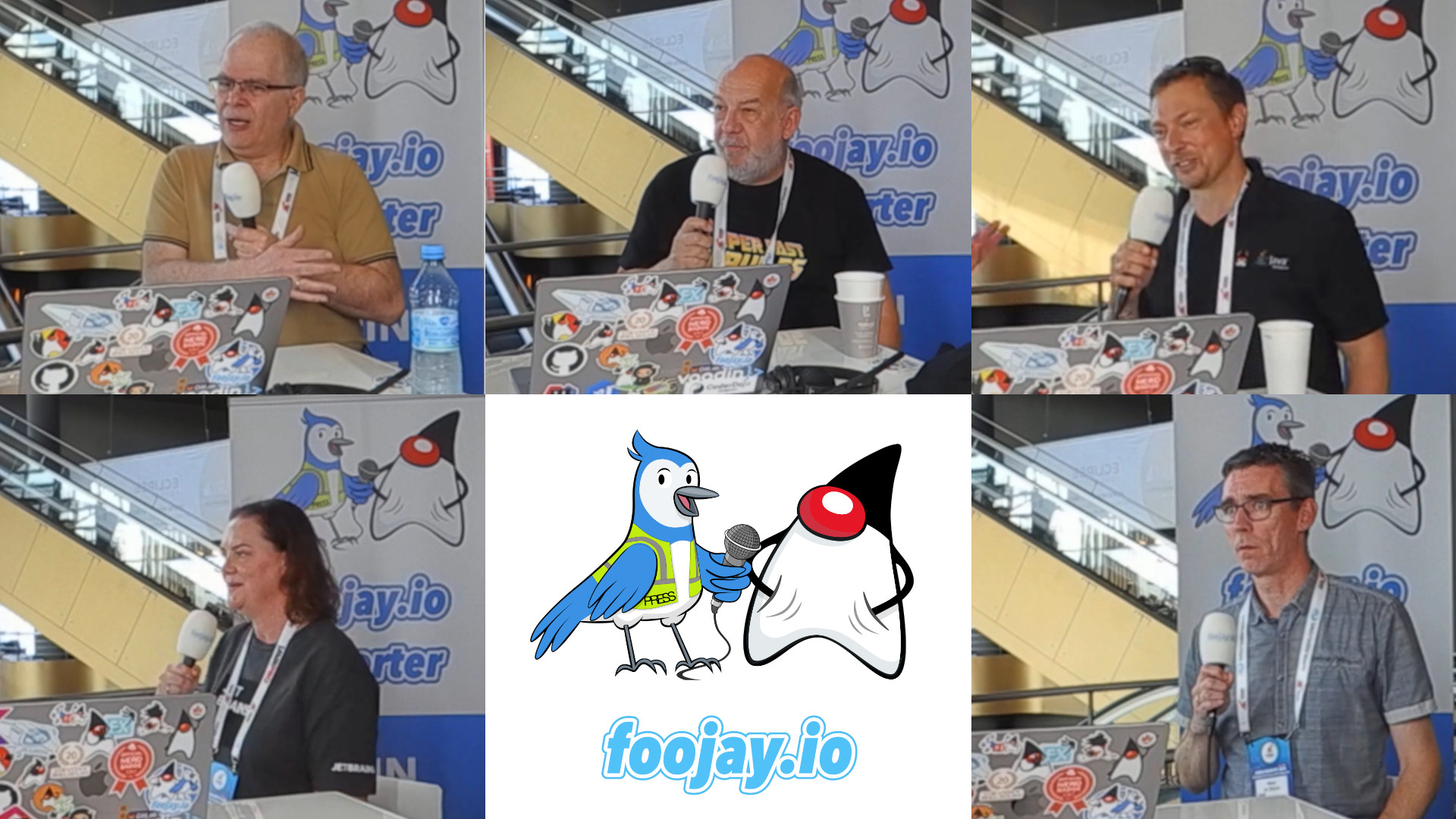
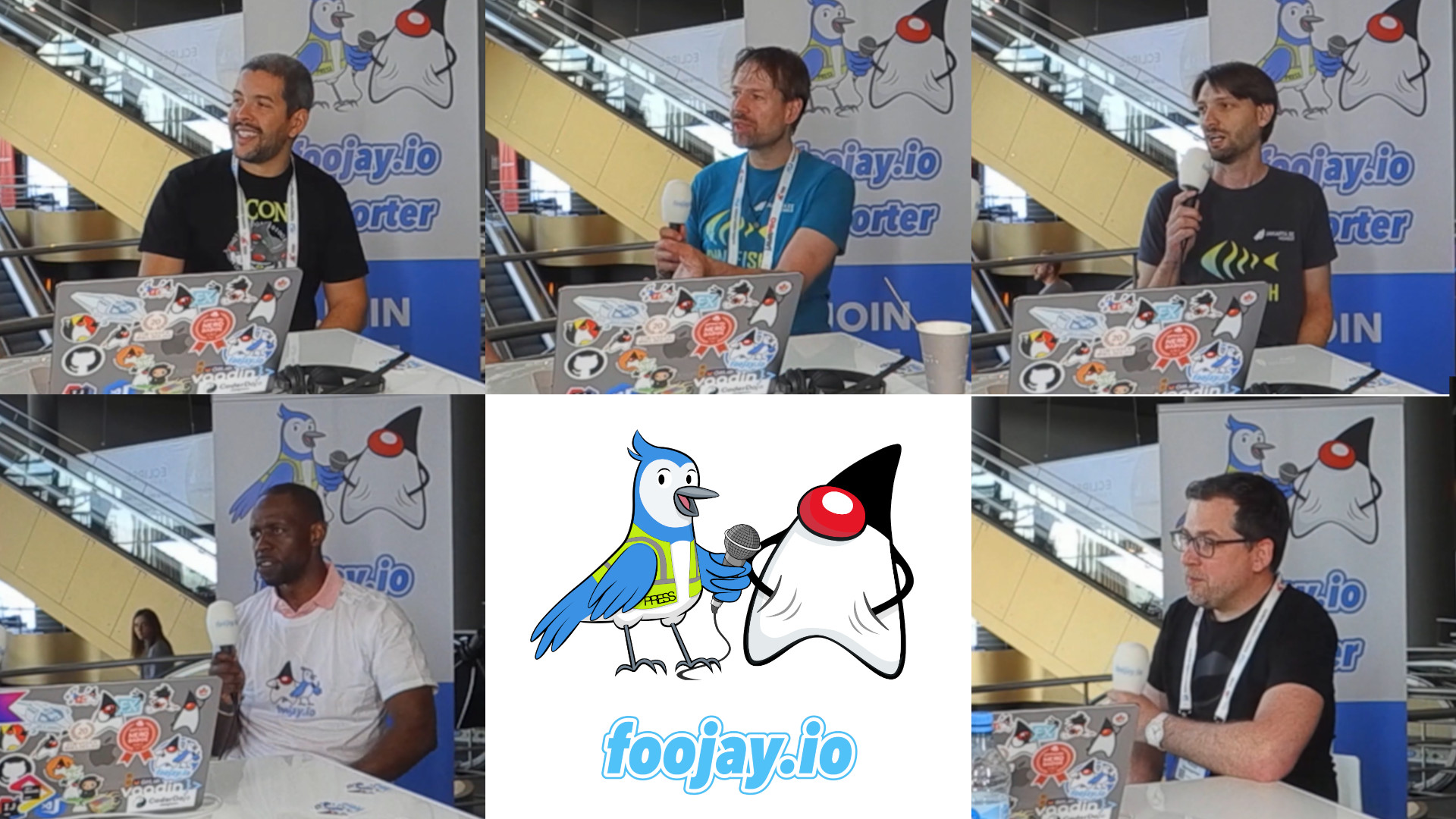
00:42 Otavio Santana: Book Author, Talks about the persistence layer and evolving your career thanks to open-source.
https://www.linkedin.com/in/otaviojava
08:44 Arjan Tijms: Jakarta EE, Eclipse Foundation, Which version of Java to use
https://www.linkedin.com/in/arjan-tijms-1214aa1b1
17:08 Ondro Mihalyi – Jakarta EE, Eclipse GlassFish, Creating small Java applications, Edge devices
https://www.linkedin.com/in/mihalyiondrej
24:09 Buhake Sindi – Talks about Jakarta EE in the cloud, Comparing Jakarta EE to other frameworks, Java community in South Africa
https://www.linkedin.com/in/buhake-sindi
31:50 Patrick Baumgartner – Swiss community, Talks about a PET project with messaging via Telegram
https://www.linkedin.com/in/patbaumgartner
Transcript
Automatically generated from the audio, so it can contain errors in names and technical terms. Suggest a correction.
[0:00] Welcome to the f j podcast all your news about OpenJDK welcome in part three of the Jacon interviews some time ago I did a book review for the first time but I didn’t meet the author in real life yet so I was very happy to meet otavio Santana for the first time in person in Germany where he gave a talk about the persistence layer and how you can evolve your career but of course we also talked about his book mastering the job virtual machine in this podcast you’ll also learn more about Jakarta e glassfish pet project with messaging via Telegram and more but let’s first start with otavio so my name is otavio Santana I’m from Brazil right now I live in Portugal so what I’m been doing here I come here to help people to understand better soft with Java especially the persistance layer inside and that’s the main reason to do my presentation today is talk more about how deep you can go with assistance layer understand better how the JVM works and how can affect the job and of course your career okay your career so it’s not a coding talk or is it talking about code and how you can be a better developer it’s mostly about
[1:23] Code yeah soft tat as well so some diagrams and of course if you do a good job you have a chance to get promoted to understand my feeling today is a lot of people who wants to become a senior and both senior stuff as staff plus engineer forget about the basics especially the code Arts of understanding the problem to solve the problem and of course we are soft engineer we are solving these issues with codes and of course I need to show a little bit of codes in the meantime so it most of the time talking about code code how to achieve your career with code yeah people who follow you online they can learn a lot about evolving your career that’s one of the things you’re working on you’re really helping people why are you doing this because somebody helped me in the past so it’s like a gratitude to answer that way to how you can achieve career a better career with open SS because open SS Chang my whole life I mean when I was beginning in my city I had no idea about how the word big is and right now thanks for the open source I can travel I can go to
[2:47] Conference like this I can increase my network I can learn I can achieve more technical skills soft skills hard skills and so on everything around open source MH so a lot of people talk about open source as philosophy it is fine it’s true however in my opinion open source goes much beyond that I mean you can do a better job if you apply the techniques that we learn from open source in your career for example do a better C review understand what’s going on doing your test doing integration test run with cicd achieving better results and scalability in organ ation exploring more documentations and this kind of thing I learned in open source I applied my career and thanks for that I could move forward in my career so right now I’m living in Europe I’m running my own business because of that you have to explain one thing to me so you’re helping people you’re coding you’re doing conference you’re traveling and you’re writing books H how much hours per day do you sleep yes I do that’s a question that most time I answer my secrets is not doing like every day eight hours of Open Source and things like that no no I try
[4:09] To do my best I do my best every single day but at least 10 minutes take for example learn a new language English you can think about okay if I learn eight single words one day might be not good enough but think about one year after one year you are capable to learn 365 words in a long term you can achieve good results and that’s my secret I do not write the whole book in a single day I wrote a small piece every single day I learn everything about soft engineer every single day and after one year I can get a better result so the habit to study the Abit to go to the gym to go to confer like this is super important so it’s more about have organized life a life balance and do everything a little step every single day then try to do a huge step in that day I had the honor of reviewing one of your books the internals of the gvm were you a specialist in the gvm or was it I want to learn this myself let’s find out and then write the whole thing yeah I mean my first contribution was in the open JK at the time that was Java 8 was released and that was the main reason that I come to the JCP active
[5:42] Member in so Java so I contributed a lot to the open GDK I helped to enhance performance refactor in some codes for example I moved the whole infrastructure code in the bullet to make sure that we only only have two instance of bullet true and false because everything else doesn’t make sense it saved a lot of memory and it was a single step I also removed string buer to string Builder it save a lot of memory so I did small steps every single day in the long term it’s become a huge contribution on the open JK not because I decide to do every I use comit m in a single day no no I start to do a small step contrib little contributions every single day and after that I learned a lot so I went to dsrs then I come to Jakarta e and based on that knowledge I decided to write a book about my experience contributing to my first open source product that was the open JK yeah and I invite everyone to go look on GitHub to OpenJDK because I discovered that it’s actually a history book it has all the information about time zones for instance is also in there so it’s it’s a massive amount of work by
[7:07] A lot of people and like you say yeah small piece by piece it’s improving yeah it’s improving a lot of people when you talk about soft engineer we talk about new products right so you come here to conference like this we talk about new technologies but on reality of course you can apply these new technologies but it’s impossible to forget what we done what you wrote ni code in open source in general we learn about Legacy modernization that’s mean I need to modernize the code that I do have however I cannot forget the code that already Road not just myself but as organization and open JK we did exactly like this so Java right now has more than 25 years old and you can see the code refactoring moving forward if without breaking a lot of compatibilities and that’s the real life I mean the finance they do have a lot of codes that they need to migrate to Java 8 to Java 21 to Java 22 right now and it’s still a lack because a lot of people has no idea how to do that how to achieve that and you can learn that using open source because all about open source especially Java is about let Legacy
[8:29] Modernization strategy like exactly why you’re doing your job right now yeah there were a lot of speakers and visitors who showed interest in Jakarta e and I talked with Aran tames and miali and bhaki Cindi about this topic so my name is Arian times and I’m Manning the boot here at the eclipse Foundation and I present Jakarta e and classes so that’s what brings me to the conference today so and hoping to meet the Java Community I guess yes yeah of course so we always like to talk to the community ask what they use ask what they want how we can help them so I represent also my company which is omn fish and with omish we provide support services consultancy where needed and if people have issues with jata e or with glassfish specifically also with other glassfish with other a run times we can help them that what are the most important utions that people should know from the eclipse Foundation the evolutions like how it what new things are you supporting and building yeah so at the moment with the eclipse foundation and the Jakarta e working group we working
[9:45] Towards the Carta E1 which is the second feature release that we’re working on so as maybe people know or maybe they don’t know umart evolved from a jav a and Jaa a had been at Oracle before that at Shan it evolved over the years to become like a quite interesting framework but then at some point Oracle kind of lost interest in it or they want they didn’t want to spend so much for it anymore so they transferred it to the eclipse Foundation yeah and that in a way was like really good for the community because a lot of things were like really open source and the Foundation is a f the neutral thing like the eclip Foundation is of course F neutral so the specifications the apis are the ownership of the eclipse foundation and then companies vendors can Implement them or can maintain an open sour implementation as we do but the entire thing is owned by a foundation and it’s open source and the process is you could call it an open API process like everybody can cont to evolve the API and that makes Jakarta e quite special and that was a good thing for the community that was so open and so
[11:07] Fending neutral on the other hand the transfer took a long time yeah and people may know it because they had to change package imports from java X to Jakarta correct yes but I think a lot of that is also hidden because it’s also part of a lot of Frameworks it’s also in Spring I guess yes so actually spring Heights a bit that this transition happened within spring for instance yeah so in Spring specifically spring Heights a couple of things but also still like applications do import the jav fox namespace which mean they still have to do the transition yeah so we have a few the company we had a few suggestions about how to change in the namespace how to do that which tools you could use for that so if anybody wants to have more details about that to look it up online I guess open rewrite is one of them yeah open rewrite the eclipse Transformer just search and replace is of course always an option it’s a bit more yeah careful bit more work but it’s still an option if you want to do it manually if your application is not too big you can do it yeah that way and so we had at some points the transition
[12:27] From java X to Jakarta which was just a dropin replacement no new features now you say you’re going to Jakarta 11 yes what are the new things coming in there yeah so we have a lot of good changes in persistence Jakarta persistance added a lot of new small features but very convenient to use we have extended support for JK 21 future threat in concurrency it’s with a smart catch since we also are still compatible with JK 17 so it’s not guaranteed yeah that your application gets a f threat but it’s there with as regard to validation it was previously called Bean validation but now just validation and we support a records with security security is now possible to use multiple authentication mechanisms which are things like form or basic or open ID and we introduced a new Handler where you can it’s a bit technical but you can inject multiple authentication mechanisms like basic or form or maybe two different forms and then your application can route requests to different mechanisms when needed it’s still bit manual the plan was to do it automatically but it the basic
[13:51] Foundations are there you said the migration to Virtual threats and you have to be on Java 21 for that do you think Java 21 will be picked up faster compared to previous versions because of that kind of Evolutions like virtual threats I did think so I at least I hope so for starters and there’s always a bit of a debate in the community how do we get people to JDK 21 or to high J in general so there’s two groups of people basically within the Comm Community within the fender and Library community one says okay well we have to support everything so we support even down to JK 6 if possible other say well we need to be an example and we need to change to newer JDK versions faster so we kind of smooth the path and give people a reason to upgrade if everything stays compatible with JDK 6 yeah for ages then people companies might not feel the pressure to update so much and then the entire ecosystem stays at JK 6 yeah or in this case maybe JK yeah so then we forcefully say okay well now the minimum is going to be JK 11 or JK 17 and then it gives people more of an Impulse to upgrade yeah I know it’s a
[15:20] Very difficult decision for a lot of companies who have Legacy applications but on the other hand you have developer improvements you have code improvements you have runtime improvements so exactly there are very good reasons to upgrade good reasons and we had this with the update in Jakarta E1 to JK 17 as a minimum and of course some people ask well you have this API like G the persistance and there’s nothing in the API that requires datk 17 the API is just it doesn’t use jk7 features you can compile the API I think still with jk7 probably but then of course the reason is that there’s a guarantee that all implementations are at least J 1 so by by limiting what you support as a spec you actually give more guarantees yeah and there’s this balance that not always everybody understands or maybe they do understand but they have different reason but as a spec the tighter you are the less things you support Yeah the more guarantees you give so if you would say okay well we do this back at JK 21 then you would have to guarantee that every implementation supports JK 21 because that’s the
[16:50] Minimum currently we are at 17 and 21 yeah so whenever you have aicart e application Library you can’t compile it to JK 21 because it will not work on those systems that used J yeah yeah hello I’m Andre miari I’m came here from my company omish to support the eclipse Foundation booth and Jakarta e and we’re also involved in the eclipse grassfish project so that’s what we’re going to promote here and we’re we’re basically a company that is a Jakarta e member so we’re involved with a lot of Jakarta e activities and we are involved in Eclipse glassfish which I already said but we also provide support for Eclipse glass fish for companies that use it we built a new runtime based on glassfish components which kind of aims to provide an alternative to quarkus helon and spring boot in the area of Jakarta e with all the Jakarta e apis and we’re here just to help and talk to anybody who’s using Jakarta e and get a feedback of what they think about it and how to make it better I’ve never used glassfish before what should I know about it what does it offer me as a Java
[18:14] Developer okay so glassfish is an application server but it’s more than that like nowadays many people think that application servers are Obsolete and they don’t need them that might be true in some cases in other cases is you still can benefit from clustering Administration console and a lot of things like transactions provided to your application that you don’t need to care about also monitoring is there a lot of things that you don’t need to build into your application it’s just there when you run your application with glass fish but you can now also embed glass fish in the same way as embed Tom Cuts you know a spring boot by default EMB St cuts to run the application so you can do the same with glass F and still benefit from all the services that it provides that you don’t have to build into your application and it still provides the whole Jakarta e apis so if you have an Jakarta e application a war or ER you can still run it with this embedded version of R so yeah most people are not aware of it but bring use stom cut inside you can change it with J for instance which is
[19:21] Also another website so glassfish has other benefits compared to Tom cut yes it does but mostly for Jakarta e applications so spring spring boot uses some parts of Jakarta e but most of the things are not compatible with Jakarta e so if you run a spring boot application on glassfish you can still have some benefits of monitoring and like troubleshooting options there but it doesn’t give you so much if so much more than Tom Cat yeah if you have a Jakarta application then you can have less code in the application then in the spring board application and then you can run it or you can end at glassfish and you have a lot of these because glassfish will understand your application better A lot of developers go to spring because they know that’s the best it’s used a lot what is the advantage of going to Jakarta e the advantage is that you can choose the runtime that’s one thing that most people don’t really realize and don’t even see the value in it because they are happy with spring but maybe then they face some situation where spring is not the perfect case like in iot devices you
[20:41] Need to have a really small application or serverless you need to start your application very fast and that’s where spring is okay but doesn’t act so with Jakarta e if if you jakata application you have the option to choose the run time you run it on and this these run times are compatible more or less maybe you will need to tweak some things or refactor some some things that are not standard but it’s very likely that you will have with little work you will be able to run your application on any of these but in reality you usually Target some runtime so you don’t have to really migrate between run times but you have the option to reuse your knowledge so if you learn Jakarta e platform the apis and the specification you can run up application that scale in big clusters and application service but the same with the same knowledge you can write small applications if you read if you choose a small runtime that even supports native compilation like quarcus then you can reuse your knowledge build the application and get something completely different than with application servers or with spring boots
[21:52] I’m working on a few blog posts about Java being able to handle from The Edge devices up to the biggest cloud environments and that’s actually what you’re saying if you have an edge device which is for instance collecting data from sensors and you want to process that before you send it to the cloud there you would could have a Jakarta e application running on a small device for instance that’s what yes yes provided that there is a r time that is small enough and fast enough to run on these iot devices for a long time there was no such run time but recently there are some run times that support that like quarkus there’s also helon which is sort of they don’t support all the Jakarta e apis but much more than spring dust for example they try to support or at least the relevant parts of jakar and for their use case we’re building a new framework P or it’s not so new anymore but it’s still not mature enough to compare it to quarcus it’s called pan it’s based on glassfish components and it’s very small or at least you can combine only take only those parts of Jakarta you need and
[23:06] You can make it very small and fast like in 200 300 milliseconds if if you really shave shave it to the basic and with these run times you can really run on iot devices very comfortably with things that don’t require much memory that don’t require too much CPU to start and also on server L which is sort of like iot devices because there you can have a lot of memory but then you still care about starting your applications very fast because it may be started for every request and then you don’t have to slow down every request so now you have these options it’s so pity that for Jakarta e for a long time there were not so good options like for couple of years ago I think five five years ago there were no good options like this but since quarkus and PIR and hel started you now have a lot of options with the same Jakarta eapi to build small applications my name is bhake Cindi I’m from South Africa right now it’s spring so it’s no it’s Autumn it’s going to go to Winter soon and what brings me to jcon is there was a code for paper and I wrote and then I got
[24:26] Accepted surprise normally I see the Lon I’m like these are smart people so I’m like okay so it’s interesting yeah but it’s not my first time this is my second time here and what is the topic of your talk me my topic is basically embracing Jakarta e in the cloud with real world example because I’ve noticed like there’s a lot of tutorials and a lot of especially with colleagues and teams when you talk about Enterprise Java they’re like no go spring it’s easier the spring cloud and all of that stuff and then when you go go around to figure out how to do it with Java e or Jakarta e it’s like sep tutorials so I said no man we’ve done this before so let’s take the latest version of Jakarta e create an application with the database that talks to a third party Services all of that stuff and then let’s deploy it in the cloud yeah so I couldn’t care which cloud provider available but then over time i’ as I was trying to figure out which Crow provider to use I found out that you know what asj as much details there was one or two hiccups but if after rereading the tutorials you’re like okay this is what I was
[25:51] Missing and then we talked about Jakarta E before today that you can inde make your application a lot smaller yes if you just go for Jakarta instead of spring for instance that’s Aon now that’s the reason I didn’t go for spring because I tried my previous experiences a developers like to mix Java e and spring Frameworks together just to create a solution and then it always backfires because like the life cycles are totally different and then when I decided let me try spring full out and understand it so I tried to write you know like the a simple page that says hello world on the JSP page and it was 300 Mi and also in South Africa we don’t have very high F internet speed like here so if you trying to deploy your application in production and you’re on a network you always get a time out so I said why are we struggling with these things with job e you can write a simple application couple of meds deployed within seconds and then start so ever since that I was like Java all the way so it’s been almost 20 years so and they were mentioned about helon quarcus other Frameworks on top of Jakarta yeah did
[27:21] You use those or Jakarta is enough for you for now Jakarta Frameworks is more than efficient to use unless you write the microservices and you need some new micro profile features but other than that a lot of Enterprises application today are just usually web frontend that talks to the database or some third party nowadays people like to use no I think with a C1 with J no coming in then you pretty much have everything standardized in the box and the beauty about Jakarta e whatever container you use it’s already got a bu in default implementation so you don’t have to worry about am I going to use hibernate or I going to use Eclipse link or what kind of in memory database do I have to use you can use already something that’s in memory standard and they just write your application that’s why I always tell my people just focus on creating the application let the container handle the rest so you mentioned you are from South Africa one of the earlier Foojay podcast we had a session about the JS in South Africa we had Cape Town and hburg yeah Josie ju yeah Josie J indeed I forgot the name very bad with names
[28:45] Sorry are you member of one of those JS or do you live too far away from them no another guys cor Rory yeah I attend all the DRS in well I can’t attend Cape Town because then you have to fly but in Johannesburg yeah yeah it’s every it’s a last Monday of every month and there’s always a jack session there’s a Meetup and then and I’m trying to promote it couple of weeks ago I promoted it no last week yeah Jo for D developers in one of the conferences that sessions you know that was happening in South Africa so I said no if you job developer and you want to try and you want to be a speaker go to a j j and try and present at least it’s a small groups people will give you feedback so that you don’t have to come to a cinema and then there like 600 people and then you get nerves so yeah that’s actually a nice point that we didn’t mention before so we already talked about the J and it’s important to that people know that JS exist yeah but you have a very valid point a jug can also be a starting point to become a speaker yeah yeah is that also what you did you present first at a j or
[30:12] Did you just submit to conference and got accepted no no no actually funny enough I trying to do talk in sou Africa first but I actually didn’t even realize I should have actually tried from the Jack mhm and I was declined so I was online on X for Twitter and people like man there’s a lot of conferences and kof speakers try one m so I like okay where’s all the J ones I apply then Jacob was the first one to accept and I’m like wow the same talk that I wanted to talk in Africa got got you to Germany and I flew to Germany and I thought ah probably 50 people nobody knows me geez it was packed and I’m like oh my word so I had to like and did you enjoy it no I always enjoyed it it’s look you always learn by jumping in the deep end so it’s a good experience and I always have people like if if you have the desire to want to talk or you know everybody’s got knowledge knowledge sharing is important so I try blogging and the problem is you overthink a lot at least with a talk once it’s done it’s done yeah yeah and it’s always going to live forever in online some I already talked with my next guest
[31:39] Patrick bomgardner in podcast 46 about the ju and Java community in Switzerland at Jon we met again where Patrick gave a talk about a pet project hello everyone my name is Patrick bartner I’m from Switzerland and I’m here at JC con to do a talk tomorrow morning and obviously another reason would be actually like to meet the whole Java Community here which is actually always a pleasure to see friends yeah we already had quite a few guests from Switzerland is there a close connection with Jacon or is this just the closest conference that you can go to no that’s not true I would say like Jon has a train connection which is like roughly for most of us like six or seven hours by train so you don’t need to fly so that’s nice and in Switzerland there are not that many Java conferences yeah yeah and like one of those would be walk Day St of course right okay I see you have a speaker batch yeah that means you have a talk yes I’m going tomorrow to talk about a pet project because I once had the idea I should do a talk about something what you could do like on a site project and learn actually like what
[32:53] Something you could learn for work actually so I have an example built up like two years ago or something like that where I created an application because I was tired of Android app which was really heavy weight and difficult to use so I wrote an application which deals with a telegram bot and I used that to kind of like the telegram bot to send messages and then use this kind of messages I sent and display it like like as a digital postcard on a display and I have set up it in a way that you have kind of end to end everything so it’s like automatic build automatic deployment and things like that and it was actually quite fun because I realized first I actually I did it for me because I was tired of using This heavyweight Android app which took me way too long to send these digital postcards and then actually like my family started to use it and then I realized I buil software but it’s not for me they have like different needs and now I have different needs and then other things happened like for example that spam arrived at the telegram bot and now the spam messages were sent as
[34:04] Well to the display you know so yeah quite a lot of things yes I got hacked and then I intend to implement kind of filters but you know like there is a another problem when you do private things it’s also like putting emojis on a canvas in the docker container it’s a possible because a Docker container with Bill packs does not have an emoji font yeah so you we see like running on your machine but when you deploy it it’s not working and it took me quite a while to find out actually like why and then second actually like how to fix it yeah isn’t that the story of all pet projects it’s a good idea and then it becomes too big I guess so but you learn yeah you learn quite a lot I mean I learned like how to patch my run images of the build packs I learned of like the needs of like the family or the extended family and also like my needs as well to see like if somebody sends a message I want to see it as well even if I’m not at home you know so yeah it was quite an interesting route I would say yeah yeah you use messages is there some messaging system in between or well
[35:18] Actually the telegram bot receives a message and like the library I’m using is basically just ping the telegram environment and this way you receive kind of messages I used then internally also as messages yeah so a Java Library too interact with Witham exactly and it’s it’s quite interesting because like WhatsApp and signal there is also libraries for those which are based on their web client so it’s kind of a rapper for those but telegram has a proper API you probably have seen that you can do games and other things so they really like created something way bigger and with much more possibilities which is actually quite interesting and that’s why you have like channels or you can write Bots whats in channels but also like Bots you can talk to directly you can write your personal bot so I think it’s like I would say like nowadays it’s more like for the old guys it would be a command line application now you use a telegram Bo I would say yeah so actually you’re using telegram as a message bus yeah kind of yeah kind of yeah but you don’t need to pay for the hosting that’s true but a
[36:26] Fun fact regarding host posting was also like for my pet project I found out that I can run Docker container on my Nas at home yeah so it’s super cheap it’s basically for free because the Nas is actually also running and even like the optimization how to deploy it there is also super smooth and yeah so that’s also something you don’t have to pay always like at the cloud provider for your application yeah are there raspberry pies involved somewhere no not at all it’s super simple it’s just a spring boot app and it’s right to usually I run another talk where I show people like how to optimize your spring boot app so that you can start up like in half of the time use more than like 30% less RAM have more throughput and stuff like that and this is also kind of an application where I apply those things as well you know so again your Professional Knowledge I think it’s it go both ways yeah do you think it’s important as a developer to have Pet Project of course and this will be also like one of the main message tomorrow lunchtime because the thing is actually
[37:36] Like every I believe every developer should have a pet project but it’s not my current project I work one the one which goes to production because that’s like way too risky if everyone has like his pet projects built in there but I think we should be ready for future challenges and we should actually have a pet project to do something that can be within the company but that can be also something in your free time so yeah definitely everyone should have a playground where you can play safely do your experiment and maybe throw it away or not so sometimes you have ideas which become like good open source projects or whatever you know so you use it to experiment with new technologies yeah other technologies that you didn’t use yet on production actually also to learn right yeah so if your manager tells you or like your product owner or whoever tells you and we are going to do this you have already some some pre- knowledge on something or at least like you have read about it you know how it could work you know get some ideas so I think that time spent on those projects is very important to just like
[38:41] Prepare you for the future actually it’s a bit of my story personal story I experimented with Java on Raspberry Pi yeah wrote a book wrote articles and then ended up even with a new job of course sure and that’s something which can happen because you get involved into an open source project for instance exactly what other talks will you visit at the conference or did you already visit actually I arrived just like after lunchtime so I just had some good chats and I haven’t visited any talks yet but I will definitely participate tomorrow morning in the talks yeah yeah a story I hear a lot here is the community is more even more important than the talks for a lot of people I mean there is no formal because the talks are recorded and you can watch if you want it afterward so why not use the time to like mingle with people talk about things and so on so that that’s like that’s like the opportunity to meet each other you know and even like for me personally things have changed over I would say maybe the last 10 years maybe I was a participant like more than 10 years 15 years ago on
[39:48] Conferences and I was just a regular participant but when I started doing talks I met people and I’m I’m now happy to meet them again and they became friends over time so basically it’s like visiting friends and that’s actually nice and then sometimes and that happens actually like where you sit together and say let’s collaborate on something together let’s do like a workshop or a talk on that topic for the next conference and things like that so yeah so that’s actually nice to see all these people around okay yeah nice conclusion that’s it for part three of the Jon interviews two more to come next week you’ll hear Garrett GR w p Bal Krishna rul Fran Martin and anur edar about garbage collectors aul intelligence Cloud test containers and Flaky tests toxy proxy structured concurrency virtual threats being a volunteer at jcon and much more see you give me a give me a j give me the friends of OpenJDK
Found a mistake, or something to add? Edit this page on GitHub

Frank Delporte
Frank Delporte is a Java Champion, Java Developer, Senior Technical Writer at Azul, Blogger, Author of "Java Programming for Raspberry Pi - A Hands-On Guide to Electronics and IoT Projects", and Open-Source Contributor for Pi4J, Lottie4J, Sheetmusic4J, …
Ondro Mihalyi
Ondro is a software developer and consultant. He’s passionate about helping his clients and the wider Java community with their projects based on Jakarta EE and similar technologies. He's a core member of several opensource projects and Jakarta EE …