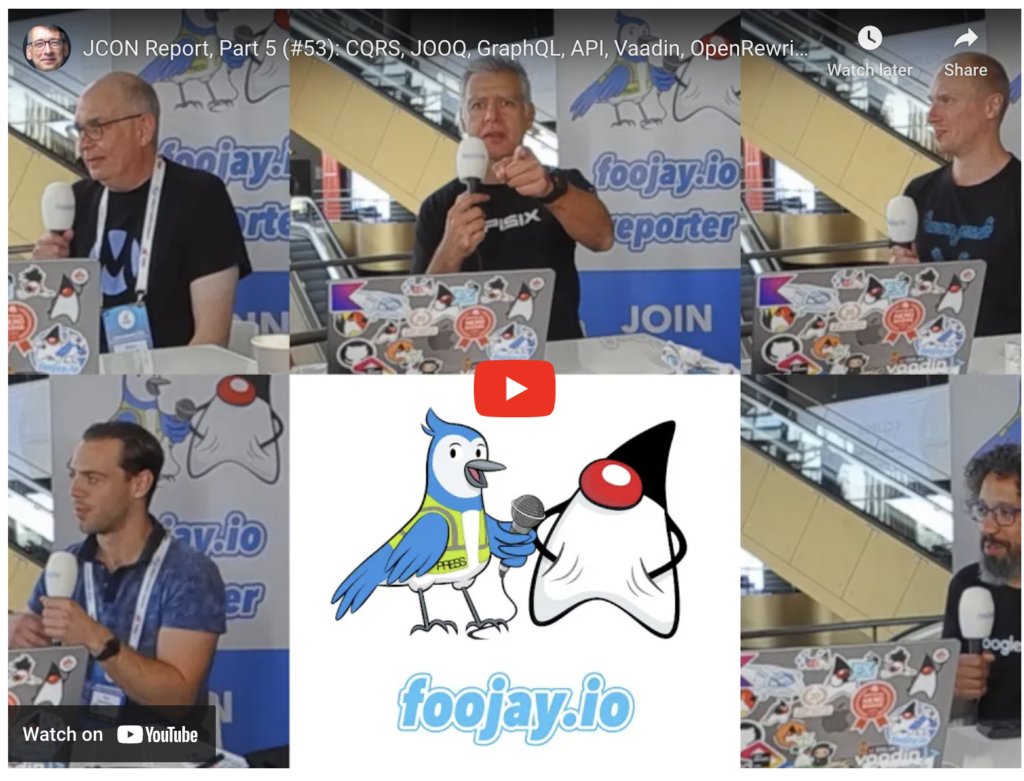
Foojay Podcast #53: JCON Report, Part 5 – CQRS, JOOQ, GraphQL, API, Vaadin, OpenRewrite, ErrorProne, Gateways, Proxies,...



 1 min read
6,064 views
1 min read
6,064 viewsThis is the final part of the JCON interviews. Did I save the best for last? It’s up to you to decide…
In this episode you’ll hear Simon Martinelli, Nicolas Fränkel, Marcus Hellberg, Rick Ossendrijver, and Abdel Sghiouar.
We talked about a bunch of topics like evolving your APIs, GraphQL, Java versus Kotlin versus Rust, Vaadin, AI and ChatGPT, OpenRewrite, ErrorProne, Infrastructure, and a lot more.
Video
Podcast Apps
You can listen and subscribe to the Foojay Podcast on:
- Spotify
- Apple Podcasts
- And most others…
Content
00:45 Simon Martinelli – Talks about CQRS, REST, APIs, JOOQ, Vaadin
https://www.linkedin.com/in/simonmartinelli
09:08 Nicolas Fränkel - Talks about evolving your APIs, versioning an API, GraphQL, CQRS, REST, ProtoBuffers, Java versus Kotlin versus Rust versus …
https://www.linkedin.com/in/nicolasfrankel
19:11 Marcus Hellberg – Talks about Vaadin, Web development with 100% Java, AI and ChatGPT
https://www.linkedin.com/in/marcushellberg
31:27 Rick Ossendrijver – Workshop and Talk about OpenRewrite and ErrorProne, Code analysis
https://www.linkedin.com/in/rick-ossendrijver
35:48 Abdel Sghiouar – Talks about Infrastructure, Gateways, and Proxies, Java Community in Morocco, Devoxx Morocco
42:15 Conclusion
Transcript
Automatically generated from the audio, so it can contain errors in names and technical terms. Suggest a correction.
[0:00] Welcome to the FJ podcast all your news about OpenJDK this is the final part of the Jon interviews did I keep the best for lost up to you to decide in this episode you’ll hear Simon Martinelli Nicholas Frankle Marcus hellberg Rick osen dver Abdul shuar and they talk about a bunch of topics like evolving your apis graphql Java versus Scotland versus rust vadin Ai and chat gbt open reite error prone infrastructure and even a lot more but let’s start with cqrs and apis both Simon Martinelli and Nicholas Frankle had to talk about these and related Technologies at the conference I’m Simon Marinelli from Switzerland and I’m a speaker here and I was talking about cqs with modern Java this morning and what was the main goal that you the main message that you wanted to bring you know very often apis are created using rest or Rest full which is perfectly fine especially if you’re doing third party apis that are consumed by whoever could use it yeah but if you’re doing client server communication with like an angular or react client and the back end then you probably would like to have something like an RPC style
[1:26] Communication and so rest is sometimes not the best fit and especially because often you have something called under or over fetching so you send too much data or not enough data to do the job on the client side and so cqs is like the separation of the command side and the query side and if you apply that to your API then you have commands that have minimal data just to do the job and on the other hand if you want to fetch data from the server you can have queries you could use that do that with chuk for example and multiset to get nested structures or you could use graphql depending on what you want to do but this separation allows you better understanding for the application and the semantically better API that is very easily to understand if you’re looking at the client code so can I compare it to websockets for instance where you don’t have a separate call each time or it goes further than that no it goes further than that I would say it’s really like you have to do like consumer driven API so very often the backend team is first and creates an API and then we have the front end team and says
[2:42] Oh no I can’t use this API or I have to do tricks with the API or load too much data transform it somehow but this shouldn’t be the case you should really do an API that fits the client and then you really have Fang grain access to the server and get exactly the code or the data that you need MH on the client side yes so you’re trying to solve a problem where you indeed have two separate teams working independently and then finding out that the thing that should combine them is not working correctly yeah exactly that’s often the problem yeah you’re a bit of a developer Advocate although not officially for valden and Juke why is that are these in your opinion the best framings you can use for their goal like Juke for database stuff and Vaden for user interfaces yet I like a lot of technology I like spring boot but I also like quos or Micron out but there are areas where people tend to use not the optimal solution so for example for business applications people are using single page application Frameworks and that could be a good fit so especially if you already have a team
[4:00] That knows one of these Frameworks but for most applications it’s kind of an Overkill or it’s too complicated because what that what you want to do is have a very simple a UI with great components by the way and you want to do that fast and I’m coming back from time where we used to have awt or swing to do applications and I really miss this kind of great component Frameworks that you can use to build your applications and that’s why I like wadin and that’s also why I’m doing a lot of talks about Vin because I want to show this technology to other people because I would say it doesn’t have enough attention that’s the reason why and although it’s not officially part of your presentation it’s not in the title do you use V in your talk not in that one not in this one in that one I use just joke okay which is a unicor I think yeah you have two batches you have a speaker and a volunteer batch what does that mean did you help with your organization do are you helping today I will help tomorrow morning and on Thursday morning so I’m will be at the registration desk helping people that
[5:17] Register giving them the batches the vouchers and stuff they get so this is really a community-driven event absolutely I talked to the organizers which are also organizing a ju we talked Also earlier in this podcast about the J in Switzerland how important is this community for Java I think it makes it unique I don’t know any other community that is so strong and it’s also very helpful for new developers so they can come here or go to a user group meeting and they will find like-minded people that will are eager to help with whatever problems they have because yeah Java is the trademark is owned by Oracle Oracle is also the steering committee let’s call it like that in the Java development but I think the community contributions to Java are huge is that completely different than net for instance can you compare that yeah I also do net programming sometimes and there I mean it comes from another ecosystem right because it’s owned by Microsoft that was always developed by Microsoft and back in the days if you look at C Wind forms application you had this for example this components so if you bought Visual
[6:42] Studio whatever then you get like catalog with all the available commercial components so in this base there were a lot of commercial components so this was not Community Driven that was driven by companies that want to earn money from selling the components but in the Javas space open source was very early very important so I remember when I started there was lock for J for example and J boss and these were already kind of Community Driven because you just could use that in both cases I think you had to pay for the manual so the code is free but the manual was not free and so it’s very easy to get access to that Community or you can write your own open source framework and just publish it on Maven Central for example and then everybody can use it and that’s something that makes it unique and that’s also why Java is so strong because for every topic no matter if it’s some very old topic or if it’s AI or something else you will immediately find someone who already solved your problems and you just can use it and we discussed this before with sonar it’s it’s amazing how companies are founded
[7:55] On top of Open Source so they’re still Distributing their library or their application for free but you can get commercial support or more extended version if you pay for it so I think that that’s nice that you can build a library and if it becomes popular you can become a consultant for that library or you can build a company around it yeah yeah you’re a consultant yourself yes what kind of applications do you work in I use a lot in the retail or wholesale industry so Erp systems or other more back office like systems I’m building usually currently I’m working for a company that is building software for the Swiss Gymnastics Association so in Switzerland we have a lot of sports club they’re doing track and field artistics gymnastics stuff like that and the Gymnastics Association is organizing or is helping organizing competitions and to manage all the competition starting from the subscription down to the ranking list we build software to do that in Java of course I’m Nicola Frankel and I’m here as a speaker and the topic is the topic is evolving your apis so HTP apis the idea is
[9:18] Most of the time you are in a regular project which means that you are stressed you need to do a lot of stuff like designing your model thinking about the boundaries and then you need to think about all the rest stuff somebody said hey this is rest and this is what you should do but actually some cases it’s very blurry like some people say like the rest thesis is like the Bible somebody came wrote a book and then left and it’s up to the people who are left to decide what is the truth yeah and so there is a high chance you didn’t think about versioning your API and I will show you a few tips and tricks well if you attend my talk how you can version your API as an afterthought without breaking too many things okay and we just have Simon Martinelli here who talked about grpc instead of our next two apis what’s your so he his ID in the Talk is sometimes you don’t need all that data flowing back and forth over rest do you agree it’s very very hard to have a generic position over all use cases there is graphql there are rest I or restful API JPC all of them have pros
[10:41] And cons so it depends a lot on your context you’re a consultant it depends I was a consultant in general it depends is the beginning of the conversation so if you tell me about your use case yeah I can tell you more but I don’t think it’s the Next Generation if you are interested in performance it’s much much better if you are interested in let’s say speed of delivery if you do JPC for example it’s it’s possible but it’s much harder to call that from a browser or from a regular clients so if you have service to service interaction yes if you don’t and then if you have service to service interaction if you change your contract if you CH you need to recompile your all stuff on the client side so again it depends there are cons I’m not saying they are bad I’m saying in certain context then there are good fits in some others they aren’t how can people know grpc protocol buffers that’s Proto buffers that’s that’s related am I correct to be honest I so I think that’s the way how you define it but then I remember that in grpc you need to compile your model to some specific
[11:57] Static stuff and it might be Proto but I’m not sure and the advantage is you lose all the Json or XML markup exactly I mean it’s binary stuff that’s why I’m saying that if you’re interested in performance it’s much better yeah but again but it can be more difficult to code it and use it not to code it but again if if you if it changes regularly you will have a lot more trouble because you need also in that case to update the clients and that’s why they have to come to your talk to know about versioning it would be a great idea okay but if you are listening to us perhaps you are a bit far away so not that good all the sessions are recorded I heard so they will be online yeah in a few in a few months I don’t know we’ll see oh I was looking there but I should be looking there that’s camera yes that’s the camera yes are you also attending talks I I’m attending talks I attended one talk to be honest I attended Fran Paso talk not only is French but he also like Works in Switzerland he also lives in Switzerland no that’s true but that’s not the reason I attended he was
[13:07] Showing a few tips and tricks about hnet but from the database point of view and I think most developers don’t care or don’t know about this and I was happy to already know a couple of things but I also learned a couple of things so that’s really good are we a bit spoiled with hibernate that we don’t know enough anymore what can be done with SQL H to be honest that was the case already 10 years ago a lot of people at the time were already complaining that most people don’t know how to use iberet it’s not because it works that it works in the best way and okay okay it depends how much you want to optimize or whatever but yeah it’s always like you know the B cost benefit ratio if you don’t have any performance issue that’s fine if you start to have performance issue then you need to understand how it works I mean you know about Vladmir Al yeah he is the expert on hibernate and SQL and how it works so yeah I don’t do Java and gvm anymore or at least not as much as I did but I still read his his blog post when I can because they are also very
[14:30] Interesting you don’t do Java a lot anymore what are you doing here well that’s the thing I did a lot of java and gvm in the past so all my network is here but now I work for API 6 see API 6 it’s an API getaway that’s why my like current concern are more about apis and do you think that there is a better language than Java or what language are you using though again it depends but already couple of years ago I started cutl and I must say that I every time I have to write Java again it breaks my heart if you do Java that’s fine but really try cutl and a couple of years ago I also tried to learn rust which is very interesting like if you come from Java or cot or whatever and you learn rust it’s really really good you it’s painful like every everything new but it’s really interesting so I would advise anybody but not on the rust try to do some stuff that you’ve never done before like air langang or whatever by the way I did I’m now doing my very first steps into cotland perfect congrats and let’s say it’s just Java oh no with a bit of improvements ah it’s
[16:03] Not just Java so for example something very stupid how many static methods do you code or do you use as libraries I probably a lot yeah and I remember my first Java lessons Java is an object oriented language right a static method is what yeah it’s and what I dislike is once you understand that this is a static method so it’s a function a pure function hopefully that you need to put in a class because the Java language tells you everything is an object which is not true right we have been lied to for years and in cotlin there is this extension methods pattern so in the end it compiles in the bite code as a static methods but the way you write the codes it looks object oriented and this is stupid but it makes your codes so much better to read so much easier to read now that’s what I like what I found out after doing some cutland for a few hours and I step back to Java I was already forgetting to put put comma or use the apply from cotland yeah I was already missing it in Java so I have to agree there is C some enrichment there on the language yeah the LDA stuff is amazing I mean and
[17:34] Don’t take me wrong I mean cutl stole IDs from everywhere like if you have done some groovy you know about the it parameter the default one it stole IDs from everywhere but it assembled all those ID in a very nice language in my opinion and the funny part is already a long time ago I tried Scala and I it didn’t click I didn’t find it the same way I mean at the time I it was only scalar 2 that was no Scala three there was an implicit keyword there was this implicit keyword as autoc conversion it makes your codes much harder to maintain and I feel that cotlin gets you the same benefit as Scala but everything can be like followed to the source code like you are your ID you click and you find the source and you can read what it does so that that’s really I mean from a language designer point of view which I’m not I think it’s really interesting to see those differences but it’s not a war they’re both running on the gvm so oh definitely but you know closure is also running on the gvm I tried it I couldn’t couldn’t click yeah I think list is not for me okay but yeah you’re still here I’m
[18:56] Still here and still talking I’m sharing knowledge so thanks for being here Simon already talked about fadin but Marcus hellberg was also at Jon so he came over to talk about it and how you can build web interfaces with 100% Java my name is Marcus hellberg and I am here with b and we have a booth here I have two talks and just looking forward it’s been a great event in the past so I’m happy to be here two talks two different topics yeah yeah that’s right so tomorrow morning I’m speaking about about full stack web development 100% in Java so it’s going to be a talk just introducing new people to vonf flow to just the idea of why you might want to build an app with a full stack framework in general like what’s the philosophy behind it and then we’re going to spend most of the time just live coding because having done this a lot like I feel like the best language to explain a framework to a developer is code show it don’t don’t tell me about it don’t do interpretive dance or mime or anything it’s show the code that’s that’s what’s going to explain it to people the best and the other and the other talk is so
[20:03] The other talk is a talk that I’ve actually given at I think like 10 user groups in the past month and a half and it’s a really fun talk where we learn about building AI powered applications and again it’s got a little bit of theory just to kind of get everyone on the same page it’s AI is very new and it’s like I’ve noticed that especially like Java developers people who have actual dat jobs and don’t have time to be on the internet and just spend all their time learning about new things they’re not like everyone’s not on the same level so we spend a little bit of time just going through the basics of like how does everything fit together and then again we spend most of the time just building an app from more or less from scratch just step by step adding more functionality so we build like a airplane or like a Airline reservation system chat but where we can actually like interact with our database we can change bookings and cancel bookings and get information and it’s all grounded in some actual facts based on documents that we ingest and things like that so it’s a like a realistic B up type of
[21:10] Use case for AI but you have a bit of history in this topic the very first blog I saw about searching in documentation with the chat based system was a Blog you wrote okay you were doing this with the vadin documentation yeah and I repeat your process with the aul documentation yeah so it was two steps at that time you first had to create a vector database yeah and then use it now with L chain for J for instance it becomes a lot easier I’ve done the same thing now with the Java vix application yeah you’ve done this with Vaden are you also using LangChain4j or yeah for a lot of my projects I’m using like J for J I actually have a project where I’ve essentially the app that we’re building in my talk on Thursday where I have that same app implemented with L chain for J with spring Ai and semantic kernel just so you can kind of compare the three and out of these right now I prefer using Lang chain for J it’s just kind of perhaps the most evolved of them but it started earlier than the other two and it’s makes it super convenient to build AI power apps in Java they’ve done a
[22:27] Really good job I think so I actually last week I created this little app starter where all you need to do is just change in application properties one property to point in to folder where you have documentation it’s using aach Tika for parsing doc so it can literally be anything that you have in that database it just goes through it creates Vector embeddings by default into an inmemory database and then you just start suring UI and you can start chatting with that documentation so the intent there is to make it like this whole AI Thing feel a little bit less intimidating and difficult to get started with so you can maybe somebody who’s interested in trying this out can take this app they can point it to some Internal Documentation whatever it might be some PDF about their product and then go and show to their boss like hey look what I just built and they’re going to be like wow this is just what we needed you can now spend a week exploring this topic further but was it you who shared if I remember correct correctly 16 lines of code for a ven chat application yeah that was the minimal
[23:39] Code you needed yeah and that included the spring boot application as well so which is amazing that that’s what I find amazing about the Java Community if you find the right library and it’s probably available somewhere yeah you can write very powerful stuff with only a few lines of codes because the library is taking care of all the rest yeah yeah it’s it’s definitely true and I remember when I built the application that I wrote that blog post about that you mentioned like this was over a year ago when none of these libraries existed and it was really difficult to build it because I was stuck as a developer working on a very low level of abstraction where I’m counting tokens and trying to make sure that I don’t exceed the very small context windows that we had back then and like trying to figure out how do I expel old messages and what do I do and this and that and it was like several hundred lines of just boilerplate code that was basically just a recipe for index out of bounds exceptions and stuff that I don’t really want to deal with because it’s not helping me build the actual application
[24:48] That I want to do so these days it’s like it’s just in the libraries yeah it’s all hidden away so now I’m actually working on the level of abstraction where I want to be where I’m focused on the actual task I have at hand like I don’t have to deal with all the boiler plate underneath and it’s it’s really nice if we go back to Vaden yeah I’ve used it in one of my previous jobs as DUI tool for a business internal yeah interface is that the kind of use cases that ven wants to cover yeah so we I think we even say it on our front page that we’re kind of we don’t think that business should suck we think they should be great and that’s unfortunately not the case in many cases where business UPS tend to be very kind of complex by their design there’s a lot of data and a lot of rules and forms and stuff and at the same time they’re not a product that brings in Revenue so they tend to be built with a fairly budget and they need to be maintained for a long period of time and all of this so there’s a lot going against them but at the same time there are people in businesses who are sitting in a cubicle
[25:59] Or at home working on these apps like eight hours a day and not having a great time and we really want to make sure that we make that experience as good as it can be so that’s what we’re focusing on of course you can build non business applications with bin but specifically you can maybe tell from some of the components we have in the library where they’re quite more advanced than you see in some like bootst type Library where we have data grids and jarts and these kind of higher level components that you can use to build apps quite quite quickly out of them and mainly they can be fully in Java they can be fully in Java exactly yeah which is again the library solving a problem Vaden takes care of binding what the user sees with the back ends and saving things to the database for instance and updating yeah yeah and there I mean there’s a lot that goes on behind the scenes like you just instantiate a Java object but what you get out of the box is quite a lot so for instance you know that the EU and the US and others are rolling out quite strict accessibility requirements for instance and we spend a
[27:10] Lot of time making sure that all these components that you just get when you type new grid actually are really usable for people with a screen reader for instance and that is something again like this is similar to me writing all that boilerplate code counting tokens like if you start with just a bunch of divs and try to build a data grid that’s both performant and accessible and everything you can spend a lot of that like a lot of the budget that you had intended to spend on building your actual application you’re now spending on building components and we don’t want people to have to spend time on that part because it’s not anything that’s specific to their business it’s something that we can provide that they can build on top of and it’s very powerful because I was at devox in anwp some time ago doing a talk with the Raspberry Pi and I had all the people in the room connected to a Vaden application and I could just touch something on the Raspberry Pi and they got all all got an update at the same time and my Raspberry Pi was using no memory at all so yeah it’s really powerful I can use it on a very small
[28:15] Raspberry Pi that means if you run it in a business on a big server you can serve a lot of people with that single thing oh yeah so my coworker miti did like a little myth busting blog post on this and like there’s always this persistent myth that if you have some kind of server State no matter how small it is it immediately means that you can’t handle any kind of scale and essentially just by doing some tests and some math like a quite modestly sized Amazon node can handle just like tens and tens of thousands of concurrent users with no sweat at all so it for again for the types of applic we’re focusing on where maybe you have a few tens of thousands of users that that’s not a problem is that the demo where you have the electricity system that’s visualized no that’s that’s actually a another co-worker of mine vessa who did that for his own use initially a lot of course hobby projects start from your own need so this was you’re fixing a problem like a year year and a half ago with the whole energy crisis starting up prices went high and he wanted to have a way of monitoring that
[29:33] And that kind of then evolved to a thing where you can download in Finland your energy usage data in a format and then you can upload it there and it actually tells you like if you had a this type of contract you would have saved or paid this much more and anyway so he built that and of course because this was such a Hot Topic at the moment and still is that has ended up having a lot of users I think like 10,000 per day roughly and he was running that on a hetner server that was like five euros a month and like no issues at all so Java is powerful we already knew that but you proved that even with the user interface and web yeah and of course then we have things like bra VM that Orel has been building and I have the documentation app that I built I just because I wanted to see like how low can we go I compiled that to just a rvm native and put it on fly.io and it’s it’s been running for a year using 100 Megs of ram it’s it’s like it’s mindboggling what we can do indeed and that’s what yeah thanks to all the evolutions in Java and all the technology around it what we’re seeing
[30:47] Here at the conference and the several no I think it’s like I I’ve been in the Java space for a long time and it I don’t remember like it’s been many years since things have been this exciting in the Java space where you have all this new stuff happening all the time and it’s it’s super fun and some amazing libraries like Ven and some amazing podcast like thank you very nice message to conclude yes upgrading to newer versions of dependencies can be a bit hard open rewrite is a solution to help you with it and when you combine it with error prone you get more reliable tests that’s exactly what Rick osen dver explained in his Workshop my name is Rick driver and I’m giving a yesterday I gave a workshop and tomorrow I’m giving a talk here at jcon and your topics my topic is yesterday was on transforming code with open rewrite and refaser I did it together with Tim toake from mod and tomorrow it’s about saying goodbye to bucks and anti patterns with error prone okay saying goodbye to Bucks everyone wants to do that how do I do that well we at picnic I work at picnic as a software engineer an
[31:58] Online grocery store based in Netherlands where we heavily rely on a prone it’s a static analysis tool for Java which not only detects bugs in your code but also can automatically fix them for you okay and is er prone is it a tool you run next to your application is it a library how do you use it it’s a it’s a compiler plugin so it runs as part of our build so we use Maven and if you do like a maven Kean install it will run a lot of extra checks to analyze your code and see if you have any like code style issues or bugs you can also write your own rules and that is what we do a lot at picnic we write many rules to increase consistency across all our applications because aone runs on all our 70 plus different repositories to have very consistent code base and have as as the lowest amount of bugs possible in our code base of course so it’s not during your tests it’s really analyzing the codes exactly yeah it’s like when you compile the codee just when the compiler is done apron can kick in and uses the extra context that is made available by the compiler to do a much
[33:06] More thorough analysis and then it tries to find all the bugs and anti patterns in your code base have to try it out so you also gave a session about open rewrite we already mentioned it before when we were talking about the move from java X to Jakarta that’s one use case what did you show yesterday in the session well so Tim and I both have a passion for improving code quality and preferably like in an automated fashion and we both have our own way of getting there so we use air prone a lot and he is from the open rewrite perspective what we wanted to do with the workshop is basically show both ways in which you can reach like this level of Automation and automatically improve your code base code based quality and give a lot of hands-on experience to all the participants and then we ended with like a nice comparison and yeah show how you can use both of the tools and which one is best at which parts of yeah of automatically improve your code base so it’s a combination I guess exactly yeah yeah and what is the strong point of each of
[34:13] Those so apron is meant to run as part of your build so every time you build your code it will do the analysis and open rewrite is more for running once every two three weeks see what it finds because it takes a lot more time to run it unless you use the their platform so yeah I would say that’s the big the first big difference and the other one is that a prone is mostly on a per compilation unit basis so it analyzes per source file whereas open rewrite can makes like a big model of your whole codebase analyzes all the files and then for that reason can do a lot bigger migrations and refactorings compared to aor prone so I was thinking as open rewi is something you use if you want to go from Spring 2 point something to exactly and that’s also something we used at picnic yeah but you’re saying that you can use open rewrite continuously also so what will it give you at that time so eror prone is more for the continuous usage okay yeah yeah so you use open rewrite if you want to bump to newer version of your framework libraries exactly or if we want to find
[35:25] Some common static analysis issues for examples then every once in a while we run it to see hey did it find any new issues and then we commit that for example okay Abdel shuar is my next and final Jon guest we talked about the Jon community and the Devo conference in Morocco but of course also about his talk about infrastructure gateways and proxies my name is Abdel Sig I am a cloud developer advocat Google I actually it’s funny I am the least Java developer probably in this conference because I don’t do Java at all but I do hang out a lot in ja in Java conferences my background is in infrastructure I do kubernetes and containers as like a main thing and I am here today because last year we were in Jr and I was talking with Andes Al and we started joking about the fact that everything that we use in our world as as computer scientist is either proxy or VPN and so I started digging and I went down rabbit all try to understand what a proxy is and how proxy works and so my title of my talk which is the first time I’m going to do it is proxies gateways API
[36:35] Gateways why words are so confusing okay I had a guest who is looking forward to your talk okay good I have so it’s basically just me nerding for 45 minutes about a research that took me like a couple of months to try to decipher what a proxy is and how is it different from Epi Gateway and what why people use that sometimes the term Gateway and in my world in kuet World there was an implementation called the API Gateway which is not an API Gateway but it just they use the word for it and so I went down that rabbit hole for like six months I think and I submitted the talk and I was like if they accept it I will just basically go over my finding so I don’t expect a lot of people to learn a lot from my talk I don’t expect people to even go down this level of detail at all but the whole idea would be to just nerd for 45 minutes I guess so H can you condense it in two sentences what is the difference between all of them okay I can actually give you the last slide everything is appr proxy right so the thing is like we use words interchangeably sometimes but if you really look into the detailed
[37:41] Implementation of everything that handles traffic it’s always a proxy it might have features that makes it lean more toward an API Gateway it might have features that make it lean more toward a forward proxy or backward a reverse proxy there’s there’s the two different types of proxies that people know but at the end of the day everything is just a process that receives an request and just play that request back to a different entity right that’s aoxy let’s it you said it’s it’s six months of research yes is that a good way to learn something is trying to present it in one hour or write blog post or that’s a very good question yes I think so yes I think if you are able to articulate the findings I mean it’s not six months d at it’s six months on and off right but if you’re able to articulate the way you understood the what came out of your re research in 45 minute talk I think it’s probably good in the sense that it allows you to understand if you have understood correctly but also maybe you give something some value to the to
[38:50] The to the attendees that okay so here is what people mean when they say proxy or Gateway or API Gateway or whatever so or use the term sometimes wrong I think or yeah we people do that all the time so I can give you for example what is the Gateway right like if I ask you the question what is the Gateway for you something giving data from one point to another Point okay and also you could argue that a proxy is a type of Gateway because it essentially connects one entity to another so in my opinion Gateway is just a generic term that talks about anything that sits between a client and a server right and people use this term even in non Tech world like we talk sometimes about payment Gateway right which essentially means the remote end point you connect to say charge this credit card this amount of money so yeah it’s it’s it’s I hope it’s interesting okay here who is picking out my guests for this live podcast yeah he said we should talk about Morocco the ju Morocco yes are you involved in the ju in the organization in the so no but I’m involved in a conference called devox
[39:53] Morocco right it’s the only devox outside of Europe it’s 2nd to the 4th of October this year in Marakesh the city of Marakesh the cfp is still open so it’s a dvma 24. cf. deev and I in the committee for the conference I’ve been involved for a very long time it’s super Co conference there’s a lot of interesting things this year is going to be around thousand slightly more than thousand people and yeah you should come you should submit and come or just attend I just talked to the photographer yes so yeah if I understand correctly he has to fly from Belgium devox to Maro Devo I think it’s the other way around if I’m yeah yeah I think but I think it’s not a problem because from maresh there are probably direct flights to Belgium not to antp but it’s really one after the other yes yes they are in the same week but I was with Dimitri a few weeks ago they had to do devox France and devox Greece yeah and now they come from devox UK yeah and then they came here yeah and I yeah I met them in the VX UK and then they came here I went to Jordan meanwhile so you’re also
[40:55] One of those people traveling from country confence to conference mostly yes yes a lot of times yes yes yes it’s part of your job it’s out of personal interest it’s it’s part of my job as a developer Advocate is part of my job a lot of times when you have conferences that overlap I try to combine them yeah so also collecting frequent flyer miles yes of course yes like gar my colleague yes exactly actually I’m going with Garrett tonight to kco for a gon so you’re also going to the next one yes exactly so you’re speaker are you also visiting a few talks I’m going to attend couple of talks I talk is at 2:30 so I still have some time time probably go grab some lunch and then attend few talks until my session stress for the talk no not really I’ve been doing this for a while so you say it’s new talk this yeah that’s yes I think like the stress is a little bit of stress because it’s new talk in the sense that I’m just scared that people will not be able to keep up because there’s a lot of kind of details but hope it’s at 2:30 so I hope people will be caffinated so I hope so I hope they’ll be able to keep up
[41:54] Keep up I think a very technical talk can be very challenging and give you IDs to research further if you leave The Talk and you have Tak some notes that you come home and think let me dive into this topic a bit further or how can I make this easy to understand yes yes can understand okay thank you for being here thank you for the talk and have fun thank you very much thank you this was the final part of the Jon interviews five podcasts with many speakers and even more topics thanks to all my guests for taking the time to visit the Foojay boot and sharing the knowledge check the Foojay website for all the previous episodes and there’s more to come before we take a summer break in the next weeks you will get new episodes about music and midi Java unembedded and Vector databases see you give me a food give me a j give me the friends of OpenJDK
Found a mistake, or something to add? Edit this page on GitHub

Frank Delporte
Frank Delporte is a Java Champion, Java Developer, Senior Technical Writer at Azul, Blogger, Author of "Java Programming for Raspberry Pi - A Hands-On Guide to Electronics and IoT Projects", and Open-Source Contributor for Pi4J, Lottie4J, Sheetmusic4J, …


Nicolas Frankel
Technologist focusing on cloud-native technologies, DevOps, CI/CD pipelines, and system observability. His focus revolves around creating technical content, delivering talks, and engaging with developer communities to promote the adoption of modern software …
Simon Martinelli
Simon Martinelli is a Java Champion, Vaadin Champion, and Oracle ACE Pro, with over three decades of experience as a software architect, developer, consultant, and trainer. As the owner of Martinelli LLC, he specializes in optimizing full-stack development …