Foojay Podcast #59: DevRel Explained!



 2 min read
6,570 views
2 min read
6,570 viewsWhat do people who have Developer Relations as their job description do? And how do you become a conference speaker? You’ll learn in this Foojay podcast!
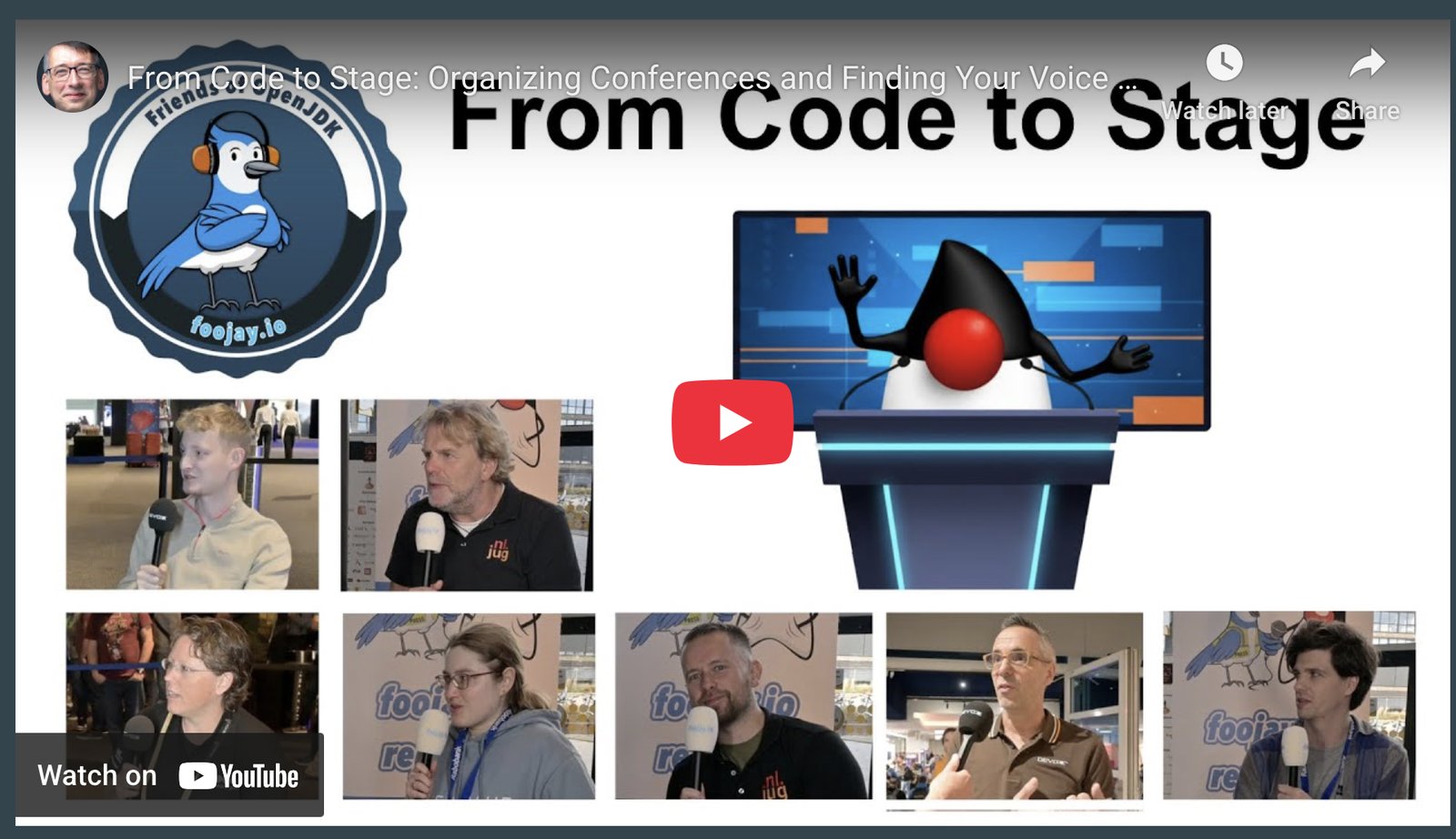
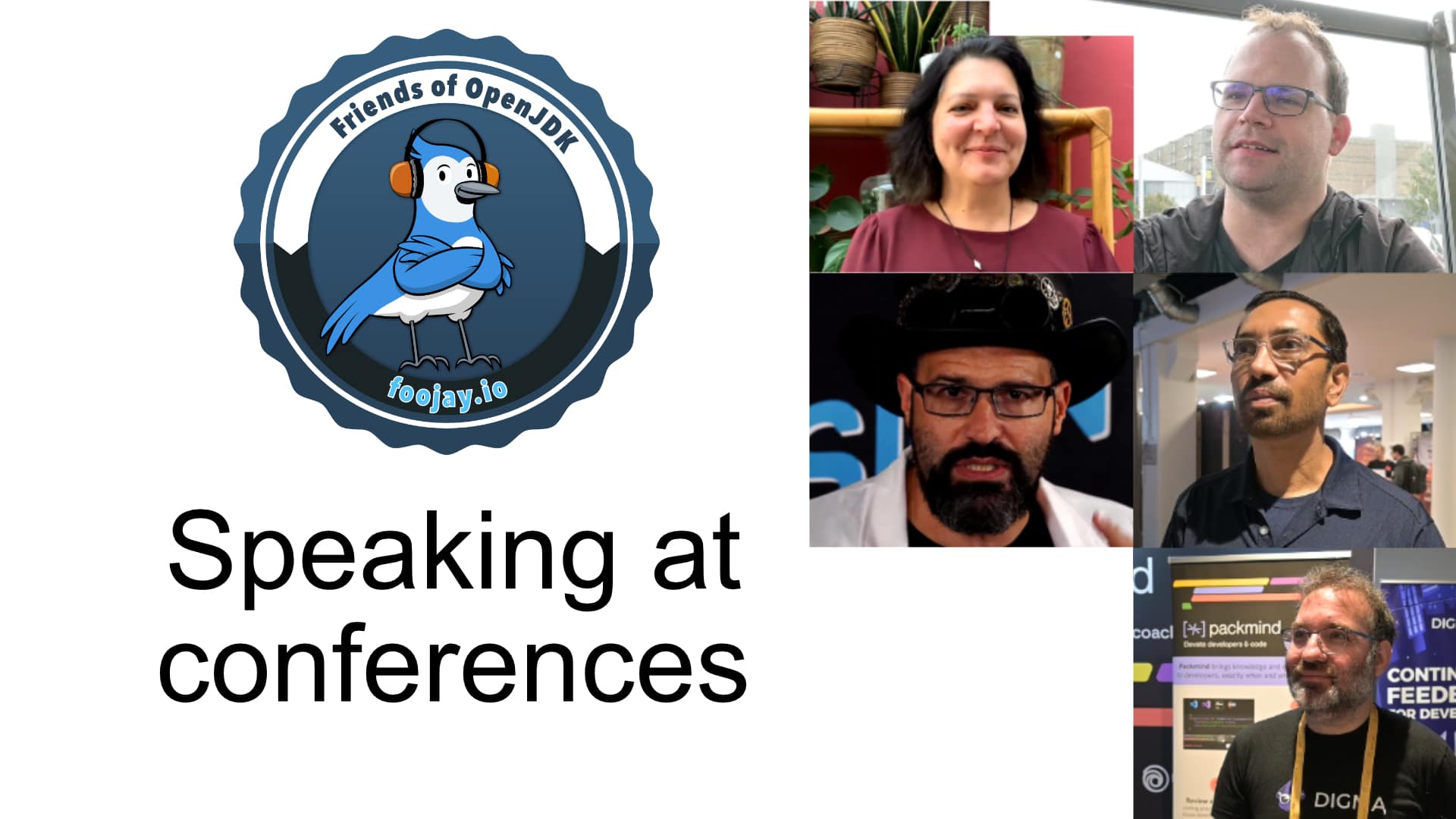
At Devoxx in Belgium, I got to talk to Josh Long, Baruch, Pratik Patel, and Roni Dover, who were on the stage because it was part of their job. They shared many tips about being a DevRel and the many tasks involved in such a job.
I also talked with Clo Willaerts, who inspired me many years ago to become a speaker myself when I saw her presentation at a marketing conference.
Video
Podcast Apps
You can listen and subscribe to the Foojay Podcast on:
- Spotify
- Apple Podcasts
- And most others…
Guests
- Clo Willaerts
- Josh Long
- Baruch Sadogursky
- Pratik Patel
- Roni Dover
Content
00:57 Clo about the difference between marketing and technical conferences
02:49 Impact of ecological cost on our work
04:56 Fast changes in trending topics
07:33 How to get paid as a (keynote) speaker
12:53 Josh about being Developer Relation
14:53 How to reach the energy level of Josh
15:42 Do you have to be an expert about a topic to talk about it?
18:34 How to create a story for a new talk
19:02 Only use slides when really needed
22:29 How hard is live coding?
23:48 Baruch about the DevRel role
24:52 How to move from Dev to DevRel
25:44 The focus of Baruch
27:57 Pratik about the role of a dev team at a conference
29:50 How DevRel influences product development in their company
31:36 How Pratik became a DevRel
32:40 Good and bad of being a DevRel
34:38 Roni about the role of a DevRel
35:54 Importance of using your product (coding) as a DevRel
37:35 Back side of the job
38:43 Tip 1: Ask to be a speaker
39:31 Tip 2: Stand out!
41:01 Tip 3: The show must go on!
42:31 More tips…
48:08 One final tip from Josh
48:16 Outro
Book by Geertjan Wielenga: “Developer, Advocate!”
Transcript
Automatically generated from the audio, so it can contain errors in names and technical terms. Suggest a correction.
[0:00] What do people do that have developer relations as their job title and how do you become a conference speaker you learn in this Foojay podcast welcome to the FJ podcast all your news about OpenJDK at Devo in Belgium I got the chance to talk to Josh long baruk sadoski pratic Patel and Ronnie do who are on the stage because it’s part of their job they share a lot of tips about being a Deval and the many tasks involved in such job but I want to start with an interview I recorded some time ago with claw Willards she was my inspiration many years ago when I saw her talking at the marketing conference K identifies herself as a girl geek and is a well-known keynote speaker you may have seen her on the stage of jring in the Netherlands some time ago I wanted to learn from her what the difference is between a marketing and Technical conference and what we can learn from it to become a speaker well what I have in common is that recently they’re focusing more on the impact so whenever someone comes on stage and then talks about some project that they did or some tool that they’re using until five or 10 years ago you
[1:12] Could get away with you know this wonderful story about a great tool and a wonderful future and then on both I see that if the speaker doesn’t do it the audience will ask a question what was the impact on the organization if you’re selling something did you actually sell more if the goal is to get more visitors did you get more visitors but also about the team how did the team react did they enjoy working with for example this new Tool were you able to keep it insource to Outsource so actually they do have a lot more in common than you think specifically for marketing conferences I think the budget challenge is becoming bigger and bigger every year most organization barely made it through the pandemic and then they landed in a cost of living crisis and had to cut costs and for example in Belgium it is U very expensive to simply fire people so they will be looking at marketing budget so that’s usually that get that cuts cut very easily in the past few years it’s a big challenge when people leave the marketing team there are no new hires so the smaller team has to
[2:29] Take on more tasks I’m not sure if that’s also the case in Java in the Java it depends there are big changes in companies across the globe I think Belgium is not that bad but there are a lot of different countries where yeah a lot of cuts are in teams indeed you mentioned impact what we see at Java conferences lately is the impact on cost indeed but also on the ecological impact if you deploy a lot of servers you have a lot of emissions and electricity needs of course it’s also related to cost the more servers you have the more ecological impact you have but also the higher the cost so lowering your ecological impact also lowers your cost is that something which ripples through through marketing yeah I’ll give you one example so a friend of mine is consultant on the ux level and he told me that one of his customers they had a very successful AI based chatbot on their website and it kind of helped them save a lot of time and effort because this chatbook would take like the first wave of questions and complaints and then very often there were literally
[3:50] Frequently asked questions so aot is very good at that and he took them off the website because since it was driven by AI and AI needs a lot of bandwidth it’s it’s very CPU GPU intensive and U he took it off this customer because he didn’t want to carry the weight of the impact the negative impact on our environment I that to me that was new I mean it’s a very extreme way of trying to battle climate change it was not because the chatbot was promising things it shouldn’t promise probably I think honest now that I told you the story there’s something fishy about it what can one humble chatboard actually change about but AI in general is just like cryptocurrency both of them they’re very energy intensive on a server level and they get criticized for that mhm you spoke at jring in 2020 to about nft web three the metaverse M we are now two years further there didn’t happen did it no they’re gone yes yes but that’s you know when you talk about the future the problem with the future is that we don’t have any data about the
[5:19] Future so all you can do is just you know guess it’s gas work really and a lot of it was wishful thinking from my part because to be honest during the lockdowns I felt more comfortable working from home all the time and not having to drive all the way to Brussels for a meeting and then getting stuck in traffic jams so this metaverse for example I like the idea very much but now you know it didn’t happen nftd same thing I know like literally two or three people who actually made money selling their art and all all the others so lost a lot of money yeah is ating for you as as a speaker about technology that things are so changing rapid rapidly no on the contrary that is I think well I’ll never be without a job it’s the whole and that’s that’s why I’m still in the same business internet and digital for 25 years I get bored very easily but everything internet and digital related reinvents itself completely every six months for example the CH gbt was launched two years ago more or less nobody saw that coming I mean it wasn’t the impact of that nobody saw it coming and it’s
[6:43] Just like the last time I saw something that nobody saw coming that would is like with the launch of the iPhone in 2007 so the whole world changed with the launch of a simple language model so that’s what keeps it interesting for me to talk about the future I am now fascinated by generative y as is everyone of course but its capacity to create videos on the Fly and I think that will open completely new worlds something like Netflix might stream in real time something that is made just for you and that is I can hardly wait maybe I have to call you again in two years to see if yeah you are a keynote speaker you get asked a lot at conferences for a keynote without calling saying any numbers but do keynote speakers get paid at conferences yes they are although there’s a big difference between the Netherlands and Belgium for example the in the Netherlands the speaking industry is much more professionalized than it is in Belgium and if a Dutch conference asks you to come over and speak they will pay you something like between 1500
[8:10] 2,000 EUR without without any hesitation they have high demands though I mean if you mess up on stage they will not ask you again in Belgium it’s I think except if there are two a-listers in Belgium that I look up to the names are Peter hinsen of course and oh damn St of Vell again right these two I mean they are the a-listers and they can easily ask like five to 10,000 EUR for a speaking assignment everyone else you I mean if you get like 1,200 1500 EUR you’re very lucky usually it’s more between 500 and 1200 for a speaking assignment for me however sometimes I do it for free and there are two case I don’t want to you know give any ideas to anyone but there are two two instances where I will gladly do it for free the first one if it’s aligned with my personal interests if it has if it is a conference for example about female entrepreneurs I’m I’m very much interested my volunteering is also in that area female entrepreneurs young entrepreneurs then if I’m available I I’ll I won’t even ask a fee and the second case is that 2025 years ago when I was you
[9:41] Know developing as a speaker and not very good yet and there were a number of conference organizers that believed in me and that would give me a stage and so this one of them is called he called R Vos and there was this social media day 20 years ago and it was one of my first speaking assignments and he’s still organizing conferences about AI for example and he never has to pay me for anything because I’m so thankful for him to give me to give me a chance I’m I’m astonished that like for instance devox in Belgium they have I think 200 speaking slots they have over 800 proposals from people who want to speak for free I think this is amazing in a Tech Community that so many people are willing to share what they know what they learned for free yeah it’s it’s wonderful this whole speaking so you have of course the developer Advocates that’s their job but still there are a lot of people who want to share their knowledge if you’re passionate about what you’re doing then you’re just glad to be there to be honest sometimes I will also not ask for a fee because
[11:02] Backstage you actually meet like the big guys they are there as as speakers you know and I’ve had some really interesting U meetings over the past 20 years people that are really looked up to and then all of a sudden I sit next to you and you could just talk to them as peers so it’s it’s actually quite nice to be a speaker I’ve I’ve always been treated like a queen everywhere I went as a speaker people are really nice and they’re happy that you’re there and to be honest being on stage you can get addicted to the feeling that you get when you get that final Applause it for me that’s that’s one of the reasons sometimes you get this tough audience and you try a couple of jokes and the first joke just flies over like a l balloon and the second one there’s like like two or three people like and then you have to work really really hard I had a couple of audiences like that in the past but when you get that final Applause you actually physically feel it right here I do and that feeling that you get that can be very very addictive to be honest and that’s one of the reasons
[12:20] Of course it’s it’s sharing what I know about my expertise but to be honest there’s also a very yeah like addiction side to it I really enjoy trying to convince like 500 people or a thousand people that what you have been talking about in the past 20 minutes or so that it is something that actually changes them that they are able to take something home with them and that they start doing things differently and that’s that’s also why I’m on stage everyone knows Josh long for his highspeed spring talks filled with life coding and tons of energy I wanted to know how he defines his developer relations role I work in whatever capacity I can to help people do that obviously it’s to find their way towards Spring and for me there’s no single way to do it it’s all about this sort of well-rounded approach right it involves podcasts and YouTube and blogs and Public public presentations and whatever and it’s often that hallway track you know that’s one of the things that I sort of took for granted before the pandemic and then with the lack of it you know you can’t deny there’s some there’s
[13:35] Something very important about the and I hate I hesitate to use this metaphor but there’s something very important about the here in Europe it’s a very poor metaphor I don’t know a better one but you know that boots on the ground experience you know so you got to be there there’s something about being there you know so I guess you’re not a fan of virtual talks look I get why we needed them I’m not saying we did anything wrong I just and very happy to be able to do them in person I think there’s a well first of all there’s first of all there’s a kinetic energy for a speaker and this is a purely self selfish sort of perspective there’s a kinetic energy that you get from being in a room that’s engaged you can see their eyes opening up when they have that moment of epiphany that moment of appreciation for whatever the heck you’ve just said but there’s also just as importantly that moment after you’re trying to pack up and people are able to ask you questions or they can cornate you in the hallway just after you finished because there’s so many questions that are go unanswered
[14:32] And go unasked that would be asked if you if they had the chance to do so privately you know and that’s super valuable because you never know who among those people will end up doing something amazing with this with these ideas or better yet to refine the ideas such that I get something better out of it and I learn myself you know so it’s it’s I really missed that yeah your talks are always very energetic the energy is throwing out of the room how do you do that how do you achieve that kind of level this is well okay this is I know this is going to sound cliche it’s because I like the stuff about which I’m talking it excites me this is why I could not do what my former manager used to refer to as the Josh long show I could not do that for like Cobalt or PHP right there’s no such thing as that I couldn’t be excited about it right I’m kind of a you know in that respect I suppose I’m a one- trick pony you know like I don’t know how to make everything interesting I don’t even know if I’m making the things about which I’m excited interesting but at least it’s exciting to me and
[15:36] Interesting to me and in that I find endless Wells of energy and excitement so someone who wants to be a devel for a certain topic do you have to be an expert the best in this topic so I used to joke that there’s like two people that would come and see my talks I realized very quickly that the things in which I’m interested are by definition not the things that will be the most interesting to most people so I for example I love workflow business Process Management here in Belgium of course you’ve got some really formidable talent in that respect you’ve got a the flowable team of course and that eventually ultimately spawns from the jbbm folks Tom bayans and yuram Barz and so I love workflow big I’ve got a long long background in workflow and I also love messaging and integration so we have we’re at Devo Belgium there’s Gregor H who’s the sort of father of Enterprise application integration right he wrote the book it’s a quick 1,000 plus Pages book it’s riveting riveting read right you keep it under your pillow read it to the kids and so I love both of
[16:44] These things the number of people that love integration is not huge the number of people that love workflow not huge both groups by the way they’re not wrong if you need those if you have those use cases then of course you’re going to be enamored with that solution because it works very well I don’t know anything that does those things better but the VIN diagram the intersection between those two is like me and one other person like there’s nobody there’s the group of people that care about both those things avidly at the same time very small group so the talks that I as an expert in those things would like to give and would like to watch Are by definition not very successful in the sort of Norm in the large you know so I think it’s quite the contrary I think actually people forget they take for granted that there are always are going to be New Comers to the technology and so quite the opposite if you want to be successful find something that speaks to as large a group of people as possible you know and that will always by definition be the non-expert stuff right that’s why in conferences
[17:48] They categorize you a lot of times they’ll ask you to submit a talk and it’s beginning middle and expert you know and you know there’s a room for those expert talks but you can expect to be in a smaller room room you know and in the same vein I think it’s very useful to start all my talks at the absolute simplest level with no tricks up my sleeve I start with no rabbits up my sleeve no nothing and I by the end of the talk I’m very thoroughly in the deep end of the pool so to speak you know I’m I’m doing my best in whatever topic I’m covering to sort of bring the depth that I can but I start with nothing I want that to be so I try and make every talk you can start as a beginner and you’ll end up an expert as opposed to you need to be an expert to ride the ride and then you end up more of an expert you know so having a very good story and a timeline of your story is important before you can start writing on a talk yeah I mean well okay that’s so the when it comes to writing a talk yeah there’s a I like a through line I like a good story very important to me I don’t know how to
[18:49] Tell a story without a story right because remember technology is itself very sterile it’s it’s antiseptic it’s there’s nothing interesting about it in of itself right and I don’t use slides I mean I’ve used slides before like to show my name and the title of the talk for example that’s a slide and then maybe I’ll have a slide with about my book you know if I’ve got a book or whatever on offer but most of the time I don’t I certainly don’t use my slides to communicate the story I’m trying to tell and it’s not that there’s anything wrong with the slide I think they’re fine in some channels but if you’re talking about software it just seems to me you could just talk about software U on the other hand that and the reason you can talk about software and show software is because you’ve got a computer in front of you it’s a natural home for software is the computer on the other hand if you’re doing a presentation about like open heart surgery well not everyone can have a patient live in front of you to demonstrate clinical practice right it’s use a slide it’s going to be easier
[19:50] Right there’s a point at which this doesn’t work so okay so I don’t use slides for my things because I can show the software I also find slides are limiting I do a lot of presentations and you don’t get good at what you’re doing without lots and lots of rehearsals and I’m not good yet so but my theory is that if I keep going they’ll be good and having slides forces you into a rhythm into a framing into a story arc that is inflexible and a pain in the butt to re to refactor to reor you know so I will have an outline on a text file somewhere and an outline in the text file is you know it’s the opposite of Microsoft Word there’s no structure to it there’s no rigidity I can just cut and paste and move things around and tab and space and rework the story or just delete it very quickly there’s no you know I want this to be as as friction free as possible I don’t want to feel any investment to a particular structure and so I use a text file and I’ll just eventually I’ll just remember the beats the notes the items in the text file in which case I don’t even I don’t even
[20:50] Need the text file you know and so if you’re going to use slides I my sense of it is that they should be visual there’s if they’re going to be bullet points or if they’re going to be text then just send me an email you know don’t don’t show slides and if you can’t send me an email then if you’re going to be the speaker on stage and your showing slides have the decency to be quiet have you ever sat there tried to read something while somebody’s talking to you it’s very hard to focus on what you’re reading if somebody’s talking to you right so if you’re going to show people slides in your slides you have to be quiet at which point one wonders what is the value of having you on stage at all as a speaker when you can’t speak because the most efficient way for you to communicate your ideas is via the text that you’ve displayed on screen so my thinking is either be good at speaking or don’t bother with the you know don’t bother with doing a talk right and so then if we agree that you shouldn’t be talking while showing text then maybe maybe don’t show the text okay so what do you use slides for then
[21:52] Use it for visuals and in my case I happen to be lucky enough that the visuals I chant upon that I want to show usually they respond to URLs on the internet so I just keep bookmarks so now I have no reason for slides like unless I’m building like a complex animated diagram or whatever in which case I grant you that might better be communicated via you know some fancy powerpointing or keynoting or whatever but even there I use I just use After Effects I have animation software but again I grant most people won’t have that use case so I don’t know I feel like slides really are completely pointless for 99% of the talks I want to do except for the visuals and even there I find those in the internet you do a lot of Life coding only because I want to show code yeah is that not next level is that not difficult to be afraid to make mistakes I mean I’m I don’t well of course I’m afraid to make mistakes right but again this goes back to what I just said a minute ago I couldn’t do the Josh long experience in cobal or you know j2e from 20 years ago I couldn’t these Technologies don’t Grant
[22:58] Themselves to efficient conductive fast-paced presentations on stage right are you work in Spring and spring happens to be really good at this it it’s fast and productive that’s the whole point if I were doing PHP it would take weeks to do anything useful you know and so I don’t I just don’t that’s the whole point is I I’m not an idiot I I’m am terrified of making mistakes I use something that makes it so that I can get a lot done very quickly you know and then sure after that is true then of course there’s still a function of you know do you remember what you’re doing and like I said that that’s keep that text file with your bullet points somewhere and eventually you just won’t need it it’ll be it’ll be a life draft you don’t need anymore you know you can swim but it’s always there in the background you know I always keep it it’s on my phone if I need it somewhere you know baru was at devox with his built propulsion Lab live studio which I took over to interview him I had the same question what is the role of that Ro first of all there is no such profession as developer
[24:02] Relations developer relations is the area of multiple professions in it I’m doing developer advocacy which is part of develop relations as people love to think highly about themselves I would say that it’s the most important part of developer relations H but yeah it’s it’s definitely a part of it there are others there all the community work that people do there is an engineering aspect that you can do fulltime if you wish there is a documentation and everything has to do with that and then based on your organizational structure people stretch develop relations to even stuff like platform engineering like sorry partner engineering and this kind of stuff so developer relations is a lot very broad yeah yeah if someone wants to move from being developer to more being a relation developer how do you do that how do you start with becoming a devil yeah so again first of all you need to understand what part of Deval you want to become right and if we’re talking about hey you want to want you want to be developer Advocate that’s the natural path of I would say software engineer that is a little bit of
[25:17] Extrovert a little bit of out there loves to a maybe present Concepts talk with people maybe L loves blogging or do L to video this kind of stuff this is very natural progression for a software engineer to become de a developer Advocate which is obviously a part of developer relation and what’s your focus yeah so that’s that’s my career PA as well I started as I started as a developer many many years ago in the early 2000s and then did a couple of conference dos and a couple of blogs and my former boss and my mentor the co of Jeff frog schoi he was like hey bar I want you to try yourself in this new area and you know now 13 years later I’m still doing it and I guess he was on point and as he usually usually is it’s fun if I look around to what you have with you as stuff here to make these recordings I think you’re also a bit of a nerd loving this kind of stuff is that not a very fun part of being this kind of task that you can combine writing code with going outside and combining your what you love to do and make it your own type of profession absolutely you are on point I love this
[26:54] Because because it’s exactly that it’s a lot of things it’s everything and if you love this kind of combination of writing code but also talking to people dealing with technology and you know here with our setup we setting setting cameras and lights and AV and all this kind of stuff so this is fun always try new things speaking with people here at Devo for example I’m doing I think about 20 different interviews with speakers and every interview is like a new new world right one day we’re speaking about generative AI the next thing we’re talking about web assembly and then we’re talking about containers and about devops and it’s it’s it’s everything and it’s very very exciting so yeah this is a part of it if you’re excited about this kind of a fastpac doing everything developer advocacy in particular and develop relations in general might be definitely something for you PR Patel who is the developer relations team lead at aul explains to us the role of his team all right so what we do is we do a number of different things we produce content videos we go and talk at conferences
[28:11] Like devox I give presentations and we also we’re at the booth we have a booth here we also explain to the developers who are coming by our booth about what aul does and what benefit we provide to developers so as a developer relations person you speak a lot at conferences which is a 1hour job which means the rest of the conference you’re talking to people yeah so that’s a good question so aside from giving a presentation or a workshop you know a presentation might be 1 hour Workshop would be like maybe half day or full day where you get Hands-On so we do that all that stuff but one of the reasons we like coming to this conference is because we get to interact with developers we get to understand what they’re doing you know what are the projects that they’re working on you know what are the things that they’re interested in and then of course we get a chance to talk to them about like what we do at AO systems how we fit into the JVM space so for example earlier today I was standing at the booth talking to some folks who are Java devs and I was explaining to them about
[29:14] This code inventory tool that we have for Java developers which allows them to see what code that they’re actually running down to the method level on production and how it can help them reduce technical debt and help them with maintenance and stuff like that so you know we explain them about the products or sometimes it’s we just talk to folks about you know I was having conversation with folks about how they’re looking at AI to use with their Java project right so it’s it could be a number of different things you know it’s mostly just like tech nerd talk and just kind of connecting with developers and you know having a nice conversation with them so okay so that’s one side of the job you talk to the users but actually what I didn’t handle yet in the podcast is there some some way that you bring back this information to the company to the people who are developing your product yeah that that’s a great question so the developer relations team at Azul is under product management so we’re not in marketing we’re not marketing people even though we do stuff for marketing like write articles and
[30:16] Stuff like that a lot of what we do is we’ll talk to somebody and they’ll say hey we really have this thing that we’re having trouble with right on the JVM or with their application or whatever right so what we’ll do is we’ll we’ll take that we’ll take some notes on that you know we we’ll keep in touch with that person and after the conference we might contact them and say hey remember that conversation we had about this paino that you had When developing a Java app so we’ll take that and we’ll distill it down and take it to the product owners at aul and say oh we met someone and you know they’re really interested in what we do with code inventory but they’d also like to see like what libraries are used in production for example right and so we take that information back to them and provide feedback to the product manager for example for aul core zul prime or zul intelligence cloud and say someone someone was interested in this and then we kind of are the glue between the developers out in the world and the product managers inside our company so we help also shape the direction of the
[31:19] Products by providing them feedback from the developer Community okay what I already learned is that there are different parts leading to a role as a developer relations person the role itself is also very different for every company what’s your journey how did you end up in the job that you’re now doing yeah that’s a good question so long time ago I started to give presentations at u a conference circuit in the US and so I was used to like you know presenting in front of people and stuff like that while also working just you know regular devel architect kind of role and then in probably about six or seven years ago I was approached by someone to start a developer Java and Cloud developer relations team and I was like you know what it sounds like it might be fun I’ll try something different for a while instead of just doing architecture and coding and you know leading teams so that’s how I got started in that right it was a long long time ago just talking to developers about or you know doing presentations and training actually to be specific training on you know how to
[32:27] Do G you know how to tune garbage collection in Java for example or how to do performance profiling for Java applications Etc so it kind of naturally led to that point for me so you’re now in this role what is the good and what is the bad side of being a developer relations yeah the so for me the good or the fun part is being able to talk to people and you know hanging out with folks and you know doing nerd talk with people with developers and seeing all the cool cool stuff that they’re working on the bad part is it can be a little bit overwhelming at times because there’s a little bit of travel obviously involved with some of these things and the bigger thing though is as a developer relations engineer or developer Advocate you have to wear a lot of different hats so on any given day you might be writing code you might be looking at a customer specific issue you writing an article might be producing a video you know there’s lots of different things so there’s lots of different kinds of things you have to work on a continuing basis so just trying to keep
[33:33] Like all that organized and having to switch hats from you know now I’m going to like be heads down coding for the next three hours oh I need to finish this article today and then you switch gears and you know you’re writing an article so it’s that’s a it’s not necessarily bad but it can be challenging you know you have to be as they say in English you have to be a jack of all trades right so it’s not just you’re not just focused on one or two things you’re you have three or four or five or seven things that you have to be good at to be successful as a developer Advocate developer relations engineer so it can be challenging but would you advise it as a job yeah it’s a good question it’s I think that it’s not for everybody because again it’s if you’re like the kind of person who likes to stay focus on one or two things and do them really well it can be a little bit difficult because you have to contact switch a lot and you know use different parts of your brain and all those kinds of things right but if you’re the kind of person who likes to you know is likes to talk to people
[34:29] And like you know have have empathy for developers or just people in general it can be a lot of fun it can be very rewarding for sure so Ronnie do CTO of digma is traveling around the world to promote his company and of course I also asked him how he looks at the tasks of a devoll so first of all it’s the absolute opposite of everything that I used to be before this is kind of as much out of my comfort Zone as I could imagine like my preferred way of passing the time would be actually to sit with the code and kind of work long into the night but it was actually an amazing opportunity to try something else for a change so over the last year or so I’ve traveled a lot talked to a lot of amazing people and I think overall and I’m kind of being very biased here you cannot be a successful founder you cannot be like even a product manager if you don’t interact with the community a lot and it’s not like one conversation here and there it’s like prizing your message carrying across and getting a lot of feedback so I’m very grateful for the opportunity to being able to do that for the last year
[35:52] Or so being in some kind of developer relations job doesn’t mean you’re not coding anymore should you even be the best coder of the company I gave up on being the best but I certainly am opinionated I think like many developers are I think it is important as you said to have a balance between these areas so if you’re a Dev Advocate and you’re not Technical and you have lost touch with code you’re not going to be a very effective Advocate because you’re not speaking out of you know From The Trenches lessons that were written and you know pain and this is something that will carry your Authority across and will allow you to be genuine and I think what is different today especially since we have so much AI generated content is that people are much better at Discerning what is genuine and what is plastic what is artificial so you will not be successful in kind of getting people to take a notice of what you’re saying if you come up and what you’re saying is messaging from your marketing team that’s maybe yesterday’s way to be a deal I think today you actually need to have kind of
[37:14] Gone through the same processes and also come to listen not just to speak and I think that’s that’s a really important part as well a lot of devs kind of think yeah we’re spreading the word spreading the message no like more than half of what you’re there to do is actually listen to what people are experiencing right now so getting into contact with your end users your developers is probably very great thing what I for my opinion looks bad at the job is the traveling being away the whole time being in the plane being waiting is that not the backside of this job it’s definitely not fun I don’t know some people love it like they love spending time away from home and going places and so on for me it’s kind of what I need to do it’s it’s a necessary sacrifice but at the same time you gain a lot of relationships you gain a lot of amazing people I’m I’m coming back to devox this is like my second time in devox and I can just look back at all of the people I’ve met the first time around that I’m still in touch with today and a lot and that I’ve learned since then because I’ve been in contact
[38:31] With so many amazing people so it more than makes up for the fact that yes you stay at hotels and you kind of go through long flights it is what it is let’s go back to my conversation with Klo for the top three tips to become a good speaker well the hardest part is getting on that stage being being asked and my first tip is do not wait to be asked no do not wait to be picked for anything in life because if if that’s what you do you put the word speaker in your LinkedIn description and then you wait to be picked you will not be picked and so you have to actually and I know it’s a cliche but you go to conferences and if you feel that you should be there on stage find the organizer and tell them it’s as simple as that organiz will constantly be looking for new speakers and my second tip is the less you look like the average Tech conference speaker the better for example they know they are aware of that U when I started speaking 20 25 years ago I was literally the only female speaker literally and if if you there’s a lot of good female speakers but they’re very
[39:56] Much Limited and I hope I’m wrong but to the work life balance and topics there’s not a lot of tech related female speakers and I am aware that is one of the reasons that I get picked but if you are for some reason not the average 50 plus year old white guy wearing a suit you should consider that as your most important asset so if you don’t wear suits for example if you’re not I don’t know whatever you look like you’re you’re the way you’re built is completely different you might even have something funny in the way you speak you might be able to sing or dance it doesn’t matter just don’t please don’t look like everyone else it really really helps and if you have to wear like bright green glasses and red shoes and you feel comfortable in it just roll with it mhm it will make you stand up so my third tip is that whenever you are on stage remember that whoever is going to hire you next is probably in that audience so that’s where recurring business comes from someone was in your audience and they remember you because you were good so that’s the attitude you
[41:22] Have to have so even if all sorts of technical issues shoes and they do happen you know you can train yourself to just roll with it doesn’t matter really never blame it on the crew just do your utmost best even when the lights fall out the microphone dies someone bges in the police comes in I’ve had all of these things happen to me what did you do wrong that the police came in it was they were not there for me okay but they did actually The Show Must Go On and your show must be a good show yeah it’s it’s a it has to be a good show no matter what yeah if it’s your fault not your fault that something go wrong don’t blame it on anyone else Show Must Go On especially when it’s in live streaming it’s very annoying during a live stream if if someone you know the cat might walk by it doesn’t matter train yourself to keep calm and then show must go on no matter what yeah so those are my three tips and it’s and the rest I think most people already know the more you do it the better you get at it yeah that’s it’s as simple as that you might start small or you might start big it
[42:48] Doesn’t really happen but your first like 10 or 20 FS that you will suck but remember that most of the things you do are technical you can learn techniques it’s it’s it’s like a circus act what you’re doing for example how you enter the stage and how you leave the stage these two together and they’re pure Show Business tricks you know but these two together are like 80% of your show how do you end the stage how you enter the stage and how you leave as well so I remember I had to speak at a conference for government officials government officials 900 of them and the four speakers before me they died on stage because the engagement in the room was like zero zero so and I was number five the speaker before me had sat down on a chair and read from a piece of paper that’s like the worst thing you can do so that was the one in front of me so I was backstage and I was thinking wow that’s GNA be a tough one but the stage manager was a Dutch guy and I know that it’s a cultural thing the Dutch guys they D to experiment a lot more than the flamish ones in my experience so I could see that if I would asking something
[44:20] Crazy he would be willing to go with it so I was wearing high heels and that’s a very important detail I asked him when my name is called can you literally push me on stage so that I would like stumble stumble on stage and people could see him you know his arms they could see his arms like pushing me as if I was not paying attention or didn’t want to be on stage and I managed not to break my legs but it was that was how I stumbled on stage and I could see the whole room just perk up jump up and they paid attention from then on also how you leave stage is I remember that Elvis Presley one of the greatest show business Professionals of all times he always got a big Applause the only the way he did this is that he asked for it he always ended with thank you very much that’s literally how he ended every show thank you very much believe me if you say thank you very much I’m I’m not going to wear the heels at my next talk but I ask for the Applause then something I will do yeah heels are great on stage you know I in h my regular life I never wear any
[45:50] Heels never wear makeup but on stage it does make a difference what you wear but you have to feel comfortable in it right but what you wear makes a big difference and it’s very tempting to wear all black but that’s not always a good look you know heels heels help dress for the occasion dress for the occasion yeah I want to add one tip you mentioned try to get invited for the yava developers we have the luck that we have local Java user groups small events where people gather to learn from each other that’s also a really good starting point if you want to become a speaker try it out and join one of these these local JS or ask on LinkedIn because your audience just like mine is very much active present and active on LinkedIn one of the most underestimated social media platforms I think and typical falling T is that when you openly ask for input is that people will actually post some very decent things the comments on link very you know there’s a lot of quality in there so if you ask we’re still looking of for two speakers for this conference
[47:09] Who do you recommend and then in the comments and they will already tag these people they will mention them in the comments and a lot of these will already DM you so I think just ask on Linkin from your profile and you will get a lot of good names okay a lot of good tips thanks a lot thanks a lot for sharing your experience maybe something you want to add still well I would like to plug My Weekly Newsletter it’s called chaos and amazement chaos and amazement is a Weekly Newsletter that I’ve been sending since June 2018 and it talks about the impact of digital technology on our daily lives it’s on substack great platform sub sub.com you just put clo arts. sub.com so just my first name last name clo arts. sub.com and then you can see the previous editions if you like it you can subscribe and I have one short final tip from Josh aim high don’t be like me do a good job instead it’s you can do it if you want to learn more about this topic I can advise you the book of hean willinger the father of the Foojay website for his book developer advocate he interviewed 32 professionals about what
[48:28] It’s like to turn a lifelong passion for knowledge sharing about tech into a rewarding career thanks for listening or watching this podcast and thanks to my guests of course keep an eye on Foojay for future articles and podcasts about the development and everything related to the Java World thanks give me a give me a j give me the friends of OpenJDK
Found a mistake, or something to add? Edit this page on GitHub

Frank Delporte
Frank Delporte is a Java Champion, Java Developer, Senior Technical Writer at Azul, Blogger, Author of "Java Programming for Raspberry Pi - A Hands-On Guide to Electronics and IoT Projects", and Open-Source Contributor for Pi4J, Lottie4J, Sheetmusic4J, …


Roni Dover
Afflicted by an acute Product Manager/Developer split personality disorder that was never treated. Currently, CTO and co-founder of Digma (digma.ai), an IDE plugin for code runtime AI analysis to help accelerate development in complex codebases. A big believer …