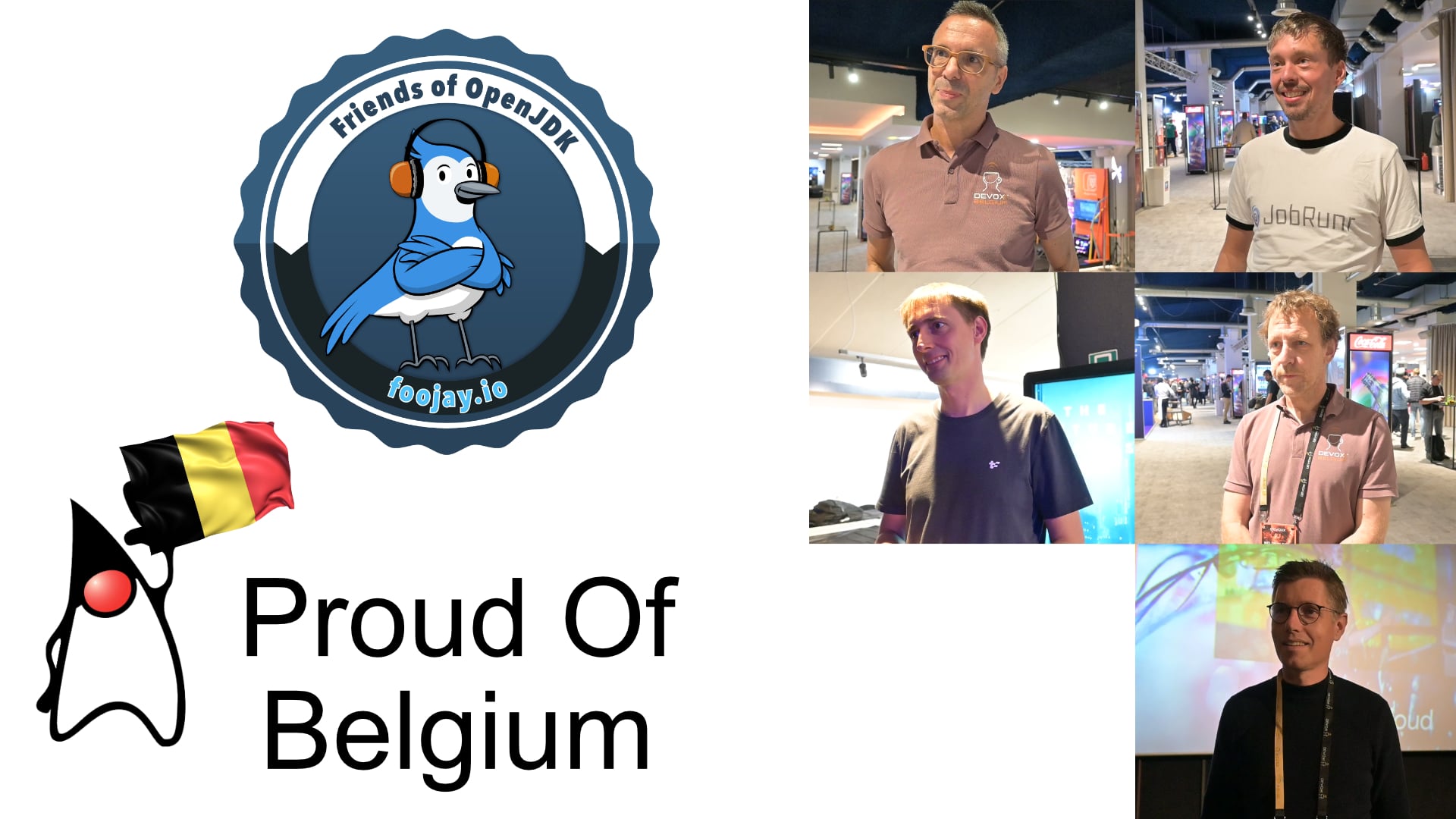
Foojay Podcast #60: Proud Of Belgium - Devoxx, JobRunr, Timefold, OpenJDK Mobile, OpenJFX, Thymeleaf, htmx,...



 2 min read
7,148 views
2 min read
7,148 viewsBelgium might be tiny, but we have a strong Java Community!
As I was doing interviews at Devoxx in October, I met several of these people, and we talked about their projects, how you can get involved in OpenJDK, and maybe even start a company out of it.
This podcast will teach you more about Devoxx, VoxxedDays, Devoxx4Kids, JobRunr, Timefold, OpenJDK Mobile, OpenJFX, Thymelead, htmx, and more!
Video
Podcast Apps
You can listen and subscribe to the Foojay Podcast on:
- Spotify
- Apple Podcasts
- And most others…
Guests
Stephan Janssen
- https://www.linkedin.com/in/stephanjanssen/
- https://x.com/Stephan007
- https://www.devoxx.com
- https://events.voxxeddays.com
- https://www.devoxx4kids.org/
Ronald Dehuysser
Geoffrey De Smet
Johan Vos
- https://www.linkedin.com/in/johanvos/
- https://mastodon.social/@johanvos
- https://x.com/johanvos
- https://gluonhq.com/
- https://github.com/openjdk/mobile
- https://github.com/openjdk/jfx/
Wim Deblauwe
- https://www.linkedin.com/in/wimdeblauwe/
- https://x.com/wimdeblauwe
- https://www.wimdeblauwe.com/books/modern-frontends-with-htmx/
- https://www.wimdeblauwe.com/books/taming-thymeleaf/
- https://www.wimdeblauwe.com/projects/
Content
00:00 Introduction
00:47 Stephan Janssen about how Devoxx started
02:22 Difference between Devoxx and VoxxedDays
03:47 About Devoxx4Kids
04:22 Sponsors are needed to keep the entrance fee low
06:26 About the speakers and CFPs
07:11 Important Belgian Java people and tools
09:08 Ronald Dehuysser about JobRunr
10:00 How to turn an open-source project into a company
11:09 Reviewing and validating the evolutions in Java
12:35 Importance of conferences
13:23 How government support can help a startup
14:02 Challenge of starting a company…
14:40 Geoffrey De Smet about Timefold and the challenges in scheduling
16:47 How AI helps to find the best schedule
18:34 How it started as an open-source project (Optoplanner)
19:06 The challenges of growing Timefold as a company
21:26 Visiting conferences as a “yearly training”
22:36 Johan Vos about OpenJFX and how he got involved
24:49 Everyone can contribute to OpenJDK and OpenJFX
25:50 The goal of the OpenJDK Mobile project
29:33 About the Belgian Java community
30:29 Wim Deblauwe about Spring libraries and books
30:50 About Wim’s Thymeleaf and htmx books
32:08 How to get involved in the Java community
33:06 Goal of writing a book
33:40 Wim’s involvement in the community
35:08 Outro
Transcript
Automatically generated from the audio, so it can contain errors in names and technical terms. Suggest a correction.
[0:00] Belgium might be a tiny country but we have a big Java Community welcome in this proud of Belgium podcast welcome to the f j podcast all your news about OpenJDK I live in Belgium and I’m proud of what’s happening within the Java Community here as I was doing interviews at devox in October I met several of these people and we talked about their projects how you can get involved in OpenJDK and maybe even start a company out of it in this podcast I have for you Stefan yanson about devox Fox days and devox for kids Ronald theer about Job Runner jeofrey desmat about time fault Johan Vos about open jfx and OpenJDK mobile and last but not least whim the blower about his books let’s start with stepan jansson the founder of the devox conference which started in Belgium already many years ago yes 21st Edition over 23 years we had to skip two years because of Co but yeah it’s just crazy I mean 20th Edition and because of Co it was clear for me you know I’ll I’ll just love doing this and I’ll probably continue doing this until I drop that on stage that would be the nicest way to go is like just drop that
[1:13] That’s it finished game over maybe even on a live stream yeah exactly you’re here in the podcast because this is an addition About Belgium devox is a very important brand or an event within the yaa Community correct well I think so yeah I mean it all started with the for me with the Belgium Java User Group which now luckily Tom kls is taking over which I’m really happy about thank you Tom but yeah it started like that with the team we did like every month we did like meetups and then we want to do a one- day event and we had like 500 people attend and then we’re like oh we should do a bigger event like every year which Java pool is started in 2001 and that has grown up to now 3,500 people 5 days and even more there were other Java User Group they’re saying like wow devox that looks really like I would love to do that in my own city so we have now devox France which is actually the biggest one congrats Antonio they have 4,500 atanes but it’s more a French event but we have like in Greece in Poland in the UK we used to have one in Ukraine and I’m I’m sure I’m missing one but yeah it’s all over
[2:20] The place I think we welcome about 20,000 developers every year over the different Dev voxes and VX days because we also have VX days events which are the smaller events yeah so how did this happen so you have the devox conferences multi-day events and Vox days what is the IDE they’re smaller yeah so what happens is that people come to this devox event and they go wow I love it I want to do this as well and then they go like but have you ever organized with your user group in event and they said no well maybe start first with a smaller Java user group see if there’s a community and then you can if you want to you can do a Vox days and so Vox is the anagram of devox which allows you to actually it’s like like an incubator it’s an incubator to see if there’s a bigger enough Community you can use all the tooling that we have the brand you can use it’s a franchise model and once they reach a thousand people and it’s multiple days they can Rebrand it to a devox so for example Greece it started in Vox days Athens and they’ve reached a th000 people and now it’s theox Greece we have a special in
[3:21] Belgium we have the combination yeah true well it was AA who really wanted to do Vox days in Brussels and I said as long as you stay six months away from Belgium so we don’t compete with each other you can have also a Vox days because normally Dev Vox is it’s exclusivity on country and a Vox days is exclusivity on a city that’s how it works basically so we as a Belgian yava Community have the luck that you have two events we can join per year yeah you do and the other thing we started was like Devo for kids which is also a beautiful you know franchise so to speak it’s a nonprofit I think we have a nonprofit in Africa in Europe in North America and that’s already 10 years that that’s been going on and that’s Danielle Duca who does an amazing job and we get support like from Banks from in and hopefully belus might join us as well but they really support it because they even use these open-source workshops for children for their own employees children so it’s a really nice way to get this stem movement where they actually are starting to play with robots and code Etc we have here in
[4:23] The background the conference space with a lot of sponsors it’s quiet now because venot is talking and other very popular speakers how important are the sponsors for an event like this it’s it is really important I mean thanks to all these sponsors we can really keep the entrance fee as low as possible so without them it would be much more expensive because it would not even be Break Even so having these sponsors from a financial point of view really important to have the entrance tickets low but also it’s the opportunity for them to show what products what services they bring and it’s always interesting to know you know the new tooling Etc so it’s it is the commercial aspect of it but it is like with intellig for example you know you can talk to the engineers you can talk to the Google or Oracle Engineers they’re here so you can really discuss and ask questions so you have that first line contact which is very important Yeah you mentioned some banks which are Belgian but most of the people here with the boot are not Belgian no it is really International I mean
[5:24] We’re one of the biggest Java conferences I would say in the world now so they really want to be here and they come from all over the world same for the attendees it is really an International Event compared to devox France which is more a national event it’s all in French here it’s it is really more International like the atendees I think in general we have it from 45 different countries even from Japan and South Korea and things so yeah yeah someone asked me how much of the group is Belgian you have any ID it’s roughly I think it’s about 45% is like Benelux and 55% is like nonbu roughly but the problem is we’re sell out in a few seconds so I don’t really do any analysis it’s like we’re going to sell out so you get a bit lazy on that level where you don’t look like where should we go do marketing we don’t do marketing anymore because the tickets sell out in two seconds literally two seconds you’re doing better than tomorrow land looks like it but it’s a smaller scale of course but nevertheless it’s a very positive problem to have I always say it’s easier to get in devox as a speaker than as an attendee it sounds
[6:31] It sounds to look like that it’s yeah it’s it’s just scary but even from the speaker point of view I think we had about 7 no 650 speakers submitting about 900 proposals and we only can allow or we only select 200 speakers only you know it’s still a big chunk but the beauty is that we get all the engineers from the top companies submitting so the competition is fierce and the quality is like I get goosebumps really because like you have vent card you have nikai you have Victoria even Gregor hope now I mean we get the best Engineers talking about what they’re passionate about so that’s really an honor to have that okay you mentioned a lot of names can we focus on a few Belgian contributors Java programmers companies that you’re proud of Absolut well the things that come in mind is the people’s tools that we’re using for example opap pler which is now being rebranded to timeold by Gregory I mean we’re using that of course to do our scheduling of the conference and I’m very proud like Gregory is really jofrey sorry is really moving it to the next level I mean he’s like
[7:38] Starting to employ people even Tom CO’s just joined so he’s doing an amazing job so that’s I’m looking forward to the public offering when they go public but then they also have job Runner which we’re also using so what I try to do from Ronald is that I try to use also the tools that are driven by Belgium and get it included in the tooling that we use here in B in the defox cfp for example because they you can have meetings with them face to face you know in antw or in Gent or in Bru so that’s that’s nice but you also have quite a few Belgium speakers which I really try to get that mixture of be a bit chauvinistic as well is try to get some new faces in and if possible from Belgium so they get the honor to actually get on the stage and it’s often their ticket into the devox franchise where they can speak a lot of it like for example from on I always mispronounce their name but lck manette he does a great job on talking about angler we’ve got the spec lead on HTP 3 Mark something I’m really bad with names but he’s here he’s here as well so we got quite a few Belgium speaking
[8:47] If the guy from t Team fall it team leave and so on sorry we exactly so we do try we it is a focus point for sure to get some some Belgium on stage and for them once they can say hey I spoke at devox Belgium it really opens up doors at other conferences so I’m glad to help so Stefan already mentions the names of my next guests here is the next one Ronald deher founder of job Runner is a scheduler which allows you to distribute any kind of task either directly now or sometime in the future and distribute those TS over many servers you start it because you needed it for a project you were working on yeah I saw that often because this Distributing of tasks needs to happen but it often doesn’t generate any business value for the End customer so it’s often hecky hack D and I thought in the end yeah let’s solve this once and for all took eight months off and went into my basement to develop it and yeah that’s when I opened Source shop Runner so you open sourced it but how do you earn money you have kids you have a family you have even people now working for you yeah so
[10:07] Originally the idea was to create a pro version so I could take out my wife for dinner once because yeah she allowed me to work for eight months in my basement almost but that started to grow grow grow and now we have indeed four we are with four people in total the fifth one on boarding hopefully soon and we 50 customers awesome customers all over the world so I really like the idea that you can actually build something in your basement or your living room yes share it as an open source project and still because that’s the trick or the pain point of Open Source how do you make money out of it well the pro version offers more features and those features are some customers wants to pay for them instead of developing themselves so and then there is also of course if they have any problems they can ask questions they have more priority support than open source users you’re a big fan of java your tool is also built on Java how do you look at the evolutions of what’s now happening in Java I love it I love that it’s a release every six months now I love it
[11:21] That it’s going so fast the virtual threats and the concurrency is really important also for us because in we need to work still on Java 8 I’m afraid but as soon as you’re on 21 we switch to Virtual dress of course I like what’s going on and the community is the thing that amazed me the most to be honest I was in your presentation yesterday the workshop you also mentioned that you evaluate the new features coming in the next Javas can you explain a bit about that yeah yeah so Oracle reached out to ask whether to test new JDK releases so that they are sure that they don’t break anything and we are sure that we still work on the new JDK releases and this allowed us to test virtual threats for example already back in 2021 when it’s was not even preview and yeah it’s a really nice collaboration where we just say hey all our test are still green on JDK 2324 soon and we sent them an email and they know okay this has been validated by other users than us just to make sure that things keep on working you’re the founder you’re the developer you’re the devil now how important is being at a
[12:41] Conference like this to be honest I think for me everything started at a conference I was allowed to speak at Spring iio in Barcelona and there one of my first customers decathlon was also had some developers over there and by speaking at the conference and showing that you have some maturity it really convinced some some people and stakeholders to take the pro version so the community building the getting to know these informal talks that we are having often this is are the ones where yeah friendships are made and deals are closed about deals so I call this podcast proud of Belgium but actually you have some sponsoring or some funding from the governments to share the knowledge about Job runner at other countries yeah yeah so last year indeed we got some extra subsidies it’s called indeed that we and this is also something I really like of being a Belgian based startup subsidies to go promote sh in the US in Spain in Oslo so they give you a travel budget to go speak and all also other budgets if you can show the value that it brings to the
[14:02] Company you’ve taken this big jump of building something yourself and building a company out of it is it something you would advise to others try it if you really have a good idea yes but be prepared of what’s coming if you because the things is happening that I never could dream of it’s been long hours working long hours you have customers calling on a Friday Saturday night sometimes stuff that you don’t always have to deal with when you are just an employee so yes but be prepared of the consequences if you want to do this as we heard before the schedule of Devo is generated with time fault Jeoffrey desmat the CTO of time fault explains what his tool can do timeold solver is an open source solver to solve planning problems and we are now also releasing our platform which is just a rest API where you sending a pln problem and you send you back the solution so it helps me to schedule classrooms and classes in teachers yeah you can solve any kind of planning problem with it for example field service routing where you want to assign a number of technicians who drive on the
[15:14] Road to figure out which technician does which job and in which order or you can do shift scheduling with it for example to assign nurses or doctors or security guards to shifts so when a nurse or somebody else says when an employee says I want to be free on Friday afternoon that we actually try to accommodate for that and we also do machine job scheduling and school time taing and Conference scheduling for example for defo what is the problem with schedule isn’t it just assigning teachers to classrooms it might seem that simple right but these problems are what they call NPS which basically means that if you say I take one of these tasks and assign it to a person right that you don’t know which task to assign first now you so you could say okay I’m just going to take the tasks and assign them greedily just take the top task assign it to a person take the next task assigned to the person but you’ve probably started out with the wrong task well I can pretty much guarantee you that the chance you start out with the right chance is like one it’s easier to win the lottery right so the amount
[16:18] Of combinations you can actually solve these planning problems with like the amount of different ways you can assign let’s say 100 shifts to 20 people or 100 visits to 20 technicians or whatever is the case right it’s it’s it’s it’s not just billions it’s not just trillions it’s actually you know 10 to the power 80 and stuff like that so what we do is we try to find the well we find a near optimal solution or the optimal solution within reasonable time by throwing AI algorithms at it AI the buzz word yes is it the only solution you can have for this kind of complex problems so it is so it’s it is AI but it’s not machine learning and it’s not LMS right so it’s not gen AI we call it planning AI so basically there’s a number of algorithms out there who can do this for you they have been around for quite some time we’ve just improved of them and make them easier to use but there some of these algorithms are for example meterics which we use or construction hor istics which we also use others are mixed interior linear programming and things like that right so basically
[17:26] It is AI right it is you know we deliver better examp better results than a human can in a fraction of the time and not just a little bit better actually significantly better for example in field service routing we reduce the travel time by 25% to give you an example over human planning so it’s the return on investment is really big not Millions but hundreds of millions in some cases but the algorithms behind it are actually quite a long are here for quite a long time but were always very difficult to use and we’ve just simplified that so there’s a lot of mathematics and complex yes but not if you use us so that’s under the hood so we do a lot of crazy stuff down there probabil probabilism and stuff like that it’s it’s really a lot of fun when you go under the hood but when you use it you just send in so with the solver you define your model right with the open source solver you define your model you have it and you just say Okay solve this for me with arrest apis which are not open source for the record you just send this you send us the vehicles the
[18:30] Visits and we figure we send you back okay this visit to that vehicle right this was an open source project correct yes yeah opop planner so I started it 18 years ago in my spare time for seven years then nine years for redhead and so when opop planner had no longer a future it’s end of life now we continued it with timeold as a as a company and so the solver is still fully open source well mostly open source we have one or two features that is part of the Enterprise offering we give but we’re actually now starting with the models which I talked about earlier right you’re in this podcast because it’s called proud of Belgium so this is a Belgian product it’s now also a Belgian company you have some some some funding correct yes so we’ve had two rounds of funding so from the smartphone which is a Belgium VC which invested a year and a half ago in with us and also now from lakar which is German even bigger VC who and we’re continuing the project like this of course right I just talked with job Runner same thing so going from something open source
[19:41] Something you wanted to create for yourself because you had a problem to solve is it a good idea for in your mind to start a company for someone who has this is it this crazy right starting an open starting a company in general takes a piece of your soul you have to I cannot stress that enough right is it worth it well it’s what my life’s work so I would do it again right there’s no way I could let so two years ago when I saw that my open source project opop planner that’s used all across the world would die I had no other option to do this I would do I would make the same decision again have I gone have I gotten a bunch of gray hairs behind because of this might not be as obvious as it right now but yes i’ I’ve lost hair on this no no no doubt about it keeps you up at night is it worth it yes is it an adventure definitely so can definitely recommend it there’s a lot of things to learn just the technology alone is not a enough that that’s when you build the technology you have validation of your product when you achieving product Market fit figuring out the
[20:51] Go-to market that’s just a few words but it took me I’m two years in and I’m still learning what goto Market is today and so do find somebody who knows those kind of things when you start a project a good co-founder I’m I’m very lucky to find found a good co-founder on this a good team I’m extremely lucky with my entire team and then I know and figure these things out and then it’s absolutely worth it but it it’s not easy and it’s it it’s yeah you have to have a lot of patience yes and how important is a conference like this for me personally a lot for me the only way I learn is to by going to this conference for me this is the yearly training this is my education this is where I learn what the new technologies are there how we should integrate it’s also the place to network of course to figure out okay how does our technology work well with others and where can we fit into each other so definitely Devo is great I would not miss it any year right you say go to market and marketing so you’re just starting as a company you’re not here as in the
[22:03] Exhibition Hall yet or would that be a necessary next step for you definitely we want to be here someday right that’s that’s in the boot so budget wise just making choices right so last year we presented here this year we didn’t have time to submit in time but we would love to present again but that’s relatively cheap you just have to have a good talk that’s useful for people right and get accepted which is hard by the way in that especially in the but yeah and the boot costs money and so of course that’s a matter of making budget for that kind of things right yeah Johan Vos is co-founder of the Belgian based company huon he’s the lead of the OpenJDK mobile project and the co-lead of the open jfx project I first want to learn from him what his role is in that open jfx project the Java VI development happens in an open repository and in an open collaboration effort which is a sub project of the OpenJDK project so in that open jfx project we have two team leads which is Kevin Rushford from Oracle and myself and we have the we contain the vision on the overall
[23:10] Architecture we decide the what can go in and what should wait a bit in the repository so we are the community stewards of the project we provide the overall guidelines but in the end it is the community contributors who actually the ones who write the code who ultimately decide what will happen in Java Vex how did this happen how did you as a Belgian guy end up in this Java community at some point well the thing about open jfx so why I got there was probably mainly based because of the history that I have with Java on Linux so when in 1995 when Java was announced and it was not available on Linux we were gr with a group of people mainly University students who ported Java to Linux as part of the blackdown team and I was so one of the one of the people involved there and a few years later later Sun took over the Java on Linux efforts but since then I’ve I’ve been on well on close cooperation with the people leading the Java efforts and when and orle took over son and for silly non- technical reasons
[24:34] Decided not to invest that much anymore in Java Vex at that moment it has changed in the meantime some people inside the Java organization asked me to step up and call it the Java effect efforts which is a very nice illustration of how open the whole Java system is so anyone who is interested can take a look into the source of java Java vix find out how it works and can become a contributor yeah absolutely and I think that is one of the things that distinguishes Java from other languages with where there’s a dedicated leader in the case of java although Oracle is contributing most of the efforts there are other companies and especially also other individuals who have quite a big impact on what is happening with the language so it is really an open development where the quality bar is very high so it’s not that everyone can just say hey I want this pool request to be merged in the OpenJDK main line that’s not the case but everyone is treated equal whether you come from Oracle from Microsoft or from a small company or whether you’re an individual and that is
[25:47] Something I really like in the about the Java Community you mentioned also Java vix mobile so Java has the promise of run everywhere I guess for Java vix it’s maybe even a bit more complicated because because you all have these different Frameworks to render visual content onto a screen is that one of the big challenges within Java evx well yeah but that is actually the easy part so the Java a how Java Vex is structured technically is by means of abstraction between the Java apis that the developers use and then the underlying implementation to do the rendering and because that rendering is we have a number of rendering pipelines one is based on or actually the main one is based on opengl and that is something that we ported very easily to IOS and Android so all the code all the Java X code works fine on IOS and Android the main challenge though is that on iOS it is not allowed to dynamically compile code or run dynamically compiled code so we need changes to the runtime and that is why we have the OpenJDK mobile project as sub project project of the OB JK
[26:59] Where I’m the currently the Project Lead and that is that is an interesting technical Challenge and we’re making lots of progress there it already works but we need to make it faster and especially we need to shrink the size of the libraries and the binaries okay are you using rvm to compile these mobile applications we experimented with a number of aot compilers so we used the robovm aot compiler in the past and then we use the qum aot compiler and it works fine but we need to we need to make major improvements in order to tackle the size issue the size of the binary and we’re looking mainly at project gliden and really small but dedicated steps in the JDK and we want to align this as close as possible with the main OpenJDK efforts because we want mobile to be a first class citizen of java we don’t want to have a Java and then a mobile Port of java I really want that mobile is one of the key supported platforms of java which was actually the goal from day one yeah Java was born on mobile systems on setup boxes people tend to
[28:16] Forget that yes and that’s something that James goling the creator of java mentioned a number of times that Java started as a as an beded as a mobile as a language for PD and whatever but it really took off on the server side because that is where lots of the money is and but James called it often that the server site is just a distraction so it’s fine it’s it’s nice but it’s not it wasn’t the primary goal of Java and the good thing is you see that in the virtual machine you see that in the class libraries and so and as a consequence it’s not impossible it’s not even technically extremely hard to Port the or to run the Java runtime on mobile I think the main difficulty is non-technical because Java has the image of well blowed enterprise software Cloud native Java and so and if you then say yeah but it also runs on a mobile phone or on a Rasberry P then people are a bit surprised and of course the business model there is also different and that makes it that makes it harder than the technical challenges are I’m really
[29:30] Looking forward to what this will bring to mobile the whole evolution in Java another topic how proud are you of the Belgium side of the Java Community I think historically Belgium always had a good place in the worldwide Java development we have quite a number of java champions in Belgium and Java has been used a lot from the early days on I do recall on a Java one in the late 90s or early two 2000s that the Belgium Eid system was mentioned in the Java 1 keynote when there were still 25,000 that ands because at that moment everyone with a Belgium ID CT had a Java Chip and that was one of the major achievements and sun microsystem was extremely proud on it so we already we always had quite some innovators in Belgium in the Java world my next and last guest in this podcast episode is whim the blower he’s an author and software developer who is well known in the spring Community I do lots of stuff with spring I have quite some open source libraries with spring one for eror handling and then I do a lot of stuff with time leaf
[30:48] And serice side rendering as well I have two books on one a beginner book on time leaf and then one more advanced with HDMX and time leaf I want to talk to you about the book because there are not that many books about for instance specific topic like time Leaf what was the goal of writing the book the main goal for me was to summarize my knowledge on all the timely projects I did I went usually I went back to my old projects to remember like how exactly did I did how did I do that and then I gathered all that knowledge and I was hoping it would be useful to some people and it turned out it was and it still is useful to a lot of people so book is going well so that’s nice and you wrote the second one which is then focusing on HTM right there’s some drawbacks if you only use Tim Leaf because you always have to rerender the full page and things like that and timely and HDMX came along and I learned about it and you can do amazing things with HDMX and time leaf together to build really engaging user interfaces without having to go to reactor or anything like that so that’s why I
[32:01] Wrote the second book with explaining people how they can really augment their time Leaf applications with HDMX in this podcast we’re focusing on Belgian products and books and people importantly within the Java Community we are a very small country how did you get in contact with the people Offspring themselves or how did they get in contact with you how did this happen I think the most important thing is don’t be afraid just go on GitHub open issues also being on Twitter helps also a lot X now but there you can meet a lot of developers and just tweet about it you can start small and I also started with a Blog that also helps and where you just put out stuff I think the fastest way to get corrected is just put out wrong information on the internet and then people will start to correct you so and then go from there and then I got lucky I got accepted to Spring iio and then I got to speak on Devo and yeah it all kind of flow together like that as a book author you don’t become rich from writing book that’s what I say what is the main goal of becoming an author if someone has a topic they specialized
[33:16] In is it a good idea to put it into a book yeah I think for me the I don’t think I would ever been a speaker at devox or spring iio if I did didn’t write the book so of course it’s a bit of recognition from your peers and it was really fun but of course you don’t have to do it for the money that’s that’s true okay so you have this book about time Leaf in Spring and you have those spring libraries you were mentioned in the talk by Josh long right yeah that what’s really nice now is so Jo Josh did the spring tips on HDMX and also Vega is also doing some some things with HD mix on his videos so it’s really gaining traction currently Josh even mentioned me to be a Community hero I think that’s a bit over the top but it was very nice to that other people are picking this up as well because I think it’s it’s a good technology and certainly something to look into a community hero it that’s is that not one of the nice things about the Java Community you can get involved if you join a GitHub project or discussion mailing list that you can become a contributor or someone who
[34:33] Drives a bit the direction of what’s Happening yeah I think from what I have experienced the community is extremely welcoming so I heard from some colleagues that are like afraid to open GitHub issues if they have but don’t be afraid I think most of us are really willing to improve our stuff or to discuss the stuff openly and welcoming so yeah my main thing is don’t be afraid just open an account on GitHub and open an issue it’s our bll request even if you’re feeling very brave not a problem at all this was only a small part of the Belgian Java community of course next week I’ll be at jall to record more interviews so who knows who will be in the next Foojay podcast episodes thanks for listening or watching this episode and thanks to my guests of course keep an eye on Foojay for future articles and podcast about development and everything related to the Java World thanks a lot give me a give me a j give me the friends of OpenJDK
Found a mistake, or something to add? Edit this page on GitHub

Frank Delporte
Frank Delporte is a Java Champion, Java Developer, Senior Technical Writer at Azul, Blogger, Author of "Java Programming for Raspberry Pi - A Hands-On Guide to Electronics and IoT Projects", and Open-Source Contributor for Pi4J, Lottie4J, Sheetmusic4J, …
Geoffrey De Smet
Timefold CTO, OptaPlanner creator, Java coder, open source contributor, speaker, Artificial Intelligence expert in constraint solvers and mathematical optimization.


Ronald Dehuysser
Meet Ronald Dehuysser, a software architect from Belgium and creator of JobRunr. Seamlessly integrating with Spring Boot, Micronaut, and Quarkus, JobRunr is an easy solution for efficient distributed background job processing and scheduling. When he's not …

Wim Deblauwe
Wim Deblauwe is a freelance Java Developer, blogger, open-source enthusiast and author of “Taming Thymeleaf”, a book on working with Spring Boot and Thymeleaf.