Foojay Podcast #72: JCon Report, Part 1 - Grow your career, public speaking, 30 years of Java, greener coding,...



 1 min read
2,917 views
1 min read
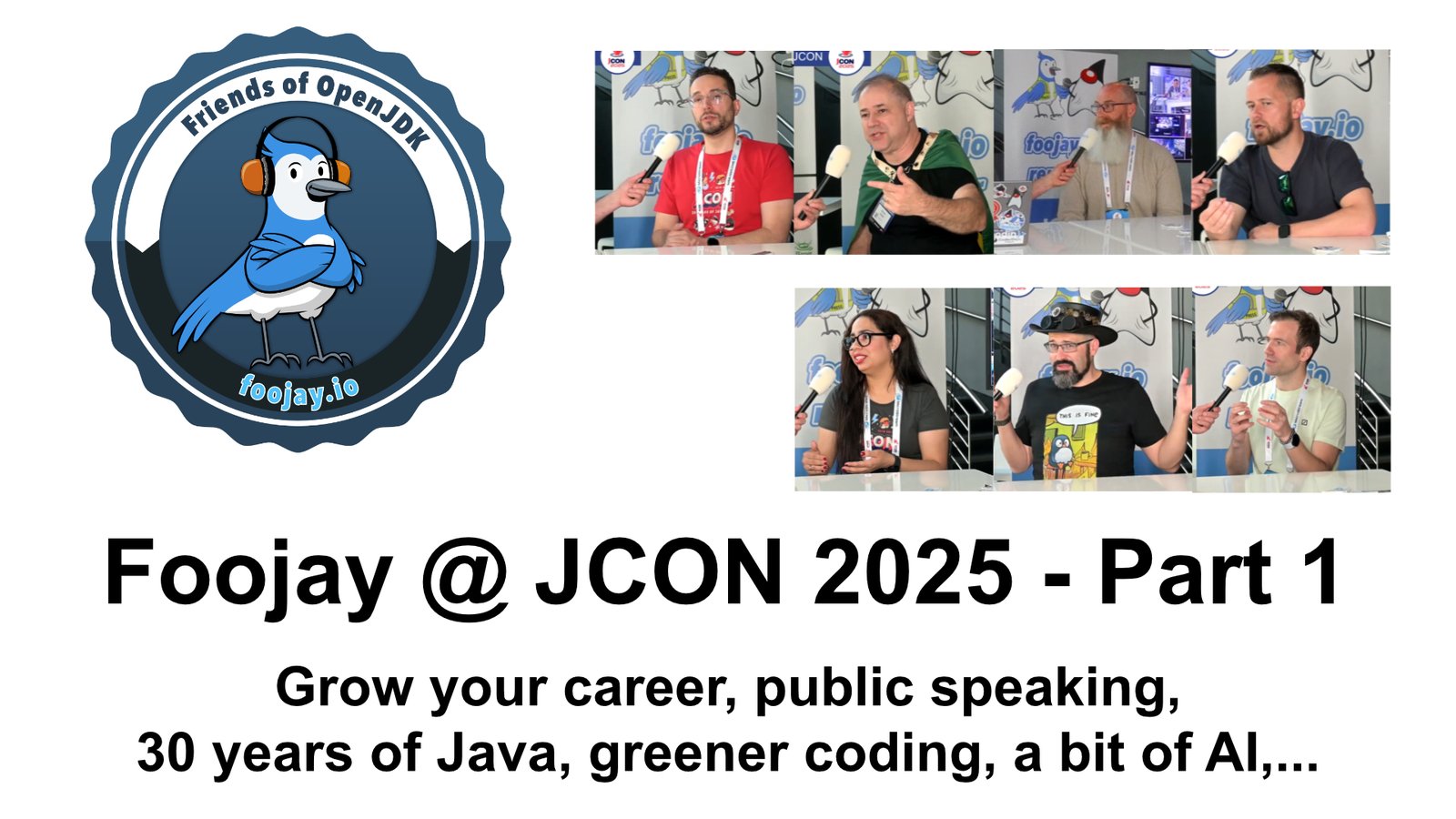
2,917 viewsOn May 13th and 14th, Foojay attended the JCON conference in Köln, Germany, where we did over 30 live-stream interviews. In this episode, we present to you the first set of these interviews, in which we focus on celebrating 30 years of Java, how you can grow your career, become a public speaker and writer, make your code more green, a bit of AI (of course…), and how the connections between open-source contributors can be visualized.
Video
Podcast Apps
You can listen and subscribe to the Foojay Podcast on:
- Spotify
- Apple Podcasts
- And most others…
Content
00:00 Introduction
00:37 Richard Fichtner: About JCON
03:27 Bruno Souza: Building your career
17:09 Markus Westergren: Mentoring and growing to become a senior engineer
21:56 Brian Vermeer: Public speaking, NLJUG, the importance of writing
30:08 Aicha Laafia: Green coding
36:33 Baruch Sadogursky: History of Java, job changes because of AI
44:40 Dmitry Yanter: Connections in open-source projects
53:12 Conclusion
Transcript
Automatically generated from the audio, so it can contain errors in names and technical terms. Suggest a correction.
[0:00] This is the JCON report part one. Welcome to the Foojay podcast. All your news about OpenJDK. On May 13th and 14th, Foojay attended the JCON conference in K Germany where we did over 30 live stream interviews. In this episode, we present to you the first set of these interviews in which we focus on celebrating 30 years of Java. how you can grow your career, become a public speaker and writer, make your code more green, a bit of AI of course, and how the connections between open-source contributors can be visualized. Let’s start with Richard Fner, one of the organizers of the JCON conference as they give away many free conference tickets to members of Java user groups. I asked him how JCON is involved in the Java community. We are here in Cologne, Germany for JCON Europe. There is other JCON for example from the 28th to the 30th of May. You can go to JCON Slovenia which is in Puros in Slovenia is run by the user group the local user group there they use the JCOM brand and there will be also a JCON in Orlando Florida in October. So if you want to enjoy some sunny weather and join us at the IBM
[1:16] Tech Exchange conference with 10,000 other attendees there is a JCON track with Java community content to enjoy for you. not only conference also magazine. Yes of course and of course there’s the Java Pro magazine. The Java Pro is a partner of JCON and there is a printed magazine that will arrive hopefully shortly here at the conference with a special edition on 30 years of Java. So with a lot of articles and knowledge around this great anniversary, a lot of people can come to the conference for free as you have tickets together with JS. What’s the idea behind this free track, the free tickets? So this was actually Marcus Kat’s idea from the Java Pro magazine. He’s also one of the organizers and he is a father of JCON basically. he had the idea to have JCON and he had to convince me to do the conference before we started all that and his idea is was to bring in the Java community and to give away free tickets for Java user group members because we feel that we compete with YouTube and we think it’s worth coming here and for a lot of people that’s not so easy because
[2:26] They have spent spend money for travel and then also for the conference and they have to convince their employer ers to let them go. So we try to make it easy for the Java community to join this year and to provide free tickets for Java user group members. Really community things. You also have the mentoring. is it a bit the idea to have a closer connection between the guests and the speakers? Yes, absolutely. We have the mentorship hub. Bruno Soua was so kind to bring that over. This is his concept, his idea to have mentoring here at the conference with speakers and Java champions. And also we have one-to-one meetings. So if you want to get in touch with somebody, you can use that. And if you are more on the introverted side of things, we also use a system called Slido to ask questions. So you don’t have to raise your hand in a room full of like 200 people and ask a question, but you can do it with your phone. And then people can upload the questions for the speaker. so the speaker can answer the questions that get the most votes.
[3:27] Richard mentioned that a vital site track during the JCON conference was the mentoring hub, an initiative by Bruno Souza, known as the Brazil Java man. Bruno explains the goal of this mentoring and how it can help evolve someone’s career. Here’s what happens in our careers, right? So when you get to a certain level, it’s hard to move up. It’s hard to know what you do, right? Because the developer career is very unique for each person, right? It depends what you do, depends technology that you work with, depends the things you’re doing. And so, when you get to a certain point, you need some help, right? That’s what we’re doing. We’re getting, people that have been doing those things, people that have been, you know, working on projects, working, working on growing beyond senior, for example, achieving higher career goals, build their own companies, and we’re bringing them here. So, so developers can come in and they can talk to someone that have done that. and so then you have some real guidance from real people to do the next step in your career. People may know the
[4:26] The Dilbert principle. You grow in your career until you reach a level of incompetence, right? So that’s a real danger that you get promoted until you become a manager and maybe you don’t want to be that manager. How to avoid this? Well, you know, you know what? That’s very funny because you mentioned that principle because I heard of that principle when I was a teenager because I got a book from my father and I was looking at that and I thought it was a joke right you know all my career I thought just oh it was a joke it was a joke book right and it’s and really but one thing that I’ve I’ve done in my career for example is that I’ve I’ve been avoiding the incompetence level right so basically if it is a place that I don’t want to go is something that I don’t really want to excel all because a lot of people get to that level because you know they’re promoted to something that they don’t want to do because it’s not actually I don’t I don’t agree with the idea of the incompetence level. It’s actually more what you want to do or not because if you if it is something that you want to
[5:29] Do, you’re going to learn how to do it, right? You’re going to be good at it. But the problem is that people are promoted to a place where they don’t want to be they don’t want to go and then they don’t want to grow in that place. And so I think that’s a good way to do is if if that is a place you don’t want to go, don’t go there, right? You know, you might be afraid. That’s a different thing. You might be afraid, you might not know exactly what that means. And if you want to do it and you just don’t think that you can do it or you or you’re afraid of doing it, then you can get help from someone. You know, that’s why we talk a lot about mentorships, right? Because you know, you get help from a mentor that was going to help you succeed on that next level. But if you are if it’s something that you don’t want to do and let me give an example for example right so I at one point you I I’m I’m a partner in a consulting company right in Brazil and at one point the guy that used to be the owner of the company he wanted me to be like the country manager in Brazil and I told
[6:27] Him I said I don’t want to do this and no I’m going to help you and I said I’m not going to be good at this and said no no but I’ll teach you and so then I said look if you really wanted me to do this the problem is that if I do it, I don’t want to do it and I’m going to break the company. And he said, “Okay, so let’s let’s not do it.” Right? And then he said he tried one last time. He said, “But Bruno, if I do that, I will I’m going to have to hire if you don’t do this, I’m going to have to hire someone to be your boss and it’s going to make more money than you.” And I said, “That’s great because he’s going to do something that I don’t want to do it, right?” And we did hire this person and he’s awesome. He’s amazing, you know? So he has done the things that I would never want to do, right? And some of those things are like the daily work, right? But some of the things are, you know, outside of work. So for example, you know, when you’re working on a consulting company and you’re working with big big customers, then you know, you have to go eat dinner with those guys, right?
[7:22] You have to go play golf with them, right? You know, you have to go smoke cigars, right? Those are things I don’t want to do, right? And I would not do it. And so I would be a terrible country manager if I was doing those kind if I had to do those things then I would know I want to do it. And so and that’s I like this example because that shows that certain positions require you to do things that you don’t want to do. And so if you don’t want to do don’t go in those places right don’t now there are other ways for you to grow where you are and I think that’s important thing. So don’t get don’t get stuck in doing something just because you like it and you never want to do something else because there are ways right so there’s lots of different actually I’m going to do a mentoring today about growing beyond senior where we talk about the five path for to grow beyond senior level positions right and many of those path are not manager yeah because in a lot of companies you can only grow beyond a certain senior point in changing to a team leader or a
[8:25] Manager but if really love the development stuff. In some companies, you end up at some blocked position and you cannot grow any longer. Is there a way to solve that within a company or do you need to change jobs in many circumstances? So, when how about growing beyond senior? That’s as I said there’s five five levels, let’s say five paths, not levels, five p different paths. The first one is what I call the people path, right? That’s that’s the one you mention a lot, right? The manager, right? you know that you’re going to manage people. So you’re going to be a manager, you’re going to be a director, you’re going to be a VP. So that’s the people path. The second one I like to call the technical path and that’s when you become a staff plus right? So you become a individual contributor. so then you can go to staff, you can go to like a principal engineer, distinguished engineer that the technical path is where you grow technically and you have more responsibilities technically but you don’t manage people, right? Right?
[9:22] And so those those two path are interesting because they are equivalent, right? So a staff position is equivalent to a manager. A principal position is equivalent to a director and a distinguished position equivalent to a vice president. So they’re equivalent in responsibility and even salaries, but the technical path you don’t manage anyone, right? So that’s that’s second path. The third path is what I call the community path, right? Is to do things like you’re doing for example, right? is that you know you become a you know you become a technical person inside the non-technical area of the company. So you’re the technical person inside marketing or the technical person inside HR or is the technical person inside sales or technical person inside which one I’m missing HR marketing sales de right whatever so then you become the technical person inside a non-technical area of the company and that’s really interesting because it’s very autonomous right and you have lots of autonomy and you and very visible know like you’re for example right you probably
[10:26] One of the most visible persons inside a zoo for example, right? Because because you’re doing this community work, right? And so that’s that’s the third path. This the last two paths are very independent path, right? One is what I call the independent path, right? So you become an independent professional, right? So a consultant or freelancer instructor, right? So you’re going to do you sell yourself as a product, let’s say, right? And the last one is what I call the entrepreneurship path is that you be you participate in building a company and then basically you sell a product instead of inside a company. So all five pathway to grow beyond senior and now what I want to mention about those things is that if you think about the first three path they necessarily happen inside a company right because you have to have a position like this and now when you think about it is that oh companies only know have the manage path and that is not true. The thing is those positions are all of them including managers they’re very autonomous they’re very unique positions and so you have to find
[11:29] Your space inside your company to do that and that’s what I think is hard many times because there’s no one telling you what to do there’s no one showing you how to go that path and so when you now answering your questions right what do I do if my company doesn’t have that path build it right because that’s the point those are very autonomous positions. So if you don’t go and build that path, then no one’s going to build that path for you. So it’s really up to you yourself to decide this is what I love to do and this is what I want to do in the next years and then push it some way into either your company, your own company or in the company you work for, right? You know, you can find your company or you can look for another company if you need to, right? that does happen is in certain companies that things are very very rigid for example then there’s no no way to do it right but I find this very rare you know I’ve mentored lots of people to actually go find those those things and the reality is that in the vast majority of companies they want you to stay right actually one thing that I say is that
[12:35] You know your first responsibility in your company is to want to stay have you ever thought about that you We think that our first responsibility is to do the code. You should to solve the problems. But no, the first as a professional you should work in a way that you want to stay in your company because if you leave that’s very complicated for your company. I’m not saying that you should never leave. That’s a different thing, right? But you should want to stay. So you should negotiate your salary. You should negotiate what you do. You should negotiate who you work with. you should negotiate your position because you should want to stay in the company because because if you if we don’t want to stay, we’re not we should not be working for that company to begin with, right? And so that’s the that’s the point. So when you look at your company, think about what do I need to do to want to stay and go negotiate. You know, developers a lot of times are afraid of negotiation because they think that negotiates like, oh, I have to it’s it’s it’s salary. It’s only salary. It’s not only salary. It’s everything is in
[13:36] Negotiation, right? But then you know people think that a negotiation is me taking something out of you and that’s not a negotiation that we have a common problem and we have to organize even in small things. So for example me and you right before I stopped by here said let’s do a let’s do a interview and I said I can’t do right now because I have something to do and so we negotiated right when can you do it a little bit not not now maybe tomorrow. So we negotiate. Why? Because we have a common problem. You know, you want to do the podcast. I want to be interviewed, right? So we have a common problem. So we have to negotiate and find something that we can do it together. And so in a negotiation, right, in your company is the same thing. Your boss want you to stay because if you leave is a big problem. You want to stay because you like the company because they pay well.
[14:26] But maybe there’s another company paying you more that offer you more. So you have to negotiate, right? or maybe you’re doing something in your company that’s not the best thing for you. So, you have to negotiate. So, you want to stay. And so, that’s our first thing we got to do. And so, negotiate, negotiate, negotiate. And, and that’s one thing I tell everyone because I I’ve I’ve coached many, many developers to actually achieve those positions inside their companies because they want to stay and the company doesn’t have a way for them to stay and so they negotiate. I have actually a very interesting case is that is even on my book. I have a tiny little book called the best developer job ever and that’s the story of a mentee of mine that he really liked his company where he was but he did not see a way to grow inside his company right and so he started looking for other for alternatives and then but I told him I said no you should negotiate right so he talked to his boss and he said look I’m looking for some things and I you know there’s some offers but I
[15:28] Would really would like to stay and they told him said if you want to stay we want you to stay. So they built a new department an innovation department and he was the head of the innovation department just so he could do what he wanted to do because he was so valuable for the company and so your company might have something like this but you have to negotiate you have to talk to people if you know what you want and you really have to ask for it and that’s what you’re teaching in these mentorships. So I will do a mentorship about writing for writing about your work like for instance for Foojay or do writing a book. Let’s let’s tell you one thing here writing is one of the most important skills you can build for your career because lots of people think that oh we I need to learn how to think and you think that you think when you think but in reality you only think when you externalize. So you only think when you write, when you speak, right?
[16:25] When you present. So writing is the best way for you to think. Indeed. You have to understand the topic before you can create a condensed example for a blog or whatever. Exactly. so if you need any help in terms of growing your career, I do have I wrote with Heather Vancou the developer career master plan. And so if you go right now to careermaster plan.dev, you can get the first chapter for free for the book. It teach you how learning and how to acquire skills in the first chapter. It’s pretty good idea. And then when you do that, you’re going to get my email and my contact. So if you need any help, just message me and I’ll help you out. One of the mentoring volunteers at JCON is Marcus Westerhen, who has a lot of great tips to grow your career. my topic is to go from being a silent coder working on your own to sharing what you know to be able to progress in your career and also help other people in the community. being a silent developer is I think a very difficult topic for a lot of people is stepping out. you can be a main contributor to
[17:40] The application of your company without most of the people knowing it. H how do you fix this? it’s a hard subject because many of us developers don’t really feel comfortable being in the spotlight. So I was one of those and the sad truth is we need to challenge ourselves but also do it in small steps so we don’t do it too much at once. we had Bruno here who is organizing these mentoring sessions. So he has his plan of becoming the next step after being a senior developer. So you are handling the topic before that. what are some of your main tips to become that noticed senior developer? actually do the things but get the mentor that can help you get to where you want to go. You need to know where you want to go but having somebody who knows the road it’s making it much easier than just fumbling about on your own. And how do you find a mentor? Do you need to look inside your own company? Do you need to go into the community? I think both. we have lots of resources where we work. So, finding a more senior person or somebody who did something you want to do and
[18:55] Just ask them. But a conference like this, going here in person and actually talking to people, it’s a really good thing. So, we have the mentoring sessions here. can I find a mentor online somewhere? Yeah, definitely. we all follow people that have information that’s fun. For instance, Foojay, lots of people who have experience. So, just engaging with them could be a good first start. Yeah, we have the Foojay Slack. So, a lot of the Foojay authors are there, other also other people of the community. I’ve I started writing a book five years ago and just reach out to some of my heroes asking, “Yeah, can I ask you a few questions for an interview?” All of these people are very very open to speaking to helping others. So is that your same feeling that you just ask it? Definitely. H and most people who are conferences want to meet and talk to people even the most famous ones. somebody said once that speakers are just people with opinions like everybody else, but they just choose to tell them to others. So they’re just people like everybody else.
[20:02] So the hallway track as they call it is the most important one I would say. So now I didn’t do that from the first when I started going to conferences. I packed the days full of sessions. I need to f the whole day busy busy and I was completely exhausted afterwards. But now later years I’ve been doing I handpick a few sessions that looks interesting but then mostly I spend my time in the hallways. Mhm. I once heard the tip if you go to a conference or a juck a Java user group, you should not talk to the people you already know. Is that something that’s very scary for a lot of people? But is it a good tip? I would say so. Especially if you go with colleagues, take you can be together for part of the day, but make sure you take time to go around and meet new people. And also if you do go to a conference for instance here in Germany as a group from a German company make sure you speak English even to your colleagues because it’s very hard for a non-German speaking person to get into that group. You will never go there and talk to them. Are you also attending a few of the other sessions? I know you
[21:06] You take time to speak to people but do you attend sessions? Definitely definitely I do and I try to go to people I haven’t heard from before. So even if you have the really superstar speakers like Josh Long or Wat or these people. If you went to several of these people’s sessions, there’s kind of the same things they say over and over. So that the interesting thing is to go to another speaker session maybe on the same subject, but then they will hear their part and their experiences on the subject and you will maybe learn something new. I heard once that it’s a good thing if a room is packed and you have to pick another one at right at the spot. So you want to enter a room and it’s packed so you have to go another one. Most of the times that’s the most interesting session of the day.
[21:50] Definitely. I think so. And just go beyond your current comfort zone and go and listen to something completely different. For Brian Vermier, the so-called hallway track is the most important one. He makes the hallway and the exhibitor hall his place of residence at every conference. It’s it’s an old saying. It’s not what you know, it’s who you know or it’s also who you know. and to get these connections back and keep these relationships up up to speed. I think that is so important to create collaborations, but also if you don’t know something, there’s always somebody in this network that knows how to solve certain things. If it’s a technical issue or a specific framework issue or something like that, so that this is why these connections are so important because it’s then it gets it makes my work easier. It makes your work easier.
[22:39] It’s also a tool to grow your career for most people I learned. So, asking people how to grow your career is also important topic here. I think so. I think it’s it’s undervalued in a lot of companies that conferences are a great way to grow your career because it’s not the content is great, don’t get me wrong. like that’s primarily why you come. But talking to people and getting new insights on how to solve certain problems like like-minded people which might have the same problems or have a different solution to a certain problem you can talk along with them but also if you know certain people from a certain specific mindset or specific subject matter expertise let’s say that I know where to go next time if I need the security guy or I need the spring boot guy or like hey if I need the spring boot guy I’m like I’m currently friends with Josh and like I’m just giving him a call or he can point me to the right direction.
[23:39] Also like I need something from like I’m working with IBM technology and I know people there. So like who is the right person to connect with them because we have a problem with and I don’t understand it which is fine but because of that you start to learn people but also if you want to grow your career or move like you at least know people to move yourself because I think most of these these opportunities come by conversation and not by application if you know what I mean. So yeah I think it’s a great way to grow your career. Another great way so it’s joining conferences. So, so joining JX, I think you have something that you are involved in some JS. Yes, I am. I’m I’m involved with the NLJ, the Netherlands Java user group. we for instance we create and organize two two of the major conferences in the Netherlands. but next to that we do some some other things as well. But I think for jugs and jug meetings or however a jug is situated, not all jugs do meetups. I think it’s great to connect on that level as well because it does you like
[24:44] It’s just a smaller setting so it’s easier to have a conversation and I think that is valuable conversations like this are very valuable not to only showcase what you are doing but also and inspire other people but also the other way around because I’m talking to people like oh that is actually a cool thing to do I want to play with that but can you help me start start out so it makes my technical skill better, which is an improvement for my career, but also because I know people if there are opportunities and they know like, hey, I need somebody with expertise X, Y, or Z, maybe I should ask that person. So, it’s just like, hey, if I need somebody to renovate my house, I’m not going on the internet to find out who is the best contractor, I probably will ask my family or my neighbors. So, like, hey, who did the job at your place because it looks great. I think it’s similar to that. next to the conference the jug with the NLJ you also have a magazine a paper magazine the same for JCON they also have this magazine is this still relevant paper
[25:48] In this current days oh that’s a great question I think it is because it is offline as in you don’t need a screen you can take it with you like we make always a joke like you can read it on a toilet and I’m not taking my you can take your phone to the toilet but I’m not taking my laptop to the toilet if you know what I mean But I think it’s it’s easier to read. You just grab it and you read an article. And I think on the other hand, it’s also good for people to start with sharing, start writing, have a printed thing, like you feel you actually achieved something. I know my first articles in Java magazine. I still have it. I still have the physical edition and it’s just memorabilia now, but it’s a thing for me like, hey, I did this. so it’s from different angles. I think it’s it’s still relevant. Yes. how should people start contributing to the magazine or to a jug or to conference?
[26:44] How can they get into this yeah this world of what we see here? becoming a public speaker or an author of articles. I think it’s it depends on what you want like writing is not for everybody. Speaking is not for everybody. some people are more say in creating videos or more into writing instead of speaking or the other way around. So figure out what you want. That’s one thing. But I think it starts with attending. I think the things with attending and asking questions and being interactive. It’s it’s just like if you’re if you’re going into a talk and you don’t have to do it publicly, but say afterwards to the speaker like I have a question. If you actually have a question, dare to ask it to the speaker because they want to connect with you as well. And that’s how you contribute like with that question you already contributed and you can move from there because like talk to new people like hey what do you think of this or if there’s already a conversation going maybe you can go into that conversation and give your opinion on things and it doesn’t need to be big or
[27:48] Or brutal it it’s it can be like yeah I agree I think we had the same thing and that makes you grow your community and then if you did something like every I think everybody is able to create a blog post or even a conference talk. start but start small. Start for instance at meetups like see like share whatever you did and why that is relevant to everybody else and it can be something that is either new but it can also be an old technology but you have probably a specific use case and that makes it interesting because it’s your use case your problem u and how you solved it which in what conditions that make make people think like okay so this can be a good solution or maybe like we shouldn’t be doing that because whatever so I Think everybody’s personal story and personal angle to a story can be a blog post, a video, a thing and you can or a talk and you can share that and start small and grow your posture and grow your audience I guess and you can also share on Foojay of course even if you already have written something for your personal blog or your company blog or something
[28:59] Like that it’s a great way to repost this on Foojay to make sure that it gets more attention. I want to go back to asking a question. So at the end of a talk, people in the audience can ask questions. A lot of people don’t feel comfortable doing so. But as you say, just go up to the speaker after the talk and ask you directly. That’s one the one one way of doing that. obviously like here at JCON, they use Slido, which is probably a good way to do it more anonymous. but I would say go go after the talk, go to the speaker or like if you if the most speakers are around for the full conference, go to the speaker afterwards. Maybe not like right after talk, but maybe a few hours later or tomorrow, it’s fine. Or connect with the speaker on one of the social media platforms. Everybody is on Blue Sky or the other pl the other platform with the bird or Mastadon or LinkedIn. And feel free like, hey, I saw your talk at JCON. I have a question like how do you solve X or Y and most of the people will be more than happy to help you out and that’s a connection.
[30:08] Aisha Lafia came to JCON to present a talk about greener sustainable coding. Shouldn’t we all be worried more about how our work impacts the environment? Can we be better developers by creating greener applications? But above all, Aisha was probably the most enthusiastic Java lover I met during the conference. I’m a Java lover. Like I drink Java. I work with Java. I wish I live in Java. Yeah, that’s that’s a nice nice goal for life. and you have a talk. So what’s the talk about? It’s about green cloud. How to implement sustainable Java application in a more like greener cloud. It’s more practical like the practice you can do as coding in Java and if you want to go more advanced you want to deploy it how you can really manage your resources in Kubernetes like some chips in hacks how to do so. So as a Java developer I can use certain techniques programming systems in Java to make it more green. Actually yes because mainly we are talking about clean code and it’s the first step into the green code because clean code can make your application more maintainable but green code can make it more
[31:25] Sustainable. And this is why like it’s simple like you can use some algorithm that use less power and less like less CPU over less cycle and so on. Also you can go for this is my first one DVM. You need to make sure your GVM is not using like many resources. You can start with choosing the right garbage collector for your use case or even tweak some GVM options and so on. There are really some simple tips you can do that can like make your application more sustainable because for the fact our tech industry contribute to 4% of greenhouse gas emissions and with EI and so on it’s going like up crazy. Yes. And this is why like and as a developer we cannot really go to the like the upper the stakeholders to tell them well we need to make sure that we are using more like in friendly environment resources but as a developer we can make sure our code of lines are efficient are greener. this is a bit of an eye openener for me. So I was thinking yeah I can make sure my environment is green because I only use the servers that I need. I use them to the maximum. What is for instance the impact of the garbage collector? How can
[32:44] The garbage collector be greener? Actually like it depends if you want something more like in real time you we want to make sure that the posy sign are low you can use shinandua. If you I love Shinandoa because it doesn’t matter what the memory size you have it always make sure you have the lo like the lowest posy side and if you are more something like patch is high throughout you can work with parallel GC it’s already like vend otherwise if you don’t know where to start with first thing first like start with the having a GDK that’s 21 or more because you have G1 GC by default which is good like idle for realtime application and also it have low posit time because the longest the posit time they are the like the more energy you are going to waste for like the machine to have to work when it doesn’t do anything like really more efficient and so on. So this is why like you have first thing to do is choose the right garbage collection. Second thing is you don’t you don’t have to rely on the GVM default like settings you can’t some for example the percent of the target that the heap using we have like a lot
[34:01] Of settings we can do for or how many mixed GC you want how many like mix garbage collection you want to use running your code and so on you can like max customize this so I also hear that you say the version is important So if I cannot change my code, if I bump to a newer runtime, I switch from 17 to 21, will that already make a difference? Yes, because we already like we will have advanced GC garbage collection and that’s something I really loved about the Java because they know the impact of the garbage collection and the garbage collection itself, the old one wasn’t doing some really good job. It wasn’t cleaning enough because virtual you can say garbage matters too and they are making sure that it’s more advanced and more like cleaning more greener too and also for the fact that some we can say some real features for example virtual treats helps to structured tree streets that’s much better because even virtual treats it’s a good but if you are using it only for example calculating methods or monolithics don’t use this please yes better use tracker concurrency it’s way better because
[35:24] Virtual treat have a long pos time a long waiting time and that’s on like actually and also for records too they are greener than relying on the classic class methods or class entities and so on so for me the better use the latest future in Java because they are paying attention to sustainability too. Okay. What people maybe forget is if you make a greener application, you also make you reduce the cost, you don’t need not that much pots. So is this a technique to sell this approach to your manager? Actually, yes. Because when people talk about green programming, stakeholders often think we are going to cut resources, we’re going to reduce number of customers. When it’s opposite, we’re going on scale. We’re reducing the cost of electricity of like the CPU and so on. Even machines right now instead of relying on traditional one, we’re going on the cloud. We even like reducing the cloud bills and so on. So this is why you can say that sustainable application save saves the environments in your pockets too. Baruk Saduhushki is also a big Java lover and has been using it since one of the early versions and
[36:39] He’s looking back at the history and evolution of the Java system and how it compares to Cotlin. And we also discussed how our jobs are changing because of the ongoing AI evolutions. It’s very exciting to be at JCON on their 20th annivers anniversary and celebrating 30 years of Java. Boy, are we old. Please speak for yourself. But yeah, I was not born in Java. I mean I discovered it let’s say 15 years ago. I think Java 7 8 maybe. you have a longer history. Where did you start with Java? Java 1.3. Okay. 1.3. It’s the year 2000. compare 1.3 with 25. What’s what’s the biggest difference to you? It’s it’s all the same. Nothing really changed. No, I’m just kidding. I think that the two kind of fundamental changes are the Java 5, the generics and this kind of stuff. And then the streaming and collection was it Java 9 reactive and now well I said two three and now the virtual threads I would say those are the ones that changed the language entirely and then we don’t and then cotlin so we don’t need to write Java at all for a long time groovy and then cotlin were the much more friendlier
[38:17] There are a alternatives that actually guaranteed even I can say a more productive development for Java developers you almost don’t need to learn anything else but now Java is catching up so we’ll see if Kotlin will keep the pace and will keep the lead or will Java catch up in the next 30 years. Oh wow. You’re looking forward for 30 more years. you have a talk. Yeah, I just finished I spoke about incientification, technical incidentification, basically how everything is terrible. that was like the majority of my talk. We just ranted with the audience about how everything terrible. And then in the last 10 minutes, we spoke about how we’re going to fix everything. And the solution is the solution is a combination of going back to basics stuff like agile and devops in their purest forms not like the cargo call that we’re doing with scrum and devops teams but what the principles stand for a lot of developer productivity and delegating concerns when possible for example for security you can delegate to taxare Mhm. Okay. Yeah. A bit of selling. Yeah. Yeah. They paid my ticket
[39:44] To be here. Otherwise, you won’t have my company. Indeed. Thanks for that. A lot of evolution that you’ve seen in this 30 years. What’s coming next? That’s important. Oh, we have a new revolution coming up and that’s we are jumping once more the level of obstruction. Java was definitely one of those jumps from the older languages like assembly and CN not that was like one of those monumental shifts and for that matter codlin and java and groovy and net they’re all in the same category they are all like the next level of abstraction and now we are living through going even higher with AI right so prompdriven development is the next level of obstruction. It’s exactly the same. It’s like people told Grace Hopper 50 years ago, no no computers don’t understand English. You cannot use compilers. we hear exactly the same rant today. No, no, no.
[40:50] Computers don’t understand English. You cannot write your code with prompt. And this is as as was there. It they definitely can and they will. our job is changing. We h we will have completely different responsibilities but we are definitely going up one level of abstraction more. Mhm. Will programming languages become obsolete? as they didn’t become obsolete with the previous with the previous evolution they won’t become obsolete right now. they are kind of pushed down to be not the top level of abstraction but the second level but they are still there and especially until we can trust blindly the code that is generated by AI and it’s coming and it’s coming soon it’s coming very fast but until then we actually need this lower level obstruction but it’s still very very readable for us to make sure that AI does what we need it to do so we as devel developers will not lose our job.
[41:54] If we adapt on time, if we pay attention to what’s happening, if we get ourselves ready to this next level of obstruction, we won’t. If we want to kind of be stubborn and backwards and be in denial, then we still won’t. we’ll just become you know, the dying breed. I would say even if for now I just close my ear, close my eyes and don’t pay any attention to anything and want to be just Java developer for the next 10 years, I will still have this runaway. after that maybe not so much. So we’re definitely not going anywhere tomorrow today and if we are just pay attention and being agile then we’re not going anywhere anytime soon at all. more so the real professionals the ones who adapt early and who adjust soon will be even highly regarded than just any other developer that are there today. Just like with all the tools, this is a tool you need to know, you need to understand and know how to use it and integrate it in how you work your daily job. Absolutely. and mastery and understanding becomes more important not less. Okay. are you one of those people who focus on the hallway
[43:20] Track and not on the tracks in the cinema rooms? yes. the calls the talks are recorded. with AI we can get a summary very quickly. We just can watch it in a higher speed, right? And then like save save time on that. But the conversations in the hallway track are second to none. Obviously, there are not a lot of opportunities to meet all the amazing speakers and attendees that are here at JCON. So, definitely hallway truck. Yep. Okay. And what did you learn in the hallway track? There is a lot of talk about AI. O everybody. Yeah. No, no, but I mean it’s it’s a good thing because that’s that’s what people really should focus on and it’s everywhere and some of it it’s cargo cult, some of it it’s just like everybody do it, we need to do it too, but there is a lot of real discussion of what’s what’s next. And this is fascinating because what we kind of figure out today is what we’re going to leave tomorrow. And as I mentioned, the sooner you pay attention and get on this train, the better shape you will be. Yep. Okay. I have one more
[44:41] Guest for you in this first series of JCON interviews. Dimmitri Yunter gave a talk about open-source projects and contributors. I call it collaboration quantified. So the my idea is a little bit to move from this collaboration just like we describe like good collaboration bad collaboration just put a little bit some numbers there and put some some structures around that. So I analyzed data sources from different open source projects and build effective collaboration graph. For instance, if we work together on some, you know, pull request or jira item, then we build a small graph between between ourselves. And you can imagine for open source projects which have I know more than thousands of collaborators, they’re just like quite an impressive interconnected graph and how it looks like and what we can take out of it, what ideas it brings. yeah, any tips related to that for smaller projects? So I I’m involved myself in an open source project like Pi4J which has only a few main contributors. How we can attract more contributors might maybe or how we
[45:52] Can improve collaboration there. Well so first of all first of all I would say no matter whether it’s big project or small project you should come up with this core collaboration network. So even if I know there are five people on your project, you should build connections more or less with everyone. This gives you the core network which is robust enough and that’s extremely that becomes extremely important for project to grow. So for instance, if we’re just working together on this project, if I leave or you leave, then it becomes really a dramatic effect for it. And that’s why you have to build that network in order to really to survive for in the long term. And it’s super important to build connections between everyone. And that’s what actually is happening like on JCON, right? Where we try to build connection between different people, not just like I’m leading the project and I tell you what’s what to do. I take like only your pull request or whatever. It’s it’s really must be the network where everybody is interconnected and what I see in looking
[47:06] Into this local running products is like a chart where everyone is really super connected like it’s almost a perfect graph where everyone is connected to everyone and that’s what makes what makes project and what drives project forward. So not just about not just about you know I know how to do it and you follow but really bring ideas and bring people together and make sure that everyone is involved. So how do you measure this involvement? That means that if someone makes a pull request that the other partners in the team give feedback, take care of the merch requests. How do you measure how people are connected? Yeah, that’s that’s quite that’s quite u a tricky thing. I started with a very simple thing is Jirus and again we have data sources with Jirus and for instance if I’m a reporter and you’re a developer then we connect it’s very simple thing you can do the same with pull requests if I create a pull request and you are approve of the pull request it’s awesome it’s also and I try to do it really artifact evidence based not just we talk and we measure like how many
[48:16] Words we exchange but some artifacts based like jur requests or maybe commits and That’s and that’s also then I apply some some gravity logic here. So for instance if we have together I don’t know 10 thousands of euros and some other person just like contribute one then we are closely connected. It’s like works as gravity right. So the more interaction we have together, the closer we are and that brings you like really like a solar system with the core network in the center and people coming coming sometimes they coming closer to the core because they contribute more or they just like in some like far orbits that’s quite impressive. Do you have a chart like that for OpenJDK Open Javix those projects which are discussed here a lot?
[49:03] No I don’t I haven’t I haven’t I have some for some other for instance u for MongoDB or for spring or for Apache and that’s that’s really quite interesting. Spring is also a big one here I guess but yeah OpenJDK should be could be quite a challenge I think there are a lot of contributors there but that’s but that’s great that’s that’s actually how we can how we can try to see how the things work and that’s that’s sometimes that brings really insightful understanding how your community works like who are the people in the core and how you can bring bring people more because that’s also kind of like a part of If you are a part of your of your role as a core contributor to bring more people and to attract more people to know closer and be and build more connection.
[49:54] That’s also that’s also becomes quite important for people in the in the core network to engage with others and maybe sometimes you just have to introduce some some new contributors to other other people and that’s how you that’s how you build connections and bring people together and make make exchange of ideas and really this artifacts and put requests and they top up into quite quite impressive interactions. Yeah. Isn’t it amazing that you say OPJDK Spring they have hundreds thousands of contributors but that a lot of core libraries that we use or just one two people maintaining some a project that’s that’s was one of the insights that I tried to try to a little bit to summarize. So if you look if you look into super big projects then the core network where everyone is overconnected I would say just literally have a lot of connections you might have for instance one or two% of the overall contributors networks they are in the core if you just look into some other projects which are not super big which maybe at scale of some hundreds of
[51:05] Contributors then maybe it may be five six% but nevertheless it’s really a very small number of people who work together to bring things forward on the one hand side. On the other hand side you have to you have to you have to look for others contributions as well and if you sum up people if you sum up contribution for sometimes they close I know just couple of they think just couple of bucks but nevertheless if you sum up the effort it’s really it’s really great it’s really it’s really enormous so I did also some some previous year some analysis around that and I think if you compare like core contributors versus everyone which like non-core contributors then maybe can be like 50/50. So people who just sometimes close just a few bucks or contribute to just a few features overall effect is enormous. Yeah.
[51:58] Because for some people to decide if they want going to use a library or not. they check at the maturity of a library. How old is it? How well maintained is when was the last commit? But also the number of active committers is probably one of the topics which decides if a library gets used or not. So that’s probably also one of the reasons why building up that network is so important. Yeah, I would agree. I would agree. And it’s also it’s also when you think about it when you think about this longunning libraries they became more than just the like one or two people who created it. So they became really this collaborative effort and it’s like really brain power put together with you know with the synergies and ideas exchange and that’s that’s that’s probably why people use them and that’s that’s why sometimes it’s easier to use an existing thing rather than reinvent your own just because of your mental capacity is limited and if you compare if if you compare what you can do within I know a year or two versus really hundreds of many years put of thought put put into some libraries and
[53:11] That’s quite impressive. That’s it for the first round. I have a lot more interviews for the following Foojay podcast. A lot of tips and tricks about tools and programming and of course also more AI discussions. Thank you for listening. Please subscribe to the Foojay podcast in your favorite app or on Foojay. Keep an eye on Foojay for future articles and podcasts about development and everything related to the Java world. See you next time.
Found a mistake, or something to add? Edit this page on GitHub

Brian Vermeer
Java Champions & Developer Advocate and Software Engineer for Snyk. Passionate about Java, (Pure) Functional Programming, and Cybersecurity. Co-leading the Virtual JUG, NLJUG and DevSecCon community. Brian is also an Oracle Groundbreaker Ambassador and regular …

Frank Delporte
Frank Delporte is a Java Champion, Java Developer, Senior Technical Writer at Azul, Blogger, Author of "Java Programming for Raspberry Pi - A Hands-On Guide to Electronics and IoT Projects", and Open-Source Contributor for Pi4J, Lottie4J, Sheetmusic4J, …

Markus Westergren
I help professional Java developers like you to write maintainable code so that you can become a sought-after expert in the software development industry.

Richard Fichtner
Richard Fichtner is the Principal Software Architect at XDEV Software GmbH, with over 20 years of experience in the software industry. He works at the intersection of business and technology, contributing to the open-source community through projects like …