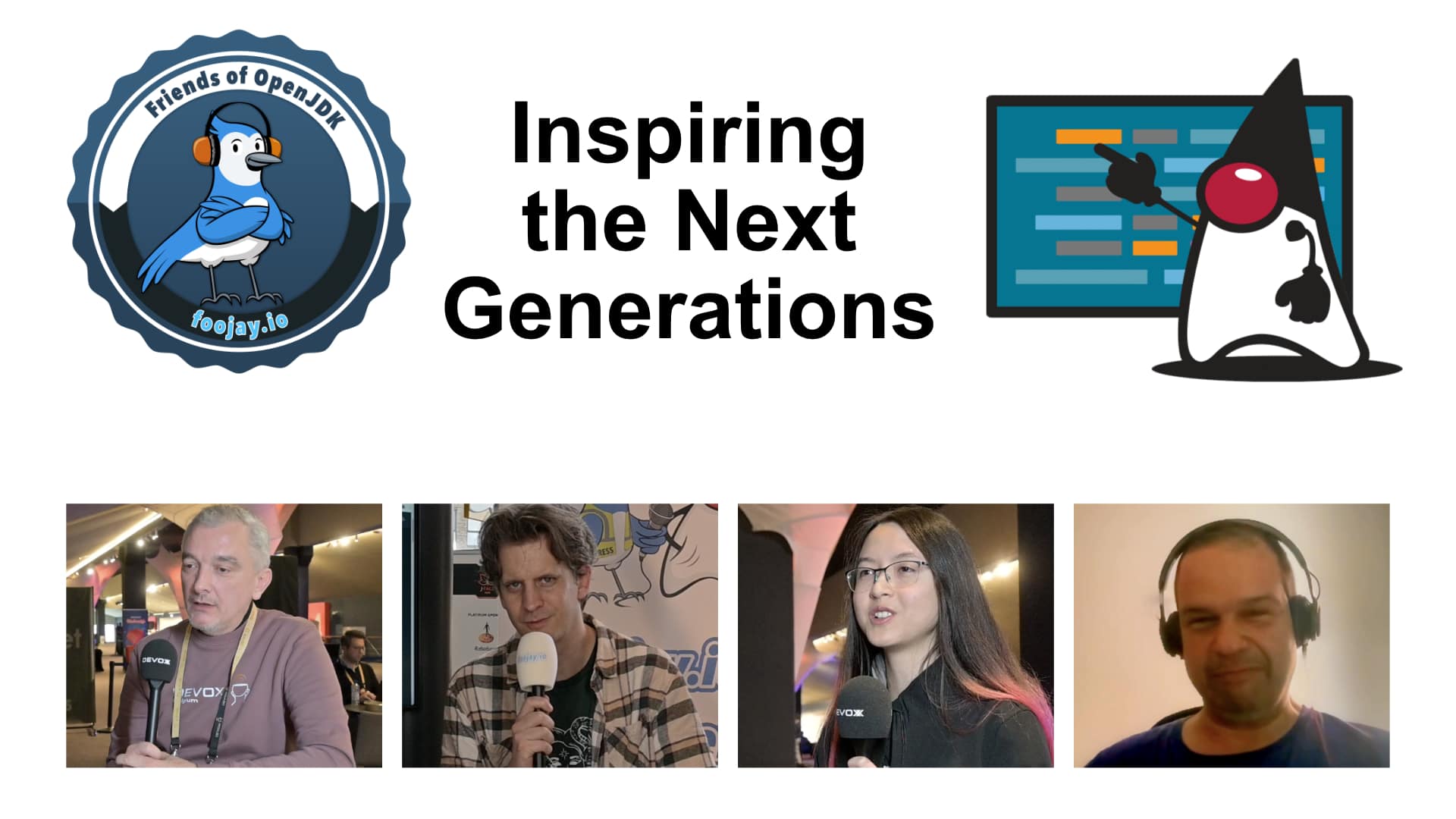
Foojay Podcast #85: Code, Community, and Opportunity: Making Tech Accessible for Everyone

 2 min read
2,383 views
2 min read
2,383 viewsWhat if the future of Java depends on who we invite to learn it today?
In this Foojay Podcast, we’re diving into something that affects all of us in the Java community: How can we inspire the next generation of developers, and how do we make the developer world more inclusive?
In this episode, you’ll hear four incredible guests who are actively working to make tech more accessible and inclusive. First, Daniel De Luca talks about Devoxx for Kids and how they support underprivileged students in IT education. Then Kenny Schwegler shares his insights on how we can actively promote diversity and inclusion in tech. Cassandra Chin, the youngest Java Champion and author, talks about inspiring young coders through hands-on projects and making technology fun. And finally, Igor De Souza discusses his mission to bring Java into Raspberry Pi education and bring more Java into coding clubs worldwide.
These conversations share one message: Talent is everywhere, but opportunity isn’t. And we have the power to change that!
YouTube
Podcast Apps
You can listen and subscribe to the Foojay Podcast on:
- Spotify
- Apple Podcasts
- And most others…
Content
01:19 Daniel De Luca
- https://www.linkedin.com/in/danieldeluca/
- Founder Devoxx4Kids
- Activities of Devoxx4Kids
- How to inspire children of all ages to get interested in technology
14:24 Kenny Schwegler
- https://www.linkedin.com/in/kenny-baas/
- How to build inclusive, diverse teams
- How the IT industry became male-focused because of IBM marketing
- Books:
26:07 Cassandra Chin
- https://www.linkedin.com/in/cassandra-chin-developer/
- Inspiring children and parents into technology
- Fun projects to introduce engineering to children
- Book:
- https://www.amazon.nl/Raising-Young-Coders-Teaching-Programming/dp/B0DVBQZ483
- 20% Discount code on the Springer website “APAUT”
32:45 Igor De Souza
- https://www.linkedin.com/in/igfasouza/
- Java in code clubs like CoderDojo
- Java in space
- Collecting Java tutorials and courses for children
- Java Catalog on Foojay GitHub
- Pi4J library
- HelloWorld magazine:
55:27 Conclusions
Transcript
Automatically generated from the audio, so it can contain errors in names and technical terms. Suggest a correction.
[0:00] What if the future of Java depends on who we invite to learn it today?
[0:04] Give me a OpenJDK.
[0:11] Welcome to another episode of the Foojay podcast. Today we’re diving into something that affects all of us in the Java community. How can we inspire the next generation of developers and how do we make the developer world more inclusive? Joining me are four incredible guests who are actively working to make tech more accessible and inclusive. First, I’ll speak with Daniel Duca about DevOps for kids and how they support underprivileged students in IT education. Then, Kenny Swaggler shares his insights on how we can actively promote diversity and inclusion in tech. Cassandra Chin, the youngest Java champion and author, talks about inspiring young coders through hands-on projects and making technology fun. And finally, Igor Soua discusses his mission to bring Java into Raspberry Pi education and bringing more Java into coding clubs worldwide.
[1:10] These conversations share one message. Talent is everywhere, but opportunity is not. And we have the power to change that. My name is Daniel Duca. So what brings me to Deox that the community, all the news, all the new updates on the software frameworks, AI and all the things that everybody’s looking at these days and for which I’m also looking for my own company I’m working for. but I’m so here to propagate the not the news about Devox Devox for kids where basically we initiated that children version of Devox basically in 2012 with Stefan obviously and then we continue to move on with this. So basically showing in different workshops where how children can with childrens how they can basically program software develop applications making games develop playing with robots and programming them and interacting with them in a very fun way and very interactive way. So just trying to show them that they can be producer instead of consumer of technology
[2:16] Like they do today. At Deox for kids, we have three pillars, initial pillars which is showing children that technology is affordable and they can be also there start being educated on that and showing them that it’s fun and easy to do. Second pillar is to show that boys and girls are all the same and they can also specifically girls now continue and having a path in IT which is important for diversity and also the third one was really to prove and show to underprivileged children that also on their side they have the opportunity to go to the IT sector basically and we try to help them and to support them into to bring them to those workshop for free and then to make sure that they also enjoy the day. So the fourth pillar is completely new and that’s something that we wanted to do since the beginning nearly is to see basically how we can help students to continue to pursue it educations high level so high high school universities primarily in Europe in Belgium but also in Europe. So we didn’t had that opportunity yet due to financial
[3:31] Constraint ourel but all of the sudden basically we had the opportunity with ING bank to which is Belgium ING Belgium which is a very early adopters of that concept of the what’s for kids they were we were working with them since for 10 years already making workshops with them at banks IT department there and They show us very enthusiasm and specifically their team also the IT department very are very enthusiastic about the box for kids and they are really continuing doing an amazing job and ING provided some big amount of funds basically and were basically said that’s the time to start the fourth pillar. So this year we created officially the Devox for kids foundations Belgium but also European one with of public utility. So basically this has been approved by the king of Belgium and the goal is really to participate and to cooperate with academic institutions for them to help us to find really student with a real potential in IT but that are struggling with financial conditions. So basically to help them. So [snorts] we
[4:56] Are there to not only to pay a sh to write a check for them but really to step by step help them in continuing their semester and their educations. Help them with local and specific dedicated process to help them with mentors and with devices also because if you want to code you need to have good materials
[5:21] To make sure that they succeed in their education. this in partnership with companies for which they provide sponsors and sponsorship to the foundations and for which we make relationship with the students. So they know that the companies know who where the money goes to who they support on the academic world basically and basically create already at that moment a strong relationship between the company and the student. So basically when the student finish his his studies basically graduate basically they know basically where they can go to because they know the company they know even the employee because employee also are in strong relationship with the students to mentor them
[6:05] And basically they know directly where they have to go to work and this is very interesting for the companies because they know that they can invest in people making sure that they graduate they have good knowledge so they can use them for their own business. Basically
[6:23] The whole goal of Devox for kids. Yeah, I really like it because I’ve done the same with code of dojo over 10 years ago started to code of dojo clubs.
[6:31] The same goal at that time there were not a lot of students in STEM schools.
[6:36] Now it’s a bit frustrating to see in the newspaper exactly this week that the number of STEM students is at the lowest level. Are we doing something wrong?
[6:45] Tech is so fascinating
[6:47] Indeed. And if you look at the statistics because I had to look at the earlier stat institutions statistics about it and employment that companies are struggling to find people and not because they are there but the market is small but because basically for example 40% of all those companies they are seeing that they don’t receive application for their job publications basically. So this is weird and you see also that all the student that are graduated goes to the IT sector purely IT sector or the telco sectors. So for 70% of them
[7:29] Instead of well you have different much more sectors that are starving for city peoples and that’s why we also want to make sure that we can increase that graduation those graduated students numbers basically over the years to make sure that we can try to fulfill as best we can. Obviously those those numbers to increase those numbers of student that are graduated and to make sure that [snorts]
[7:58] The relationship is there between between companies and students basically
[8:04] And let’s be honest there are amazing small companies who built very complicated [clears throat] fascinating products and are looking for engineers. That’s why we try we will try to be the bridge between that between companies like small one that have very good potential or very interesting in terms of working and engagement from their people and the students basically because also there it’s not a question of hiring new people also but it’s also a question of retaining also existing employee is potential because more and more people are looking for companies want to work for companies that have a really meaning social meaning
[8:45] And having those company having those employees seeing that their own companies is doing something for the ICT academic world basically helping student to graduate and having them working with them it’s something that is really honorific for the company for the employees are proud of working for such a companies basically
[9:08] If a company wants to do something with the kids of their employees with Devox for kids. How does this work? Do they come to you to organize any?
[9:17] They can come to me or basically all our workshops are on GitHub. it’s open source since the beginning. and they can find all the workshops that they want to play with and to do. It’s very easy to do the setup. If they want to have some advices or they’re afraid of how to do exactly from a practical standpoint, they can always reach us. We’ll be more than happy to help them. [clears throat] and the goal is also nowadays to have really let’s say independent groups or companies or group of people that are doing those those events whenever they have time. and something that we see also frequently is now is specifically in Belgium is that for example the guys they do workshop on their own. They don’t nearly re need me or need the box for kids anymore. There was a need at the beginning but now they have all the materials. They have a core team for doing those type of things and we have the same in academic in a high school in le for example they are asking their own student to organize the vox for kids event during the open doors of the of
[10:25] The school. So at the same times basically you have new students coming in for to register to be new students at the school and you have students that are at the same times in the same day having fun with kids in order to show them that technology is fun
[10:42] And actually those student it’s part of their curriculum and they are quoted that they receive annotation based on their work of this deox socket. I thought it’s completely amazing and this is really what we and when we see those type of actions and evolutions said
[10:59] Yes this is it that’s what we wanted to do basically since since the beginning and it works basically
[11:05] We are at the Java conference how do you look at Java for children and to as a first programming language
[11:13] You we can do that we did that and we have a several workshop based on Java so for example the we have a workshop where they can hack Minecraft. so they can start a server in Java base and they can hack the servers to let’s say to have a dynamite to explode like an atomic bomb instead of just a few those kind of things which sometimes hangs completely the computer which is fun but yeah that’s the game and that’s the fun part of it. So
[11:41] But you need to basically really tailor the right workshop for the right children’s age in terms of age. so you cannot start using Java with a very young young boys and girls basically you really have to select the right and that’s what also we have the right workshop for the right ages
[12:03] But yes Java is completely doable and you even have some some workshop that have a guey that lets you to develop something and behind the scene they can have a look at the Java code automatically also so it’s a small introduction to Java
[12:18] [snorts]
[12:19] Like we do also with electronics and all those things in a fun very fun way for to show basically electricity conduction of electricity with bodies and etc in a safe way. Obviously
[12:29] The fun projects are most of the times the ones they learn the most. Like in my code dojo club we have a girl and every month she makes a new robot with Lego.
[12:40] Each time it doesn’t work but that doesn’t matter. it does something and that’s a bit the gold experiment.
[12:48] It’s really to show them that first it’s not as simple as they thought because it doesn’t work. Yes, that’s normal. It’s your first time. It’s the first try of the running the software and then yeah might some most of the time it doesn’t work. So you need to think about all those things. So showing them that it’s
[13:06] It’s really hard sometimes to debug things. and you see clearly differences between boys and girls. Some boys sometimes are a little bit yeah it doesn’t work. So while the girls yeah it doesn’t work but let’s do it. let’s try to fix it out and that’s why we want also to bring in the in terms of diversity to make sure that also to reassure girls that yes it software engineering is also good for you and you see nowadays more most more speakers females and all thing which is great and you see the differences and so in combination and also underprivileged people boys and students and girls everybody we don’t have to stop to the financial to the wealth aspect of their parents. We are there. we need to break that barriers and make sure that all of them can reach their dream basically because you have very a lot of potentials in those underprivileged communities and that’s why also for example the deox deoxx for kits Morocco deoxx for kits Netherlands they go with the materials to the local communities with their own hardwares because they don’t have
[14:13] Hardware over there and then to start building a workshop and to do those workshop over there to help to show everybody that yeah it’s doable and it’s possible and there is opportunities over there.
[14:24] My name is Kenny Schwiggler in English if you want to pronounce it that way. I’m here to do an open space session mentorship session about how as a man how can you promote more diversity and inclusion in tech?
[14:41] Okay. where do you start? Is it schools should promote more girls into tech? Is it attracting other profiles into companies?
[14:53] I know I start with people themselves what they can do
[14:58] And I start giving him some theories and mostly ranking theory and a little bit of patriarchy. How do symbols of power work?
[15:07] So yes there’s there’s so much to uncover there especially where do you start in school? interviews there’s a lot you can tackle there but I would like to tackle with the person themselves how if they see how they benefit a from the system perhaps and how can they change it then if you’re in a power let’s say an implicit power you are like the common denominator in a room how can you change that to accompany more other people more diverse the goal of course is why do you want to do that? Diverse teams are better performing teams. People are more happier working in a environment and I think better you create better software. That’s not an I think I know you create better software. I’ve worked in many more diverse teams and you see that there’s just something magical but also it’s been proven
[16:05] Scientifically. So I start with their own impact on the system. How come that European mainly is really a male IT market while I think in India for instance you have more a mix of men and women working in that sector. Is it a cultural thing? Is it because it’s technical? I don’t know.
[16:29] I think it’s all yes. Been talking today with someone and I don’t really have an answer. I just have some some parts of it that I know. in the western society around the 70s or 80s IBM popped up as a big player of home computers and what they started to do was really target who are the ones that could buy this and the ones that could buy it I was a child myself in the 80s the ones who could buy it was people like my father who had money because you know the men worked the women so they really targeted specifically men to buy this home computer for their boy children. So it was really targeted to men and you see the lines and I know there’s data right up until the ‘7s ‘8s it was relatively equal and then the women dropped and that’s how symbols work right that’s what I mean with symbols the computer became a symbol of men and not of women and that’s why women didn’t find it interesting I as a young boy get access to a computer on a small age I could my dad had his own company and so I could the first thing I did was fisk. So it totally wrecked my computer
[17:49] But I can come back to my dad and to his personal who he had someone working in for him and he fixed it and it happened three times and like can he okay I’m going to take you with you what you’ve done right and so at some point
[18:04] You shouldn’t do
[18:05] Yeah well first actually I wrecked my dad’s computers two times
[18:08] And that’s a privilege and that’s a privilege because it was specifically targeted at men
[18:14] And so I think in the western society that’s what happened. While if you look at India and you look at nowadays more Eastern European countries as well and this is an observation is that there’s so much opportunity gained from it at some points there that schools popped up and so a lot more people saw that opportunity and got on an equal foot inside inside inside the study because when I came in and someone next to me who doesn’t have that access to computer on an early age. I already have 50 more years of experience.
[18:51] So that only enlarged it. And that’s I know from many women in tech who I’ve talked about, they said, “Yeah, every time I went to school, I didn’t have access to a computer.” So then they say, “Yeah, is this really yours?” So teachers have a high impact on it as well.
[19:07] Yeah.
[19:07] And that same impact is again in the work culture. If if we do the same thing in the world culture and that’s what you want to change. There was it’s some time ago there was a picture going around with a girl with a very good programming laptop and a sticker on it. Yes, it’s really mine.
[19:25] Yeah,
[19:26] It’s a pity we need those kind of images.
[19:29] It’s a pity. Yeah, but it’s well needed now. Yes, we don’t want it, but we need to do something to change
[19:36] The system in a way. And I talked to one a friend of mine from South Africa and she said I wasn’t so sure if quotes would work but quotes from a managural perspective. So if management change it might trickle down easier. So if you put quotas in
[19:55] In leadership roles it might trickle down but you also need to change the systems. You also need to change the symbols. I had a conversation with one developer and I was coaching her or mentoring her and she says you know I want to improve and I said okay well what do you do to share knowledge yeah my previous manager told me I need to start presenting more
[20:18] And you know that’s a solution and I told her that’s not only what you can do with sharing knowledge what do you like she says well I can write very good documentation I said yes I’ve read them and yes you can and I’m very happy you can but the thing that feels so condes that it feels less than presenting and these are the things we need to change. We also need to give people or people we also need to talk about ah this person is a good documentator right so give power to diverse people the way they have the same outcome
[20:53] Which is maybe a more impact
[20:55] And we need to change the and that’s what I mean with the symbols right what is seen as more than the other so presenting giving a presentation is giving is seen as more than writing very good documentation Well,
[21:08] Every developer knows
[21:09] I’m a docker writer. I have to disagree.
[21:12] You have to disagree. Well, I rather have someone
[21:15] Is very important
[21:16] But that’s a different thing [laughter] that that’s what I want to make my point. every developer who read good documentation and I had I was lucky when I started programming I had someone like you next to me who write very good documentation and we all know if it’s there
[21:32] It helps
[21:33] It helps so much more than someone giving a presentation in my opinion and I give presentation and I’m not a good document
[21:40] So we need to give more power to
[21:43] Every role
[21:43] Every role and every way of how people can then share or become a senior
[21:48] Because I love people like you. So thank you who write very good documentation. So it was it so these symbols are not about what’s good and what’s not what’s effective or not. It’s what we find
[21:59] Good or not
[22:00] And we can change that
[22:01] And we can we need to change
[22:03] And we need to change that. Yeah.
[22:04] I started 10 years ago with the computer club also with the idea we need more girls
[22:12] Using computers starting to program. And what I see in this club is that the girls are way more creative. They come up with completely different solutions.
[22:23] Yeah.
[22:24] The it’s again a typical use case, but the boys need a lot of blood in their games and the girls make something creative.
[22:33] Again, I’m splitting up. It’s it’s
[22:34] Yeah, but that’s the that’s the current day. But it’s it’s nice to see them together and working together and coming up with completely different ideas and solutions and what are we going to build it’s completely different
[22:48] And that’s indeed why a mixed team is so important.
[22:51] Yeah. Yeah. And then make sure that there’s what in deep democracy they call it role fluidity. So I wrote a book with Hina and Evelyn collaborative software design where we talk about this in it and how to facilitate this and it’s important that the roles become fluid. You just mentioned it. They stuck now, right?
[23:12] Girls are more creative, men are more but more bloody. But that’s probed on people. And how can you make sure men can be more creative as well and are allowed to care more and that was my mentorship about right how we as men can e im emancipate men that men can also be more than only that what you just mentioned. So that’s what we call row fluidity. So that you can be who you want to be and everyone is okay with that. And right now we have this form of strict how are you a developer? It’s very strict especially a men developer. You have to be this and you have to be that and we need to make it more fluid which if you look at feminism women have that already in a way they can do that. Most of the time they’re not allowed because you know ranking and power.
[24:03] But men should also be can become more and can be caring and can be humble and can be nice and that should be doable else. So the role fluidity as deep democracy calls is it very important to yes but women are creative and men are bloody okay that’s the current way of we seeing it how can we change that to make it more fluid
[24:27] Yeah and role models rather important there what I see in the dojo clubs it’s hard to find female coaches
[24:36] So again all the participants children mixed boys only see whites It’s male.
[24:43] Yeah. Representation is one of the five aspects
[24:46] Of diversity.
[24:47] It’s difficult to change that model. Yeah.
[24:50] Yeah. And I think if you if we and that conversation about today because my most specifically about men, how can men change themselves to be more open and more inclusive? because I think that’s important. And I think step one is try to talk and questioning how it is for someone to be in this environment.
[25:13] And that’s already a first step. And why don’t we have more representatives women in tech? I talked with a few of them. I heard their stories and I’m like, “Wow, you’re still here?
[25:26] I would have already left.” And yes, they’re still here because they don’t have a choice. That’s the problem. But one person you can follow is Diana Montalian. She wrote a book about learning system thinking. She’s a very dear friend of mine and yeah if if you just have a connection with someone and learn what they’re experiencing. It starts with that understanding. Talk ask the question is there something you’ve witnessed or experienced because I’m quite sure most women have experienced a bad experience in tech. also in life even more horrific. But let’s start with tech.
[26:05] Let’s see how can we change. Yeah.
[26:07] Hi, my name is Cassandra Chin and I am giving a keynote.
[26:11] Wow.
[26:12] So [laughter] I think I’m the first keynote and I’ll be talking about raising young coders and how to inspire kids to want to do technology.
[26:21] You wrote a book about this. Is this a book about coding? Is it a book about having fun with technology? This is a book which is published by a press and the main purpose of the book it’s for parents to read and it gives them like different ideas on how they can make technology more fun for their kids and there’s also a huge focus on getting like your daughter’s girls involved in technology. It’s a project based book so there’s like different projects. There’s like squishy circuits, which is a Play-Doh project with like LEDs and conductivity. And the hardest project is the Raspberry Pi.
[27:00] Okay. I’m a big fan of Raspberry Pies and Java. So, we have some touch point there. you’re wearing a Java Champions jacket. So, congratulations with that.
[27:13] Yeah, thank you.
[27:14] You’ve done this kind of Java promotion already for quite some time and you’re young. How did it start for you?
[27:21] I think this really started when I first started teaching kids workshops. I was only like 12 years old when I taught my first workshop, but it was a Raspberry Pi workshop with a game run in Java.
[27:34] Mhm.
[27:35] So, like at the time, the game was Zombie Time. So, you control a character which is a zombie and your goal is to like zombify all the villagers. I’m a bit surprised that you took Java then on the Raspberry Pi because originally the Raspberry Pi was designed for Python. That was a bit the ID. So I’m very happy that you took Java. Why Java for you?
[27:58] I think for me Java has always been around my life. Like we actually used to have these barbecue parties at my house tied to Java 1. So just with all these Java people around my life, it just became the first language for me.
[28:14] Mhm. Do you think it’s the best starting point for kids? [snorts]
[28:18] Honestly for kids, the starting point doesn’t matter
[28:22] At a really basic level. You’re just learning like if loops, for loops, basic coding.
[28:28] So I think it’s perfectly good to start with Java, but if they want to start with other languages, it’s also fine.
[28:35] I’m doing coder dojo clubs already for more than 10 years. There we use a lot of scratch. So you have the blog based approach. Do you think that’s a good foundation?
[28:45] I definitely think Scratch is a good foundation. I mean, I wrote another book called Fippy’s AI Friend, and that’s a picture book designed for like getting kids involved in their first like workshop. So, I do a scratch-based workshop.
[28:59] Yeah.
[29:00] And with that workshop, I tie in some AI into the workshop and image training and recognition. So you can hold up images and you take pictures and you’re basically training your own AI model.
[29:13] In Java 25, there were a lot of improvements to make it easier to get started with simpler methods and stuff like that. Do you think we really needed that?
[29:23] That doesn’t matter that much.
[29:26] I mean, it’s just about for someone starting, it’s getting over the barrier of coding. Yeah. cuz a lot of people think that coding is difficult and you have to be smart to do it.
[29:38] So I think part of what I do with kids workshops is I introduce technology to kids in a very easy way
[29:45] And it gives this gives them this idea that actually they can do technology too. By coincidence, this morning in the Belgian newspaper, they say that the amount of STEM students is at the lowest level ever, which is unfortunate for us because yeah, we are in this sector. Although we have DevOps for kids in coder dojo, it’s still hard to inspire kids to step into this yeah engineering and discovering things. Is there a role for the parents to push them or inspire them to do so? And this is why I wrote the raising young coders book. It’s to inspire kids to try coding. I mostly suggest introducing coding and like basically you’re showing kids the end result first
[30:35] Because coding can do a lot like one of the projects is the embot and you control this robot which can follow lines. So like by showing kids that you can make this robot move
[30:48] Like before you teach them coding syntax. Yeah.
[30:52] I think that’s a huge motivator for them to want to learn to code.
[30:57] In my time we had a Commodore 64. We could already program but that was it. And now you have all these amazing Arduinos and Raspberry Pies and robots and embots. And isn’t it an amazing time to be alive? Now it
[31:11] Personally I’m fortunate cuz in my house we had like 3D printers, Raspberry Pies and then just a lot of them [laughter] and also computers. But like not everyone has access to these problem.
[31:26] So like it’s a good time because they exist, but we have to actually raise awareness. Like take Raspberry Pies for an example. They’re only like maybe $35. So they’re within the affordability range that everyone can have one,
[31:41] But not everyone knows about it.
[31:44] Yeah.
[31:44] So I think part of what I want to do is introduce these more affordable technologies to more people and kids.
[31:51] I watched the book. I went through it. It’s really inspiring. It’s so very fun experiments. is that also a way of showing the fun of engineering? Yeah, first you show kids the fun [laughter] and maybe when they go into high school there’s a computer science class or maybe when it’s time to decide a major for college like kids don’t actually know what they want to do when they are forced to pick a major to go into college. But I think just by influencing their opinion a little bit, showing them what’s fun,
[32:27] It’s a higher chance they’ll choose a technology major. Yeah. Okay. So, tomorrow you have the keynotes. What is the one thing that we should remember from the keynotes?
[32:38] Basically just getting kids involved in technology
[32:43] In a fun way. Make it fun.
[32:45] My name is Igor Sa. I’ve been Java the last 20 yearsish or plus and the last 10 years I’m kind of in the data engineer road. I started with Hadoop since the beginning. it’s been I don’t know six seven years that I’m focused on Kafka. If you follow me in social networks you’re going to see that I post loads of Kafka and I always ke in coder dojo and I always ke with Raspberry Pi. I have loads of blogs regarding Java and Raspberry Pi. So then it’s when the idea starts to put everything together and make something meaningful for the community or for the future. Right. That’s
[33:29] So your goal is to have some opportunities to bring more Java into code of dojo clubs and other clubs and inspire young coders to use more Java. Is that a bit of the idea?
[33:44] Yeah, it started kindish, right? It started as a looking in coder dojo and similar initiatives. I saw the lack of Java courses there. Then I start asking people and research. I saw that there is thousands of initiatives regarding Java education. I get involved also of them. the ones regard related with Oracle and mail list and things like that. And then I saw that there is too much content and then even without with loads of content coder doer and similars are not keen and use it and they don’t use it again there is loads of why right they don’t like Java or they don’t they are not aware or they don’t want they don’t have the resources and things like that so then I when this is was when I realized that it’s not about the content itself because there’s thousands of content outside it’s about people it’s about h the awareness right so I came with the idea I was talking with someone inside the slack channel on the Raspberry Pi foundation and I came with the idea that create to create kind of a GitHub where I can cut catalog or gather all the links of resources outside and doesn’t
[35:08] Matter the quality doesn’t matter who created doesn’t matter when it’s old it’s new it’s good whatever so a place that I can catalog or collect a list of resources and in that sense first I bring the awareness of the existence and I hope right people will see oh okay I already understand there’s there’s loads of contents and then with that bring the awareness visibility and people start using Java right
[35:38] And then the idea becames more Java in education itself than Java on Raspberry Pi But Java so basically cod dojo is inside the Raspberry Pi foundation. So then I created the kind of the joke right the put adding Java on Rasp Raspberry Pi foundation becames kind of a first nice milestone for the idea right of course can have more milestones they can try to persuade Java education for more things and more
[36:09] And then but the rest the coder dojo as I said inside the Raspberry Pi foundation is a ecosystem with loads of other things right Raspberry Pi itself that that’s why I try to bring the people from the Pi4J and combine things they have magazine they have blog post there is the hello world magazine from the raspberry pi foundation there is the magpie the official raspberry pi magazine they have podcasts they have initias like the cooler projects they try to bring the best projects from code the doge worldwide in a in different events in different case they have the astro pi. The idea is that with combination of sensor heads they send the Raspberry Pi and the head to space and they run the code there the with temperature, humidity and pressure sensors. They do something so kids can pretend or say like I sent a code that runs on space right with European station. I can confirm that’s an awesome project because one of the kids of my code the dojo has his code has been executed in space.
[37:25] I think it was some kind of detecting the vegetation. So it was taking pictures from outer space of the earth and he was applying some algorithms on there. So yeah indeed that’s one of those nice projects they have is that you can execute your code if you get selected to have it running on space.
[37:43] Really fancy. Yeah. I don’t I don’t have any code running in space and these kids they have [laughter]
[37:49] You see and if I’m not mistaken the Astropi completes 10 years anniversary or so they are doing a lot
[37:57] And then because I was trying to combine everything together so helping the Pi4J to grow and to replicate the hats APIs then was a nice way if we managed to replicate the sensor hat in Java with the same names right imagine the methods they have the same signature
[38:18] So it will be easy for them to do it in Java and then why not we can say let’s put Java in space right so became kind of a trending every time when we talk about Java education people see as not popular not fun it’s quite difficult to see Java education in events and conference people normally when they go I don’t know conference they want to learn then what’s new in the new API what’s new in the jabs? What are the last Java? And maybe Java education is not a fancy or not a fun project or idea. So that’s what I I’m trying to bring the fun, right? So
[38:58] Yeah,
[38:59] Let’s put Java on space. Let’s do you know what I mean? Like do you get my point? Let’s let’s bring the awareness for that space because there is need there, right? We have the space. We need it. And again if if managed right this is going to be a journey it’s not going to happen from one day it’s not from today from but with managed to put Java on Raspberry Pi foundation this means first Java on coder dojo is across Europe loads of places loads of countries we bring awareness and knowledge of Java for loads of kids thousands right couple of thousands hundreds of thousands maybe plus Java and Raspberry Pi foundation means good or a nice visibility Pi4J good support from the community right more people will join will appear plus we might change the market of heads and sensors because they are going to be okay now they have Java so let’s release with a Java APIs by by then not by community creating direct from the fabric right so again this could change a lot of things and but I guess like the main idea is help the kids right bring the opportunity for them
[40:22] To learn Java this could be used for learning object orientation right a starting point and again not here to say Java is the best or the worst that’s not the point it’s just we know that there is thousands or couple of hundred thousands of contents outside just a way to condense then or
[40:43] H puts in a place that people can find in a easy way or kind of a universal place that you can go and search and find. Then you can use it, you can create your own, you can copy, you can modify, right? It’s open free for all. You can do whatever you want. But something official from Raspberry Pi Foundation gives a boost, right?
[41:05] Yeah.
[41:06] And then the consequences of that could be enormous, right? And as I said the initiative is Java on education Raspberry Pi foundation becames a nice milestone right but there is different orgs or different initiatives and approach outside that we can try to talk with them poke them and somehow somewhere h the other thing is I start this I don’t know not to not too long ago let’s say a month two months and I unfortunately right I already saw some kind of blocking or some kind of hesitation from Raspberry Pi foundations things like I try to get in touch with them and they never answer I speak with someone but when I say Java they start to ghost me I submit some papers or some articles for magazine and things and I never get as I know other people that already try and they get similar results, the conversation never goes smooth. So kind of a resistance for them.
[42:19] Mhm.
[42:20] And that’s what I’m trying to first I’m trying to understand why they have this resistance and then try to slowly fixing right the problem is content. Okay, let’s gather all the content and see the problem is quality. Okay, I have the let’s see if the community to join the idea, right? And have more content, more quality. The problem is they don’t have resource how what we can do for help them in that sense.
[42:48] If we spread the word probably someone is going to appear say oh I’m I’m willing or I’m keen to join to be the head or the guy is going to take this. Do you know what I mean? So first step is talk with them trying to get some clarity try to mitigate their problem in a community style right it’s not me it’s not Oracle it’s not Foojay it’s not it’s everyone right everybody and then the other point is h I used to join some meetups a long time ago I’m I stop I don’t know that it’s it’s been a while that I’m not doing but now 2026 I might start again and one of the ideas that I came was instead of me go there and say, “Hey, Coder Doge or hey Raspberry Pi Foundation, let’s add Java.” I’m trying to get the kids. So I want the kids to say there is no Java in my local coder, but I would like to have
[43:45] In that sense I proved to them that it’s not me who trying to force, right? I’m not pushing Java. It’s the kids that they want. They want the ability, right? And even so even if they don’t use it or if they don’t care just the idea to have the opportunity right you have the course there use it if you want right imagining you open the coder dojo you see scratch python HTML CSS JavaScript you’re going to see Java there
[44:14] You do it if you like doesn’t matter but the opportunity is there right Java could be a door a open door for object orientation Right? So they learn Python, they learn kind of procedural style and functions. Okay, let’s try to use the object orientation.
[44:34] Mhm.
[44:34] And then if we combine everything with u learning fun and maybe with hardware because we have the Raspberry Pi foundation or Raspberry Pi, you can have a we use it to blink like a hello world of hardware is a blink, right? We used to joke the hello world in hardware is a blink lead. Mhm.
[44:55] So imagine you have a sequence of leads, right? I don’t know a lead stripe, right? LED stripe. So then you can use that for teaching a haze and pipes and stacks or a list, right? So a sequence of leads that you can turn on. If you have different colors, you can turn on turn off different colors even you can grow, right? Mhm.
[45:19] Can go for a simp blink to what is array repetition and while and for how you teach this in a nice way in a kind of interactivity way you can with Java that’s where I start bring things right with Java 25 Java becames faster and easier right you can definitely have a kind of a preconfigurate setup your Raspberry Pi is about SD cards, right? You can have a SD card ready with everything. Then you can combine with Jbang or you can combine with notebooks. Now with the last versions you can run Java notebooks. So then imagine you already have a notebook with everything kind of a lesson, right? And notebook you can combine documentation, HML and code. So then you have nice image, nice exercise, visual stuff, right?
[46:17] Then you name it, right? The Java 25 you can do a hello world in one line. Those kind of things, right? So Java is not verbose anymore. It’s not slow. So should be fun, right? So if you put everything together, you can have a nice fun.
[46:33] It’s definitely the case that the kids in this code in this code of dojo clubs or other clubs, they don’t care about the language. They just want to learn something. They want to experiment. Then whatever you give them as this is a nice challenge like we do in my club with Arduino. We give them an Arduino, we give them a let and make it blink. So that like you said a hello world make it blink but they are using a C style of programming. So if you could do the same thing with Java,
[47:04] They don’t care about the language. And I can confirm as you said it’s quite a challenge to get inside the Raspberry Pi company, foundation, whatever magazine with Java content. They don’t seem
[47:17] Yeah. to like it, let’s say the least. and that’s a pity because yeah there’s a big group of developers there and if I speak at a conference and show them this Java code running on a Raspberry Pi and blinking and let and controlling a display and having a spring application interacting with electronics for most developers that’s something oh this is nice this is something I could start experimenting with. So there is there’s the Java on the back end but there is also the Java that you can use for fun projects and that’s also what you want to promote. Yeah, exactly. That’s what I’m saying like it’s more than like me as eagle or you saying for them okay let’s have Java is bring the community right so if if somehow we can prove then that there is a community and I’m I’m talking about a couple of thousands of Java developers worldwide maybe more than
[48:14] Hundreds of thousands right people willing to contribute to do it to for fun right generate content generate blog or using or promoting or sharing Right. So it’s it’s it’s difficult to measure right to show because this could be like couple of thousands of people worldwide using demonstrating showing more visibility. It’s it’s a cycle right more people use it more gener more more content you have it then we can kind of disrupt the market because the people who is building boards or doing hearts or sensors they are going to oh now there is Java so let’s add the Java API by them not by the community and then more content more information the Astropi for example right they combine with the international space where They so people that can run Java, right? So if they have the H Raspberry Pi with the SSD card, they can run Java by default. So then they can run the same thing in Java. It’s a another possibilities, right? Extra language for them to play. How they run just a common not going to be super special, nothing extra. And then that’s what I’d say, right? Let’s put Java in
[49:37] Space. Do you know what I like silly or funny stuff that maybe we can poke D in a way or maybe we can get the attention of D and say okay let’s let’s let’s see what this crazy guy is saying right let’s give him this attention let’s try some
[49:54] Maybe maybe and more so the idea here is more people we show more people we talk more visibility the project get receives and then more Raspberry Pi Foundation will see it and there is more chance us to achieve the goal, right?
[50:14] So how you guys that are watching how you guys can help it?
[50:17] Go there and check the GitHub Java education on catal catalog on Foojay. Frank will put the description everything and consume the docs there. Read the articles or read the ideas. If you aware or if you know if you want to contribute it, generate a pull request there. Add your contribution and share the words, right? Share them the initiative. More people seeing more people adding more visibility. We have poke the Raspberry Pi Foundation somehow somewhere. Make let them aware that we are starting something. we have the first milestone as a kind of nice goal to have this inside Raspberry Pi foundation. So if you know someone inside poke them right let them know Java is outside Java is B and then there is hundreds thousands of things outside for example I saw the last or the previous one hello world magazine there is a nice article from a woman from Oracle and she was talking about Java 25 is not verbose or Java five is fun something like that.
[51:37] Mhm.
[51:38] And probably she’s not aware of my initiative or that this initiative but you see it’s somehow super related
[51:46] Things. That’s that’s the idea right. So let’s combine efforts if if we know each other we know what we are doing right people are going to help each others and then there is the Java pro magazine as well and the last issue has a article from me that where I talk about exactly the same Java 25 with notebook with JBang there is the grow pie grow from grow VM the idea of running different language inside the JVM helps a lot because on the Raspberry Pi words if you like all sensors and heads has a Python API. So in instead of trying to recreate the wheel, you can just call the methods using grow pi, right? A new opportunity for kids to learning environments, different words, combining Java and Python, run things. So that’s possible, helps a lot.
[52:48] You’re working on this catalog on the GitHub repository of Foojay. You’re working on an article also for the Foojay website. So different content is coming. People who think they have an idea for this can of course contribute. I also talked with Daniel Duca of Devox for kids. So they already have a lot of Java content that we can probably somehow combine it some way. and we should not forget that the game for most kids is written in Java Minecraft. So it’s always nice to say yeah this is a language you can learn in which they created Minecraft. So that’s also an important one and there are a lot of fun projects where they can really program in Minecraft. So maybe that’s
[53:32] Yeah, exactly. I saw once u with Raspberry Pi and Minecraft they inside the game they put a switcher that they turn on turn off the lights on the game. But this do in a real world on and off the lights as well. So it’s a kind of a silly but you see brings the fun and they can control their home and the parents as well. The kids was playing like the kids is inside the room playing so their parents can go and turn off the lights in the real world and then this turn turn off the game. Right. though.
[54:08] That’s that’s really the fun thing why I started combining Java and Raspberry Pi 5 years ago for a book because this is really the fun that you’re doing something on a computer in software and something happens in the real world. A light is getting turned on and off or you read the state of a button or you put something on a little screen. I think those are the fun projects where you combine the software world with the hardware and the real world and see how they can interact. and definitely possible with Java and Raspberry Pi and other boards. Yeah.
[54:42] So that’s the idea. Yeah.
[54:43] Okay. great idea. I totally support it. Thanks for your initiative and thanks for sharing this message. And let’s see what’s the result of this. if people join and contribute and have yeah content available that they can publish to get more kids and young people and young coders inspired to use Java.
[55:03] Yeah. Thanks so much for the opportunity for spreading the word as you said more blog post and more content soon they are going to came and again if you’re watching this and you want to help go there create your pull request on the GitHub or poke someone in Raspberry Pi Foundation or let’s make let’s make them aware that we are here we are trying something and let’s see how it goes right
[55:27] And that’s a wrap for this episode of the Foojay podcast a huge thank you to Daniel Kenny Cassandra and Igor for sharing their insights and to you for listening. Whether it’s supporting students, examining your own biases, building robots with kids, or advocating for Java in education, each of these efforts remind us that the health of our community depends on who we welcome into it. And the good news, you can be part of this change. Support your local coder dojo or other coding club. Mentor a student, challenge assumptions in your workplace, or contribute to educational initiatives like Eigor’s Java and Education catalog. If you enjoyed this episode, please subscribe to the Foojay podcast on YouTube or in your favorite podcast app. You can find all our episodes, show notes, and links to the resources mentioned today on Foojay.io.
[56:24] And don’t forget to follow friends of OpenJDK on social media for the latest news and updates from the Java community. Until next time, keep coding, keep learning, and remember, every lead you help a kid blink, every workshop you volunteer at, and every barrier you break down is an investment in Yava’s future. Thanks for listening. Be the friends of OpenJDK.
Found a mistake, or something to add? Edit this page on GitHub

Frank Delporte
Frank Delporte is a Java Champion, Java Developer, Senior Technical Writer at Azul, Blogger, Author of "Java Programming for Raspberry Pi - A Hands-On Guide to Electronics and IoT Projects", and Open-Source Contributor for Pi4J, Lottie4J, Sheetmusic4J, …

Igor De Souza
Igor currently works as a Software Engineer in a Data Engineer team. With over 20 years of experience with Java and over 10 years in the Big Data world, Igor had the opportunity to work with Hadoop and its ecosystem right when Hadoop was created. In his spare …