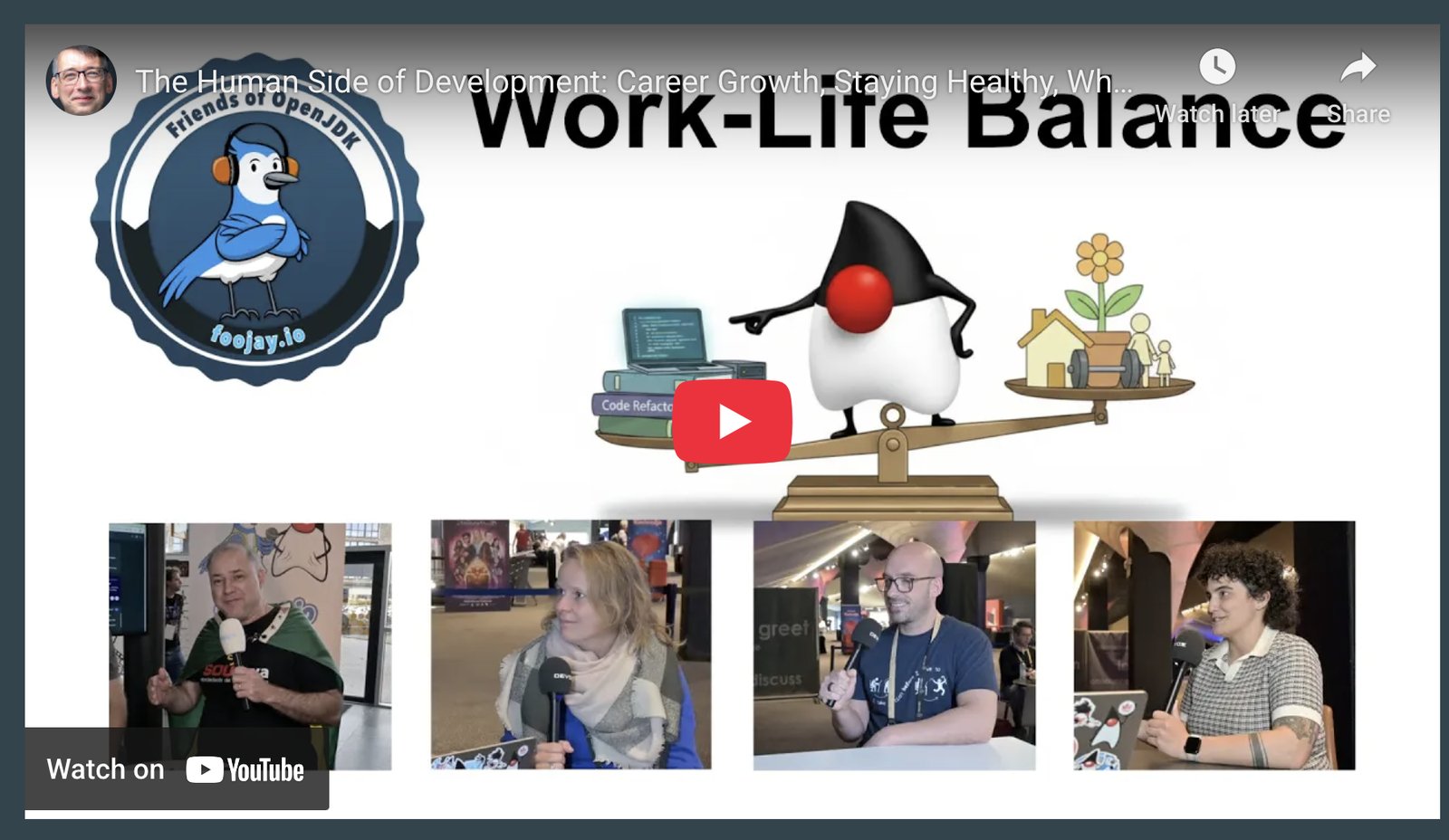
Foojay Podcast #87: The Human Side of Development: Career Growth, Staying Healthy, and Why People Matter More Than AI
 Frank Delporte
What if work-life balance is a myth, and the real secret is just… life?
In this Foojay Podcast we’re stepping away from pure code and diving into something equally important: how we live our lives as developers. Because let’s be honest, being a great programmer isn’t just about mastering Java or the latest framework. It’s about managing your career, your health, your family, and finding purpose in all of it.
Four incredible guests are all tackling different pieces of this puzzle. First up, Bruno Souza, the Brazilian Java Man, He is back to challenge our thinking about work-life balance and share his philosophy on taking control of your career. Then Patricia Lenten talks about the real challenges of hacking parenting while being an engineer, and how we can inspire the next generation of developers. Georgios Diamantopoulos brings the hard data on why sitting is literally killing us and what we can actually do about it. And finally, April Schuppel shares lessons from Apryse’s journey through 15 acquisitions in five years—and why people, not AI, are still the most important part of building great products.
YouTube
Podcast Apps
You can listen and subscribe to the Foojay Podcast on:
- Spotify
- Apple Podcasts
- And most others…
Content
00:00 Introduction of topic and guests
01:20 Bruno Souza
- https://www.linkedin.com/in/brjavaman/
- Grow your career podcast: https://foojay.io/today/foojay-podcast-72/
- Bruno’s YouTube channel: https://www.youtube.com/@brjavaman
- Work-life balance doesn’t exist, we only have life
12:52 Patricia Lenten
- https://www.linkedin.com/in/patricialenten/
- Hacking your parenting
- Technology is fun
18:37 Georgios Diamantopoulos
- https://www.linkedin.com/in/georgiosd/
- Staying Healthy
- The importance of getting out of your chair
- https://stateofhealth.tech/
22:58 April Schuppel
- https://www.linkedin.com/in/aprilschuppel/
- Pull, Push, and Merge: Lessons from a Journey of Growth Through Acquisitions
- The people are the most crucial part to build a team, product, and company
30:26 Outro
Transcript
Automatically generated from the audio, so it can contain errors in names and technical terms. Suggest a correction.
[0:00] What if work life balance is a myth and the real secret is just life?
[0:06] Give me a jk.
[0:11] Welcome to another episode of the Foojay podcast. Today we’re stepping away from pure code and diving into something equally important. How we live our lives as developers. Because let’s be honest, being a great programmer isn’t just about mastering Java or the latest framework. It’s about managing your career, your health, your family, and finding purpose in all of it. I’m joined by four incredible guests who are all tackling different pieces of this puzzle. First up, Bruno Souza, the Brazilian Java man. He’s back to challenge our thinking about work life balance and shares his philosophy on taking control of your career. Then Patricia Lenton talks about the real challenges of hacking parenting while being an engineer and how we can inspire the next generation of developers.
[1:01] Georgio Diamontos brings the hard data on why sitting is literally killing us and what we can actually do about it. And finally, April Shupel shares lessons from company acquisitions and why people not AI are still the most important part of building great products. So let’s get started. So, hey guys. How it’s amazing to be here at the 4J podcast, right? It’s awesome. And they have this very very cool sticker that’s on my laptop, right? It’s very very cool. You know, I love the combination of Duke with birds, you know. Jurgy is also around with Duke. So, so I love that. And the interesting thing is because you know on the sign right here you see what’s the name of your bird? Is it his hand name?
[1:51] J bird.
[1:52] Oh his JB bird. Okay. Right. So yeah. So then there’s a there’s a picture of him holding the microphone. Right. And the cool thing is that Yes. That’s the one right there. Perfect. Right. And the cool thing is that Duke doesn’t speak.
[2:05] Right. So the birds have to speak for Duke.
[2:08] Yeah. Okay.
[2:08] That’s that’s what I love the idea that the community Yeah. The community speaks for Duke. Right? Cuz Duke is the VM. He makes things happen, right? But we speak for him, right? How about that?
[2:20] That’s pretty nice indeed.
[2:23] All right. So, guys, this is Bruno Sa. I’m I’m known as the Brazilian Java man and I’m here to help you grow your career.
[2:30] Okay. Growing your career. You talked about that in the podcast before.
[2:34] Yes.
[2:34] Very good ideas. People who want to learn about that, I will add a link to the previous podcast.
[2:39] Perfect. Yes. Go watch that cuz we talk about some very cool stuff.
[2:42] And another question I have for you is I learned from you, you are yourself responsible for your career.
[2:50] You should guide your manager in what you want to achieve with your career. But
[2:56] How do you combine that with work life balance
[3:00] And then the combination with work, private life, learning, visiting conferences?
[3:07] How do you find the ideal mix? So I love this question about work life balance, right? Because I don’t believe in work life balance, you know, because it doesn’t exist.
[3:19] We don’t have work life balance. We only have life.
[3:22] Yeah.
[3:22] It’s your life, right? And I think I do understand that some points in your life, you want to focus more on your career. Some moments in your life, you want to focus more on your family, right? Some points in your life, you want to focus more on you, you know? So I think that’s life is something that we have to cherish right and focus our life in the things that we want to do
[3:46] And so at some point in your life this career is going to be important for you and you might spend lots of time doing this but that’s not forever you know it’s going to be for the time that you want so everything that we do should be should have a purpose you know should it should be intentional in what you want
[4:03] So if you want oh I want to learn a new techn technology. I’m going to I’m going to stay up late and I’m going to work on weekends because I want to do this. If that’s something that you want to do, right? And you see the value of it and that’s something you’re looking for, you know, you go ahead and do it, right? You know, that’s that’s what you’re looking for. I was talking to a guy here in the mentorship hub and he said, “Oh, because I want to learn some new technologies, right?” And then he said and I said, “Why?” He said, “Oh, because I love to learn.” And I said, “Okay, so if you spend a weekend doing something you love, isn’t that cool?”
[4:37] Yeah.
[4:37] Yeah. It’s cool. So it has nothing to do with work,
[4:40] Right?
[4:41] It’s it’s related to work, but it’s not work itself.
[4:44] Exactly. I mean, it’s it’s it’s because work is part of that.
[4:49] So can I say something that people hate when I give that answer, but that’s a very simple answer. Lots of people asking me how do I have time to do something to learn a new technology for example right or have time to you know to go to an event or something like this right and there it’s very simple you want to have all the time in the world is very very simple but you’re not going to like my answer right because I you know it’s too simple maybe right if you want to whatever you want to do get someone to pay you to do that right you’re here in event someone’s paying you for to come here, right?
[5:27] It’s Yeah, this is part of my job,
[5:29] Right? It’s part of your job, right? So, no. So, if you have someone paying you to learn or paying you to come to an event, right, or paying you to solve a big problem, right? You’re going to be doing that for that time.
[5:43] Yeah. And it’s as I said before, I learned from you, you’re the master in control of your own career,
[5:50] Right? You also need to convince your manager that sending you to a conference is okay. It’s one day that you lose doing work, but you will learn so much that you will be a better developer. So, it’s a benefit for your boss at the same time.
[6:09] Right? So, I like to think about the words we’re using
[6:13] Because the same words that you use that some other people do use. Right? So, you say I have to convince my boss, right? So convince is a very bad word
[6:22] Because
[6:22] It’s a hard word.
[6:23] No, because because if you’re trying to convince is because he doesn’t want it, right? And so you’re forcing him to change to want something he does not want, right? So it’s not about convincing. It’s about understanding what your boss wants and aligning going to an event to what he wants. Right? And then you said something else. That’s another important word. you said, “Oh, I’m going to lose one day of work.” So, if you that’s why you think that you’re going to lose a day of work to go to an event, then don’t go. Right? Because if you consider that’s a loss, maybe you’re not you shouldn’t go because that’s a loss. So, but that’s not a loss. It should be a win.
[7:05] Yeah.
[7:05] And so, the way to do this is figure out what your boss wants, what is success for your boss. So, you help him achieve what he wants by going to the events. Okay.
[7:15] So then going to events is boss, we’re we’re moving forward in what we want to do. That’s why I’m going to the events because I’m going to meet people. I’m going to solve a big problem, right? You know, I had a mentee the other day that she went to an event
[7:29] And she was able to have like a one-hour conversation with a speaker. You know, she was she just asked one question to the speaker and said, “No, no, let’s let’s figure this out.” So they sat down for one hour and they solved the problem for his for her company. So it’s like how do you get a top speaker, a top open source developer just to solve a problem for your company?
[7:52] Yeah.
[7:52] You know, so if you can do that, that’s value for your company. It’s a huge value. It’s a value, you know, it’s it’s it’s because it’s not only oh, how many how much it cost in an hour for this guy. It’s you probably cannot pay it. Not because it’s too expensive, but because he’s not going to give you that hour, right? So you cannot hire him and so but you going to the event she was able to get him to solve the problem
[8:18] To meet him. to meet him, right? And so if you can think about how we go into an event, we learn a new technology, we migrate to something else, we applying a new technology to our project, we doing tasks, we’re doing you know whatever, right? Modernization, right? Or you know or we reducing our technical depth. If if you can align all those things with what your boss wants, what is success for him, then he will want to do that.
[8:51] Yeah.
[8:52] So there’s no convincing to make.
[8:53] Yeah. Yeah.
[8:54] Make sense?
[8:55] Total sense. And another nice message that you share is go to the speakers.
[9:01] If you are at the conference, the speakers are here to share their knowledge,
[9:06] Right?
[9:06] So you should just grab them and ask your questions.
[9:10] Yeah. I have an awesome insight from Hi Kabutz and Hi said when he goes to the conference right you know he’s a speaker
[9:22] So he can’t just walk to you right there hey ask me questions
[9:27] I mean maybe to you because you’re doing the podcast right so maybe he could do that right ask me questions right but no he can’t just walk to someone and say hey ask me questions right
[9:36] So the speaker is in a little bit of a pickle Right? Because he cannot ask people just ask me questions. So he has to just be available there. Now you can come to speak and ask him questions because that’s what he’s expected to do. So if you don’t do it because you’re afraid because you think you’re bothering him or because you’re thinking that oh he has other things to do then you don’t ask questions and the speaker doesn’t answer them not because he doesn’t want to because there’s no one asking. Right? So that’s an insight that when I had that it’s like you know it’s a it’s like a go and ask talk to people you know if you talk to a speaker and he cannot talk to you he’s going to say look I’m busy right now or I have to leave I have a plane to catch it’s all good right but in if he can he’ll stay he’ll answer questions he’ll talk with you
[10:30] So don’t be afraid go on ask questions talk with people because it’s going to be very beneficial to you too
[10:37] Answer You know, cuz that’s that’s the that’s the goal. Same thing for your boss.
[10:42] When you do something that’s good for your boss, your boss wants you to do it.
[10:46] Yeah.
[10:46] If you do something that’s good for the speaker, the speaker is going to want you to do it, right? So when you go and ask questions and your interest, you know, say, I watch your talk, you know, don’t like this like there’s some people that do this, right? They come to the speaker and say, “Oh, you’re so and so, right? So what you should talk about?” It’s like You know, don’t ask that, right? Because you should know what it talks about, right? I mean, you know the person, right? You should ask direct question.
[11:14] Just ask a question about the topic, you know, about something. So to and so if you do that, you’re helping the speaker answer you, right? You’re helping the speaker help you.
[11:25] And one more interesting thing, people believe that by asking questions, just wasting the time of the speaker. But the reality is that when you ask a question, you allow the speaker to give to create some piece of content that he never had before, right? So, for example, I was in the in the Amsterdam Java group a couple days ago, right, with Gertin, right? And so over there was this person in the front row that he asked kids, “Oh, you’re talking about you know all this growing the career thing, but all of these is for big companies. I work for a small company. How do I do those things in a small company?” And so no one ever asked me this question,
[12:11] Right? So I never had an opportunity to get to give my take on that topic. And so I answer him, right? and I record a video on the next day that’s now on my YouTube channel, right? Br Java man. so you go there, there’s a there I answer that question. How do you know you work? You do things on big big companies, do things small companies, right? So now that’s a piece of content that I never thought about. I only Yes, I was needed because the guy was needed, right? So I only thought about because someone asked the question. So when you ask a question, you turn you know, you help us create the content to help you.
[12:52] My name is Patricia and I’m here to have my talk here in the afternoon about how to balance work and parenting.
[13:00] Okay. Which can be quite challenging.
[13:03] It is quite challenging indeed. And I’m a single mother of four kids. So you can imagine it’s even more challenging, right?
[13:09] At what age?
[13:10] Four, six, 15, and 18. So I have everything. I have one heavy 15 teenager. So
[13:18] You know how it is.
[13:19] I know how it is.
[13:20] I have it gear four multiplied four. Yeah.
[13:22] Okay. But you’re also involved in development.
[13:25] Yes. I’m an engineering manager at B
[13:27] And my background is in development and I moved from development to management positions to become an engineering manager at B.
[13:33] Okay. Yeah.
[13:34] And is the managing that you do at B related to the parenting or vice versa?
[13:41] The managing at B is also parenting in a way. I think but different right with kids is a different aspect but I think it’s a topic where we don’t talk about that much
[13:52] And that people come back after maternity leave or as a dad when the kid is born and then we just expect them to go back to work like nothing happened but it is I think one of the biggest life-changing events. So I want to tell my hacks how I combine everything together and inspire people with that and hopefully they can step out of my session and think like oh if I implement this my life will be a little bit better.
[14:15] Is there one takeaway from the talk that you have the most important takeaway?
[14:20] The most important takeaway I think is me time. So I have multiple hacks but I think me time is the most important one. So when I divorced and I was four kids alone, I did everything. I could manage it, but I had no time for myself, right? The day was full from the morning till the late afternoon into the night. And then when I when like a 9:00 in the evening, I’m like, I’m so tired. I just want to sleep. so there was no time for myself basically. And now I know ways how to implement that for myself.
[14:52] Thanks to co we have this new way of working a lot of home.
[14:56] Yeah.
[14:57] Does this help or impacts how you can be both a parent and a good developer or a good
[15:05] I think it helps right because if I like to be in the office to be honest. So in B we are like two days in the office. I like to be in the office but I also have then travel time, commute time and if I’m working from home I can just bring the kids to school and immediately start working and I don’t know do the laundry in between or cook dinner during lunch break and that helps I think the parents to better balance things and yeah to be a better parent also.
[15:29] Yeah, for me I also I work completely from home. My office is in the US so it’s a bit difficult. I live in Belgium. Yeah,
[15:37] For me it’s indeed the flexibility. You can bring the kid to school and then stay focused because
[15:43] The worries are gone.
[15:45] And that’s a bit I think the most important part of the homework.
[15:48] Indeed. And I think it saves a lot of time, right? So the commute if you live like 5 minutes from your work, it’s fine. But I live like 40 minutes and it’s like twice 40 minutes like one and a half hour without traffic. Yeah, that’s a long time. I could also done things with the kids or for the kids or in my house or
[16:06] So also the fact that you don’t need to commute helps I think.
[16:10] How do you apply some of these knowledge to your kids? Do you try to inspire them to be interested in this kind of work?
[16:19] Definitely. My oldest one is studying now to become soft engineer. So mission accomplished there.
[16:25] And he was once at defocus kids also. Yeah, it was like years ago, right, when he was small, but he was like one day there and I also have this robot from Lego and they like to program with that we do sketch. So yeah, I try to show them that there is more.
[16:42] How can we help children to know that being an engineer or a programmer or working with technology can be so fascinating
[16:51] To do more of this deox kids I think but also in school. So I know that B is doing also programs in schools like in Utre for example then we go there as colleagues just to the school and try to teach just already small children some steps right for example okay I have here a sandwich and I need to put something on it tell me the steps and they forget all the steps of course and then you do crazy things they like it but I think doing this kind of things make them aware of it will help and I think people that are software engineers can also do this right probably they will like that too to just go to a school from their kids and educate the class of the kids for example low level something fancy just low level will help them I think already
[17:34] Even the no computer programming like takes that number of steps to achieve something or like the sandwich like
[17:40] The sandwich yeah it’s so easy but it’s nice for the kids to think about it yeah
[17:46] So you work at bowl is that a Java developer group or do you have several technologies
[17:51] We have multiple Java as the texture Yeah.
[17:54] Anything from this conference you want to take with you?
[17:58] I’ve just been to a talk from AI which was nice. and I think that’s all in the world now, right? So, so
[18:04] What is it that a developer will do and what will AI take over and what not and I think that’s something I will bring back again like
[18:11] Don’t be scared.
[18:13] Nobody can really do our job.
[18:15] Yeah, we already
[18:15] Part of it maybe but yeah,
[18:17] We have the stress of having kids and having work and then the stress of will the job will still be the same. Yeah, I don’t know. I don’t think it will be the same. Everything will should be changing, right? But I don’t think it will be completely gone because we just need human
[18:30] Brains for doing stuff.
[18:32] Yeah. And fixing problems.
[18:33] Fixing real problems and understanding real problems also. Yeah. True. Yeah.
[18:37] I’m George Diamatopoulos. And I’m here to talk about the impact of sitting.
[18:45] Okay. And which is the same topic as last year. We talked last year.
[18:48] Correct. what changed or what extra knowledge do you have?
[18:53] Yes. so every time I give this talk I try to improve it and after last year I had a lot of good feedback and I just I went straight to the research to see what actual research could be useful and that seemed to have had an impact because everybody really knows that sitting is bad for them
[19:17] Which we are doing now. So we should start.
[19:18] That’s right. Yeah. but when we look at the numbers even even for me like I you know I should know right but when I looked at the numbers I was actually shocked and I made even more changes than I did last year for myself and I brought that to the presentation this year.
[19:37] So sitting 8 hours on your computer bad ID. What is the main difference we can make? So the what the research tells us essentially the TLDDR of the talk is that we need three things and we can’t just do two of them and be okay. We need all three. So we need regular breaks. So anywhere between 30 minutes and 50 minutes. obviously less is better. movement like light movement like walking and we need to ideally have that in regular intervals. So the idea is we you know we take a break and maybe walk for a few minutes inside the office or you know in the morning in the evening go outside and then we also need highintensity exercise which is defined as 50 to 80% of maximum heart rate.
[20:29] So those are all the things that we need to be doing regularly to actually improve our health markers.
[20:35] Okay. Can I have a personal consult? So I’m working from home. I have a dog.
[20:40] Almost every noon I go for a walk of 15 20 minutes with the dog. That’s not enough.
[20:46] You know, it’s a good start, but you would do even better to have more of those over the day. Even
[20:54] The dog will like it.
[20:56] Yeah, I’m sure he will love it. and then, you know, pick some sort of exercise which raises your heart rate and you like, you know, you don’t have to be professional.
[21:07] I won’t ever be a professional sport.
[21:09] Exactly. And this is true of most of us in this profession, right? but just anything. It could be it could even be a social sport.
[21:18] Just something that raises your heart rate and trains your, you know, your heart and your breathing and all that. And, you know, that seems to be the recipe.
[21:28] If I can remember correctly from the last year, you’re not a Java developer.
[21:32] I’m not. I’m actually on the other side. net
[21:36] The dark side.
[21:38] That’s right.
[21:40] Could can we get you interested in Java by joining this conference or what did you learn from this community?
[21:47] I this year I wasn’t able to I only arrived today. but the next two days today I’m still preparing for my talk because I’m nervous but the rest of the two days you know I’d love to see what’s going on with Java. And
[22:02] It’s always interesting to add tools in your toolkit and it doesn’t matter who made them, you know. So
[22:06] If there’s something interesting, I’ll definitely pick it up. Like last year, I was pleasantly surprised by lang chain
[22:12] In Java.
[22:13] Other tools that you specifically are looking forward to? I went to a really interesting talk earlier about burnout and it was a really interesting story of someone who went through burnout and then went through the motions of going to psychiatrist and anti-depressants
[22:29] And he described his journey and I think you know we can learn a lot from that.
[22:34] Yeah.
[22:34] I know you probably expected to for me to say something about a tech talk. No
[22:41] No because that’s actually a nice mix here. So you have a lot of tech talks,
[22:44] But you also have a lot of talks.
[22:47] Yeah. Developer tools, productivity, well-being,
[22:51] Developing your career. So yeah, staying healthy is the main focus here.
[22:57] Yes.
[22:58] My name is April Shupel and I’m here representing a prize. We’re one of the sponsors here. So we have a booth and then also I’ll be giving a talk tomorrow. So pretty excited about that.
[23:10] Okay. Okay. And the talk is about
[23:11] The talk is called pushpull and merge. and it’s all about a prizes journey of growth through acquisitions. So you can imagine just doing one merger acquisition is hard enough. We’ve done like 15 in the past five years. just three this summer. So it it’s a lot of change for a lot of people. And so the talk is all about the lessons we’ve learned from that. ways that we can try and make things better and all the benefits of coming together in that kind of way. All the innovation that can happen, all the great people coming together and stuff like that.
[23:50] And also the scare because getting bots for employees can be quite scary.
[23:59] And can be scary. And also, you know, of course, sometimes that means that some people are going to lose their jobs, which is you know, that’s we’ll also be talking about some of the more difficult parts. but in the end, how it helps us make a better product and also helps the people who stay with the company to grow, right? Because you can imagine if you’re coming from a company of 20 people and you’re all in the office together and you’re building things in a certain way, maybe there’s not opportunities to be promoted into a leadership role or you know maybe you’re stuck like working with one technology versus now okay you’re in a global company and there’s a lot more room to grow and move and if you’re interested in doing other things there’s more of a chance to do that. So, yeah, there’s there’s pros and cons. I think that, the pros outweigh the cons. So, that’s part of the talk, of course, but, you know, we’ll we’ll talk a little bit about everything. I prepared for the talk by, interviewing a bunch of people within the company. So I tried to interview
[25:04] Someone that has come from all these different companies as well as like the starting company that did all the acquiring and just to hear the different perspectives and also yeah like technological innovations that have come like one thing that’s kind of funny for example is you know we have acquired companies who were interested in using a prize but maybe couldn’t get a license for it but now okay they can use it. and then also the other way of teams with enterprise who wanted to use another product but couldn’t you know get approval for the license and instead we just bought the whole company. So it opens up the doors to also have technological innovations when you have these different teams coming together and more access to different technology.
[25:51] I checked what you do and there’s one that I definitely know is ITEX because I’m from Belgium. I know ITEX is Belgian based company or founded in Belgium to create PDFs with Java.
[26:03] What are the other tools or how can we know your company from which tools?
[26:07] Sure. Yeah. So, ITEX is a big one also especially here we’re very close to their office over in Gent. so nice Belgian success story of course but our two of our most recent acquisitions that happened were one is scanbot they’re based in bone Germany and then also acoft they’re in Florida we’ve also few years ago acquired a company called lead tools now you’re putting me on the spot I’m used to having my slide with the timeline and all the logos but
[26:44] A bunch of tools a bunch of a bunch of different tools.
[26:48] It for instance is both open source licensed.
[26:51] I always find it fascinating when a company is able to have an amazing open-source library like Valden is for me one of the key examples there. You can create amazing applications with a free tool.
[27:04] Y
[27:05] And if you pay for it then you get Yeah. support and additional premium features. Yep.
[27:10] How difficult is it for a company like you to build on top of that model?
[27:16] Yeah. I think
[27:17] To find the Yeah. the balance between open source and earning money.
[27:22] Yeah. I mean, I think the interesting thing
[27:26] For us being here and maybe it’s also because we’re in Belgium, but also because it has been coming to this conference for years is a lot of times people will come up and maybe they won’t know a prize, but they’ll see itex on our thing and be familiar with it. So the power of open source is it gives you a lot more kind of brand recognition within the developer community. If it’s a tool that anyone can use or anyone can contribute to then it becomes much more well known to developers where you know paid products can be a little bit more niche and hard for developers to know because you know if I’m a developer and I’m at a conference and I don’t have a use case for it right now or I have to figure out how to get approval to pay for a license like I’m not going to go and try to use it. So I think that’s like one benefit of the open source of just like being more wellknown but then thinking about okay well if I can just do the open source why would I pay for it? It’s you do get those extra benefits of support and additional features and you know there is a cost to
[28:30] Open source like it’s it’s fun to use it’s free but it’s also
[28:35] You have to be the one to maintain it and do all sorts of things. So you know it’s it’s a balance like with anything. Do you want to pay for the convenience or the additional features or do you want to build everything on your own?
[28:49] So
[28:49] Okay and with the company so you acquired a lot of other companies. What is the most important takeaway from the talk that you will give about this? my biggest takeaway that I’m gonna try to drive the point home and then also that I wanted to talk about just because you know you look at this conference or a lot of other developer conferences it’s all talking about AI all the time but one common thread that I found across you know talking to all these different people is the people is really the most important part like that is the most important thing because Yeah, AI can do a lot, but AI is just taking what humans have done and maybe it can do some calculations a little faster, put, you know, synthesize things faster, but it’s like the human creativity that is the spark. and being able to, you know, when you make an acquisition,
[29:42] Yes,
[29:43] I kind of was coming to this sort of analogy of, you know, when you do vibe coding or something like, okay, it gives you a starting point of the code and like maybe it works, but you don’t know, you don’t have any of the context of like why things were built that way or like, you know, how things have come to be. So being able to acquire companies and also get the people who have all the domain expertise, who have all the knowledge of like how something was built like that becomes the most important thing is bringing in the people and like people coming together with different knowledge to be able to build something even better and innovate on top of that. So people most important part
[30:24] People above AI
[30:25] Above AI. Yes. And that’s a wrap for this episode of the Foojay podcast. A huge thank you to Bruno, Patricia, Georgios, and April for sharing their insights, and to you for listening. Whether you’re thinking about how to own your career path, figuring out how to balance parenting with engineering, getting out of your chair more often, or just remembering that people are still at the heart of everything we build. I hope you’re walking away with at least one thing to try this week. If you enjoyed this episode, please subscribe to the Foojay podcast on YouTube or in your favorite podcast app. You can find all our episodes, show notes, and links to the resources mentioned today on Foojay.io. And don’t forget to follow friends of OpenJDK on social media for the latest news and updates from the Java community. Until next time, keep coding and keep learning, but also keep living, keep moving, and keep putting people first. Thanks for listening.
Found a mistake, or something to add? Edit this page on GitHub

Frank Delporte
Frank Delporte is a Java Champion, Java Developer, Senior Technical Writer at Azul, Blogger, Author of "Java Programming for Raspberry Pi - A Hands-On Guide to Electronics and IoT Projects", and Open-Source Contributor for Pi4J, Lottie4J, Sheetmusic4J, …