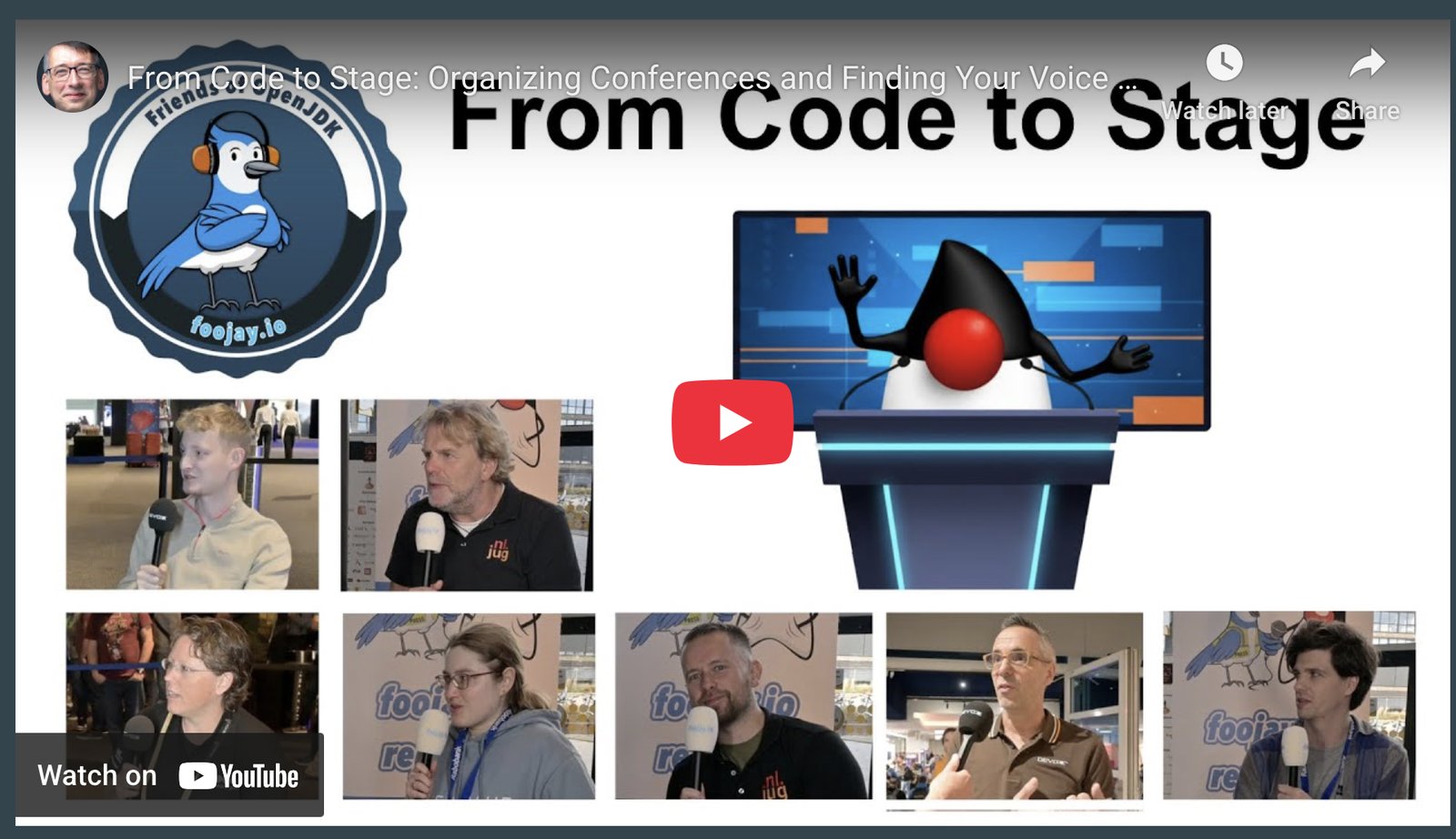
Foojay Podcast #88: From Code to Stage: Organizing Conferences and Finding Your Voice as a Speake
 Frank Delporte
What turns a nervous first-timer into a confident conference speaker? Let’s find out.
This the last Foojay Podcast of 2025 and also the last one with interviews recorded at the Devoxx and JFall conferences. Maybe you’re already thinking about your goals for 2026: organizing a meetup, submitting your first conference talk, or taking a bigger role in the Java community. If that sounds like you, this episode is for you.
I talked with the people behind these conferences and developers at different stages of their speaking journey. At Devoxx, I spoke with Stephan Janssen, who has been organizing Devoxx for 20 years, Susanne Pieterse, about what makes conferences valuable for learning, and Daniël Floor, a developer just starting out with public speaking. At JFall, I caught up with organizers Martin Smelt and Brian Vermeer, Berwout de Vries Robles, who coaches new speakers, and Annelore Egger about her journey from developer to conference speaker.
You’ll hear practical advice about what makes a good CFP, why conference organizers actively want new speakers, and how the Java community is set up to help you get started. Whether you’re thinking about submitting your first talk or curious about what goes into organizing a conference, there’s something here for you.
YouTube
Podcast Apps
You can listen and subscribe to the Foojay Podcast on:
- Spotify
- Apple Podcasts
- And most others…
Content
00:00 Introduction of topic and guests
01:33 Stephan Janssen
- https://www.linkedin.com/in/stephanjanssen/
- Devoxx Organizer
07:03 Martin Smelt
- https://www.linkedin.com/in/martin-paul-smelt-8b699a8/
- JFall Organizer
13:27 Brian Vermeer
- https://www.linkedin.com/in/brianvermeer/
- JFall Organizer and speaker
- Tips for speakers, writing a CFP
- Join a JUG!
21:02 Annelore Egger
- https://www.linkedin.com/in/anneloredev/
- How to become a speaker
27:43 Daniël Floor
- https://www.linkedin.com/in/dani%C3%ABl-floor-266652208/
- Taking the first steps into public speaking
- Finding your speaking topic
31:28 Berwout de Vries Robles
- https://www.linkedin.com/in/berwout-de-vries-robles/
- Tips for speakers
- Propose a talk to speak at a JUG
37:08 Susanne Pieterse
- https://www.linkedin.com/in/susannepieterse/
- Learning at conferences, RAG, and other topics
- Meeting and talking to the presenters and specialists at a conference
- CO-organizer of ML Con and DevOpsCon in Amsterdam
- https://mlconference.ai/
- https://devopscon.io/amsterdam/
41:20 Conclusion
Transcript
Automatically generated from the audio, so it can contain errors in names and technical terms. Suggest a correction.
[0:00] What turns a nervous first timer into a confident conference speaker? Let’s find out.
[0:05] Give me a JDK.
[0:12] Welcome to this episode of the Foojay podcast. It’s the last one of 2025 and also the last one with interviews recorded at the Devox and Jall conferences. Maybe you’re already thinking about your goals for 2026. organizing a meetup, submitting your first conference talk, or taking a bigger role in the Java community. If that sounds like you, this episode is for you. I talked with the people behind these conferences and developers at different stages of their speaking journey. From DevOps, I spoke with Stephan who has been organizing DevOps for 20 years now. Susanna Peterson about what makes conferences valuable for learning and Daniel Flor a developer just starting out with public speaking at JFall. I caught up with organizers Martin smelt and Brian Vermeier Boot Deceas who coaches new speakers and Analora Edgar about her journey from developer to conference speaker. You’ll hear practical advice about what makes a good CFP, why conference organizers actively want new speakers, and how the Java community is set up to help you get started. Whether you’re thinking about submitting your first talk or curious
[1:27] About what goes into organizing a conference, there’s something here for you. So, let’s get started. I’m Stefan Jansen, and it seems I have to be here for the event. So I co-organize it with my wife and a great team this event and it’s our 20th year that we’ve been organizing this but there were two years with co which we skipped. So, it’s our 22nd edition of Deox Belgium with a lot of great content again, a focus on AI. Why? Well, that’s where the excitement is and that’s where, you know, my productivity gains that I’m getting these days in my pet projects and even the DevOps mobile app. I mean, it is really my assistance, my coding assistance. And again, it’s the excitement. it’s clear that AI will not replace developers, but developers using AI will replace you. So you need to if you can’t beat them, you have to join them and embrace it and try to use it and see what works, what doesn’t, etc. So this here is Java Belgium, it’s Java 25 AI agents and then the combination of the two because like with project Babylon, we’re starting to see Java interference on GPUs, etc. And it’s
[2:35] Clear that’s the way to go.
[2:36] A lot of changes as you say in Java. I have a talk about FFM API which was introduced in Java 22. It seems that a lot of evolutions are now being used by AI but actually they were not meant to be there because AI didn’t exist let’s say 5 years ago or 10 years ago when a lot of these projects started. Yeah, true, true. It’s a whole I mean at the end of the day it’s ve vector multiplications, right? and if you can do it, it’s clear that you have to do that on GPU and if we can do that with the vector API in Java also f I mean we have examples where we’re doing interference using VM to native execution which is faster than the original C++. So there’s such a clear fit. I mean why use Python? Python needs to be used by data scientists. But if you want to use AI in the enterprise, then Java is the language. It’s the most performant, platform neutral, and it’s very fast. So yeah, it’s a logical mix. So I’m really happy that Oracle is starting to step up and many other companies are as well.
[3:39] You’re starting to see also new layers of frameworks like Embabble. You have of course LangChain4j which was announced two years ago here at Devox. so there’s this whole ecosystem that’s that’s starting to build up. I talked to a C# developer here and he’s a bit jealous about Java evolving faster now than C. Is that something you heard before here? But no, that’s a that’s a nice I like to hear that. Yeah, but I’m still like it should go faster. I mean like last year I was already a bit frustrated that I had to get somebody from the grow VM team to speak about interference in Java and it’s like come on this is such a this is an enormous opportunity for both Oracle and the Java ecosystem why hasn’t this happened sooner right so it’s it’s happening the pieces are moving etc and it’s going to be big business that’s that’s for sure
[4:34] Are you already looking forward to next year what will change in Java 27 Seven in the next DevOps any idea?
[4:42] No, I have no idea. I really don’t follow that close anymore, but I’m more like the next four months I’m like my off time to do R&D etc. I want to look at embabel. I want to look at chain 4J agents and more look in that aspect. I’ve built or vibe coded the new Devox mobile app. I need to fix a few things. but I also want to go deeper in like the spec driven developments which interests me collaboration between agents etc. And I mean, we’re all polygot developers. I mean, Java is my first choice of language, but with the UI, it’s TypeScript. I if I want a sexy UI, I need to use TypeScript, etc. But no, I haven’t thought about that yet. If we are all on an exponential, you know, I’ve been doing things today which one year ago were not possible.
[5:28] So, just imagine if we are on an exponential, I’ll be able to do things in 4 months time which weren’t possible now. So, it’s very hard to predict. So, that’s why it’s good. So it’s only every every year because then now I can digest look at all the talks which we publish on YouTube go to the other devoxes and then start to identify the trends that I would like to introduce in the events as the main organizer of Devox the brands you are invited I guess to many of the other events still able to learn from all these other talks. So what I do, the problem is I organize this nice events, top speakers, great content, but I can’t really enjoy it. And that’s really like the downside of the event organizer is that you try to create the best party ever and you you’re running around like a headless chicken, right? So at last with Devox, France, Greece, UK, Poland, Netherlands in the future, I can go there as the VIP guests, right? I can just enjoy a conference well put together go to talks and also see a bit like you know what are the trends who are the best speakers etc. So I’m doing prospection
[6:36] At these events to see if there are I need to invite anybody or whatever or also see the trends in the other countries etc. And that’s a bit my yeah the inspiration events for me to actually feed Fox Belgium and it works both ways of course you know even other competit competing events come here and they look at the top rated talks and they go like okay I need to invite this guy. So it’s it’s a it’s a collaboration it’s a synergy. My name is Martin Smemells and I’m one of the organizers of the JFO.
[7:08] So you had to be here.
[7:09] I had to do something and not only today but also yesterday.
[7:13] Yeah.
[7:14] Because the conference day is today but yesterday we had a couple of workshops in another venue location and of course the masters of Yava the fun coding contest
[7:27] With around 80 people participating in teams. So 40 teams I believe.
[7:33] So it was also a great day.
[7:34] And what is the idea about the contest? Because I think that’s pretty unique to be connected to a conference.
[7:42] Absolutely. It’s it’s not didn’t do it for the first time. Also organizing it at least for 50 years now. And it was started up separate from the conference
[7:55] On a Saturday because in that time we thought
[7:58] For fun you have to be do it in a wicket
[8:02] And starting with 10 15 people but it’s made possible by one of our business partners of Tanjuk and we noticed that if you go to an event you the you want it’s in our opinion it’s the best to combine it in one package right and it’s for free
[8:29] For everybody not only you have to don’t have to be an member but like the conference is but for the mar of yaf is for everybody
[8:36] And our wish is to do it the whole week going on because the energy of feeling here I can do it for the whole week and it’s it’s difficult
[8:46] Yeah it’s a lot of preparation I can imagine to organize the conference.
[8:51] Yeah. But it’s it’s it’s it’s my profession.
[8:53] Yeah.
[8:54] Besides the member of the board from the foundation and I’m a professional organizer for also other events.
[9:05] Many years ago the foundation asked me to help
[9:08] Because it’s was growing and more people so you need some professional skills for doing that.
[9:16] So this my profession
[9:18] But I yeah I love it. I love this. It’s and we’re doing in a lot of events also in different ecosystems in the net in the front end in the DevOps con and the ML code.
[9:30] And it’s it’s it’s funny to see and everybody has got an opinion about it but if you are a developer you’re not and or if you’re an Java developer network there to completely different ecosystems.
[9:44] Yeah.
[9:44] It’s another DNA almost. That’s so funny to see. I’ve done C# development over 20 years ago.
[9:50] Yeah.
[9:51] I went to Microsoft’s organized conferences because yeah, they are the driving force there for C C.
[10:00] It’s a long time ago, but there is indeed a complete different feeling between yeah commercial company products and then Java which is yeah mainly open source. Do you what’s what what’s what difference do you see? I think it will help. It’s open source and because also in the Java the community can help to get the Java better.
[10:22] It’s a good question. I don’t know. I don’t know. It’s it’s worldwide the Java ecosystem. It’s different organized. Of course, we are in the Netherlands unique as a Java user group. I spoke yesterday in the car when I pick him up Steve from the Mr. Blue from the from the London jug
[10:43] And he was listening how we organizing the jugs and think and it’s it’s quite a unique model but still it’s it’s yeah it’s completely different in the net ecosystem. Yeah, of course you have net user groups and we’re working with them. Here you have more interaction and participating in into getting
[11:04] Not only yourself better in your skills but also the language better.
[11:10] People are here arriving around us for the coffee break. We are recording this interview in the afternoon. If you look back to today, how did things go?
[11:18] Yeah.
[11:20] It’s Yeah. Yeah. No. Yeah. It’s when you have a lot of people and I always said I’m only responsible for the decoration and to finish state but we need the people to make the party right and if you almost 2,000 people if you have almost 2,000 people in one day in a venue
[11:40] Yeah then it’s incredible vibe and especially of course the participation of the companies who are here in the market with pancakes with outside with the compet barbecue. You’ve seen it and French fries and it smells food everywhere. And yeah, it’s it’s it’s a shame it’s only one day I would say.
[12:01] Is this a plan for the next years? Maybe two days or more.
[12:04] Now yeah, that’s that’s difficult and always we have discussion about that in the board and it’s more than two days because yesterday was the workshop day. So the pre-conference is two days. but it’s also we think difficult to for other people to get off from their work and the good thing here because the Netherlands is so small you can drive from everywhere. You can go home tonight. You don’t have to stay in a hotel like in America is for example you have to stay for a whole week. And so maybe that’s also the reason because you can drive from Belgium to the here and it’s not further than two hours for example you know
[12:50] I heard about the NLJ it’s the best three-day conference in one day
[12:56] Oh somebody told you that
[12:59] That’s a compliment right
[13:00] That’s a compliment because you have all these tracks at the same time with all these great sessions
[13:05] Yes I remember the phrase and expression from Katr mode
[13:10] Many years ago he once told us that JVO is the best one day conference of the world but I think we are the only one day conference of the world it’s more or less the same as you said if you have one child you’re my favorite child you know
[13:27] My name is Brian Vir and I am one of the board members of the enl organiz so that’s basically why I’m here
[13:36] I saw you this morning checking all the rooms
[13:38] Yep absolutely What was your role?
[13:41] My role within this organization is together with another person to make sure that we have all the content together and that the speakers are here and that we distribute speakers over the different tracks and that kind of stuff. And on the day itself today is making sure that if everything happen anything happens that we fix it. So this morning I was checking all the rooms to make sure that all the speakers have Ethernet connection that there’s actually that they’re patched well because I know there will be talks about AI or cloud that they need a connection. So I was testing that this morning for all the rooms to make sure that there are no surprises for the speakers that come in.
[14:22] You said also said distributing the speakers over all the slots.
[14:25] Yeah. As a speaker, can I complain that I’m in competition with other great speakers at the same
[14:32] Oh, you can absolutely complain, but it’s always a
[14:36] It’s a luxury problem.
[14:36] It’s a it’s a luxury problem. First of all, if you consider that we have say approximately between 50 and 60 slots available
[14:48] And we have almost 500 submissions that it’s it’s already a gift that you that you’re that you’re chosen like there’s so many people that we have to reject and there are great talks in there as well. and then it’s making sure that you’re might be competing to other great speakers but your topic is not competing with that. It doesn’t make sense if say you are speaking about well you’re speaking about for instance the Raspberry Pi and or JavaFX or something like that and there is a similar talk on the same topic in the same slot. So we want to make sure that if an attendee over here because that’s my own focus my only focus the attendees come here they need to have a good time
[15:34] If they look at the schedule they can choose a different topics and obviously different speakers but there’s something for them that they can go to some people are not interested in AI but are interested in things on Raspberry Pies and if I put two Raspberry Pi talks in the same slot then they’re like okay which one do I have to choose
[15:53] And that’s not really a good thing. So that’s why you want to distribute that over the different different tracks.
[16:00] You select the talks based on a CFP.
[16:02] Yes.
[16:03] A proposal that someone has submitted. What makes a CFP stand out? What is a few good tips for people who want to start becoming a speaker? How do I get a chance of being elected to become a speaker?
[16:20] That’s a very good question. there first of all there’s no foolproof answer to that because let’s let me explain a little how this works. Like we have 12 program committee members. All of them individually rate a session and then we look at okay what do we collectively think are the best sessions and then we see is there overlap. We don’t want too many sessions on the same topic. so and that that’s why we have different tracks. and so that’s how we make the distribution. First said that. Secondly, if you want to stand out in a session is think from an attendee perspective. If an attendee to reach your title, it needs to be clear what it’s about. It needs to be tingling. It needs to be snappy and say, “Oh, I want oh I want to know that.” Same holds for your abstract. H the thing that I’m looking for is like okay, what is it that you are going to bring to the audience? What they are learning? like what are your key takeaways? If that is not clear from a title most attendees at the day itself will be like me and go to something else. So my point is like I’m looking at that like
[17:32] The title needs to be clear what it’s about and how are you going to tell that then I’m looking at your abstract that okay what are you going to describe what is your clapping in the in the background for you
[17:44] Not for me unfortunately but I’m look like how are you going to describe and what is your angle around that like is it a generic talk does it bring me anything more than the hello world application that you’re talking about is it new is it a specific thing like hey how things went wrong or how I learned or how we chose between frame framework X and Y. then I look at the speaker as well as in is the speaker
[18:06] Qualified to speak and that’s always a difficult point
[18:09] But obviously if you wrote books around things on Raspberry Pi so you know your stuff if I’m going to talk about Raspberry Pi I need to I need to create my track record first
[18:23] And then we’re trying to balance out between existing well-known speakers and also give a certain percentage to new speakers because it’s also our responsibility to grow the community and to grow the speakers.
[18:36] So, next to the event, we set up a speaker mentoring program or speaker academy while we help speakers to write certain things and how to write an abstract or how to write a good title and that’s always opinionated. It’s it’s very like how do you look at it, how do I look at it, but it needs to be clear. If it’s a oneliner,
[18:57] You’re obviously that’s you’re abstract. That’s obviously not good enough. Yeah.
[19:01] If it’s like five paragraphs, like nobody’s going to read that.
[19:06] So, it needs to be snappy, to the point, and very clear what you’re going to talk about and what kind of value you are giving to the attendees.
[19:13] Yeah, the Dutch community, Java community definitely has a big benefit of NLJ.
[19:19] Yes,
[19:20] You have all these events, you have all these JS, you have a speaker training.
[19:25] Can we say that the Dutch Java community is really strong? I think the Dutch Dutch Java community is quite strong. I won’t say the strongest because that’s that’s like I’m preaching to the choir then. But I think we’re we’re we’re pretty strong and I think you can see that in the amount of Dutch Java related speakers all over the world in different conferences. Like I see most of my Dutch peers in conferences abroad
[19:54] Which is weird. We’re such a small country but we’re very invested in that. yeah that’s a luxury position I we have. I guess the community community is very very strong I guess.
[20:05] Okay. And anyone who wants to join this community they can just join one of the jugs.
[20:10] Yep. I would say I would say start start with like looking at we’ve got the NL jug which is the national Netherlands Java user group and then we’ve got individual there are individual jugs in different regions or cities. technically we are not related. Everybody operates on their own. We’re trying to support each other. So if you’re living in the Rotterdam or Amsterdam area or Utrich area in the Netherlands, go and visit these these meetups. That that’s a very low low boundary low bar to get there to get in, speak to people, find things out. and then twice a year the NLJ we create two conferences J fall which is now and J spring which is obviously in spring has nothing to do with the spring framework just saying but yeah and you can visit you can visit the visit these as well so there are so many opportunities I guess to grow yourself and to grow your career on that. I’m Laura Eker and I’m here at JFall also giving a mentoring. It’s the mentoring is called I don’t know enough to speak at conferences. So it is for people that maybe think about
[21:17] Becoming a speaker but yeah don’t know how to start or think they don’t know enough. So
[21:23] And actually it’s not about knowing enough. It’s having a specific problem that you have fixed and there are many things you can talk about.
[21:33] Yes, exactly. That’s something I really also focus on because it is such a big field and it is impossible to know everything about the entire IT field. So I always say you just have to find the one thing that you specifically like or passionate about is important to you. And usually this is the thing that makes sense to show other people.
[22:05] Yeah.
[22:06] And it’s also how I came up with my talk ideas. So when there were things that I realized that are very important to me and often I realized oh for it’s for me it’s so normal but I realized other other developers
[22:22] They don’t know
[22:22] They yeah they don’t know or they don’t care about this specific thing so I realized that this is something that is not like normal for everyone but it’s especially important for me so I’m passionate about it so it makes to sense to share about How did you start with talking? What was the first topic you talked about?
[22:43] So, I mean, I started just first to write down all my ideas and then I juggled around a bit. I mean, I also had a bit of help because my fiance is already a speaker. So, he helped me a bit to just fine-tune the talk titles and so on. But I came up with the initial idea and my first ever talk that was accepted was taking shortcuts beyond your ID.
[23:12] But yeah, I mean when I started I submitted a few different topics. So it just then depended which one was accepted first. So
[23:19] I mean that’s that’s also an approach. You just select a few topics.
[23:23] Yeah. The crazy thing was then there were three talk three different talks accepted very quickly. So in very short time I had to prepare three talks.
[23:34] You had to write them all three.
[23:35] Yeah, I had three talks in three months. So three new talks. So yeah, maybe that is not the thing I would recommend to everyone.
[23:46] But it worked out. And
[23:47] Pick your battle and then focus on one. Yeah, exactly.
[23:52] How hard is writing the CFP, the proposal? Because that’s the thing that decides if you get accepted or not. I don’t find it that hard. I mean there I also had some help to just know what questions you should know a bit. I mean to think about what your talk should cover, what is the goal, do you if you have a story and so on. and you’re joining here the mentoring hub
[24:28] Organized by Bruno Soua.
[24:30] So the goal is to help people who are thinking about becoming a speaker.
[24:36] Yeah. So I was thinking when I mean when I submitted the mentoring I also had to write what is the audience or for who is this mentoring and I was wondering yeah if it maybe could be for everyone but then I thought maybe it’s easier to first focus maybe on people that are already thinking about maybe giving a talk because I think there are already enough people that are maybe in this area and it’s easier to help them to maybe become a speaker than to I don’t know try to convince anyone that maybe is just a developer. So yeah, I thought that this audience makes more sense because
[25:24] Yeah, I think the order is just maybe a too high goal that maybe doesn’t lead to anything. So it’s better to focus on people that are already maybe thinking about it. so that they maybe can do the next step
[25:39] And find their topic to talk about.
[25:40] Exactly.
[25:41] And if I found a topic if I found a topic that I want to speak about and I check a schedule like from JFall and I see someone else has a talk, should I still find my angle into that?
[25:57] That that’s a very interesting question. Actually about the year before I became a speaker I talked to a speaker I met at Jay on the beach and I think I mentioned something similar that yeah some topics there are already talks and she told me yes this doesn’t matter you haven’t given that talk and you have your experiences so the talk will be different when you give the talk on the same topic
[26:27] And also I feel like a lot of people learn in different ways. So maybe someone else gave a talk on a specific topic and maybe you just don’t wipe with their style of explaining things. So it’s good that a lot of people explain the same concepts but maybe in a different way. So although people have different
[26:54] Yeah places they can
[26:56] Yeah. different angle, different experience. Yeah.
[26:59] So I feel like you never should yeah be afraid to submit. And I also heard that sometimes it’s called like a self censorship. So don’t think oh no this talk isn’t good enough. Just submit it and let the community decide whether it does make sense or not. Doesn’t help to just hold yourself back.
[27:23] Yeah. And it’s not about the topic. It’s about your story.
[27:27] Exactly. how you handle the problem or fix something or learn something.
[27:31] Exactly. And it’s always different. It’s not the same.
[27:36] It’s You never will have an identical talk of a topic if it’s two different people that give it.
[27:43] I’m Daniel Floor. and well, I’m here to gather a lot of knowledge regarding Java, but pretty much anything new, but I’m a Java developer, so that’s why I’m here at the Java conference. But I’m also here to learn about well speaking seeing the different kind of speaker styles how you can do your presentation and what kind of fun things you should do or not like live demos and not having a backup. I’ve already seen the demos fail here which is kind of fun as well.
[28:14] I know the feeling. But yeah, I like to learn a lot of new things and well, this is probably the best conference for me within the region to go to
[28:27] To well learn a lot of things.
[28:30] Is Java your first language or did you go through others?
[28:35] I would say that Java is my first programming language started at the university. Well, they had to choose one language and they chose for Java. Well, and actually stickked and when I came to my company, one of the possibilities was to pursue a track in Java as well. So, I knew it. So, I like to stick with it so I can naturally grow as a developer and learn more. When I started, I think Java 11 just came out. But right now, well, I’m I’m I’m happy I can at least use Java 17, but I’m I’m pushing towards upgrading the Java versions, but unfortunately that is not always that simple.
[29:15] Yeah,
[29:16] You’re here to steal with your eyes and ears from the other speakers.
[29:20] What topics interest you to be on the stage maybe next year here?
[29:25] Well, it would be nice to be here next year, but that’s a that’s a big jump. I’m also a big fan of kind of the human aspect of programming. So yesterday I listened to a talk of Victor regarding psychology in programming. the these kind of topics are really interested to me. So how do we work? How we can we improve this? But do we have biases? how does our brain work? How can we comprehend these things? All these kinds of topics are well kind of interesting to me. So I also try to pick out these kinds of talks and kind of see if I can connect these to see if I see some well if I can compare them
[30:07] And have some valuable lessons which I can take back to the company and my team
[30:11] About the public speaking. So that’s one of your ambitions.
[30:14] Yeah.
[30:15] How do you try to achieve that
[30:18] With in our company? Luckily, your company offers a lot of support for their employees to pursue the things that they want to do. And one of these things is public speaking because well, if you speak, you also gain a lot of knowledge. And we have multiple public speakers within the company. So, they’ve set up this speaker mentor program where there is one of the more experienced speakers that is guiding you towards
[30:43] Achieving your first talk. and well I’m I’m in this program as well and luckily I’ve achieved to be in one of the conferences within the upcoming months. I’m doing this together with a colleague of mine and we’re going to talk about some fun things
[30:58] About
[30:59] We’re we’re going to discuss how to integrate GitHub copilot entirely into your dev cycle and not just generating the code for you but how can we
[31:10] Well use GitHub copilot such that you are more productive into the entire cycle from writing and refining your story towards reviewing your pull request. so that you integrate your AI in into the entire process.
[31:28] My name is Baris Robles and I’m speaking this afternoon but mostly what brings me to JF is the community cuz I’ve been going here for 8 years or something. So very happy to be speaking here and very glad to be here. Yeah.
[31:42] Okay. And your talk is about
[31:44] My talk is about production incidents. So actual incident stories about things that happened to me in the last 8 years of being a software developer. real life horror stories.
[31:54] Real life horror stories and with a twist because I’m only giving a cryptic description and then the audience needs to guess what happened. So it’s like an unconference session where the audience is the participant.
[32:06] That’s great. so you came here for eight years you said always as a speaker.
[32:12] Actually I started speaking my first year as a software engineer. I was just a junior software engineer and I started speaking internally at first so at a conference that the company that I was working for was doing and I was a software engineer for a little bit over one year when I had my first session at Jfall. So
[32:33] I generally I enjoy speaking and at Jfall it’s a great place to do it because it’s for me it’s around the corner.
[32:39] Yeah. You live very close I hear a bit.
[32:42] Yeah I live about a 10-minute bike ride from here. Good. any tips you can give to people who as you are the developer who would like to become a speaker?
[32:53] Yeah, there are many tips I think. one is it can be intimidating to most people to stand in front of a room and say things. I would say to that the crowd here is always very nice.
[33:04] So if you make a mistake or mess up nobody’s going to hold it against you. It’s not going to be a thing forever. It’s just going to be a mistake in that moment. So don’t be too scared to start speaking, I would say. And most things that you work on are actually interesting to other people. And just because you see it in a day-to-day context and for you it’s very familiar. for a lot of people at this conference, it’s not something they do dayto-day and for them it can be very interesting. So look around yourself to see if there are topics that you might be using a lot in your work and people will be interested.
[33:42] Yeah. So a topic like that could be I fix this specific problem in such a way which could be something that can be useful for others for instance.
[33:53] Yeah. Yeah. So for instance, how you do your testing or if you have a nice way in your team that your deployment works anything workrelated even outside of even outside of programming like you can do about how your team runs their sprints or
[34:10] It’s very broad the community.
[34:13] I like that you say that the people in the room are very friendly because yeah they picked your topic they want to learn from your brain what you want to share. So they’re really there for you and not against you. And that’s I think they’re your supporters. Yeah. It’s very nice to be a speaker here.
[34:31] To be a speaker and to discover that you have fans.
[34:34] You also speak at JS.
[34:38] Yep. the NLJ meetups. I’ve spoken at the Leoard Jug in the north. I’ve speak spoken at several jugs in Belgium.
[34:50] Yeah. Is it a good starting point as a speaker to first go to Jucks?
[34:56] So for me my first conference was actually Jfall but I did start internally in the company. It is nice to start a little bit smaller and also it can help you because there might be familiar faces in the crowd right
[35:07] Especially your local jug. Most of the times people from the same company will go there. you will have some people that you know that you can also ask and they will give you honest feedback
[35:17] Because as I said people here are very nice but sometimes that also means they don’t give you
[35:23] Like this could have been just a little bit better or you want some people that can give you that honest and detailed feedback cuz that really helps
[35:32] Maybe that’s different the jug is a bit small so at the end of the talk you mingle with the people which I think is more complicated at a conference like people have to move to another room. So you don’t have that close contact, I think.
[35:46] Yeah. Although here coming here for 8 years, I know a lot of people that I see in the hallway, they come almost every year. So to me, this feels like home already. But if it’s your first time, definitely
[35:59] A jug might be a nice more familiar environment to
[36:03] To speak with people for a longer period of time.
[36:05] Doing Java development for 8 years, you say. what is the most important change in Java for you?
[36:13] Oo that’s a difficult one. So
[36:17] When I just started was around when Java 8 got released. I really loved lambdas and no longer having to use anonymous inner classes. Like that was to me I think the biggest leap forward I would say. But out of recent versions, I’m very happy with the switch statements, the new switch statements that we got and the more convenient
[36:42] Yeah.
[36:42] Type usage there basically
[36:45] Leading to better readable code.
[36:47] Yeah.
[36:49] Yeah. I’m I’m also excited about the educational changes. So the ones where we remove the public static void.
[36:55] Even though in a production application you would still probably write it the old way. I think for new people starting in Java, it’s really nice that we no longer have to
[37:05] Start with that hard part first, I guess.
[37:07] Yeah.
[37:08] I’m Susanna Peterson and I have the privilege to come to DeFox today or the whole week by was sent by my employer.
[37:17] So
[37:17] To learn
[37:18] To learn and to meet people and yeah basically that to learn.
[37:24] What are the most important topics you learned already? I came for generative AI and it turns out I’m on the right place for that and wanted to learn about rag. So there was a great talk about graph rag and agentic opportunities how you can work with that. So that was cool. And but the spring security president of deep dive two days ago was awesome. And we had the opportunity to talk to Daniel yesterday and he took a whole hour to help us with our own problem in our application and today we fixed it. It worked. So we’re so happy. One of the great things at these conferences, it’s not the people who do the presentations, they are stars and you cannot reach them. No, you can just go up to them and say, I have this problem with what you are doing. Can you help me please? Yeah, that’s that is what I like so much about conferences and I think the Java community and well Daniel even made a picture of us for the Deox logo that will be probably on the website
[38:39] As a proof that he helped someone.
[38:41] Yeah, he is he’s very helpful. Thank you Daniel.
[38:45] You also organize something yourself. What’s that?
[38:48] Yeah. I’m on the programming committee of MLCON and DevOps con next year in Amsterdam from the 20 to the 23 of April
[38:59] With a focus on DevOps or is it more broad?
[39:02] It’s it’s DevOps gone. So that’s one part and the other part is ML gone. So there’s it’s combined so it’s going to be pretty large. and the first time in the Netherlands. It’s a it’s a franchise that’s already all over the world or at least in Europe, I think. but now at first in Amsterdam.
[39:22] Yeah. Okay. Are you a Java developer yourself?
[39:24] Yeah, I’m a Java software engineer and an architect.
[39:30] From an architecture point of view, what can I do with Java today? What was not possible or harder a few years ago? If you look into Java evolutions,
[39:41] Oo that’s
[39:43] Or maybe just better or
[39:45] It’s really working on using AI with the factor APIs. I think that is
[39:53] Yeah also what in the keynote was told that makes it possible to use Java for a big field where it used to be Python. So I think that is maybe it’s not an architectural but may yeah maybe Phil also from the basic Java architecture I think it’s a really big forward.
[40:15] Yeah.
[40:16] Do you already use a lot of AI in the end products that you deliver or is it still a bit too experimental? well, it was an R R&D project, but I like to think that it’s production ready to do rack on we built archiving software. Our clients have a lot of information in their databases and we were able to use rag and also create view similarity search to create a search engine on steroids
[40:52] Just to use the new stuff that’s that’s available and that’s works pretty nice.
[40:57] Yeah, I think similarity within an existing data set
[41:01] It should be pretty good in this.
[41:03] Yeah. Yeah. We used to use yeah full text search which works but now you can use the similarity and all the perks that comes with using factor search
[41:15] And that yeah that’s that’s that’s a great great result.
[41:20] Yeah.
[41:20] And that’s a wrap for this episode of the Foojay podcast. A huge thank you to all my guests for sharing their time and insights. The message that came true loud and clear from everyone I spoke with is this. You don’t need to be an expert on everything to have something valuable to share. If you solved a problem, learned something the hard way, or discovered a better approach to something in your daily work, that’s your talk. The Java community is waiting to hear your story. If you enjoyed this episode, please subscribe to the Foojay podcast on YouTube or in your favorite podcast app. You can find all our episodes, show notes, and links to the resources mentioned today on Foojay.io. io and don’t forget to follow friends of OpenJDK on social media for the latest news and updates from the Java community. Until next time, keep coding and keep learning and maybe we’ll see you on stage at the next conference.
[42:17] Thanks for listening. Give me the friends of OpenJDK.
Found a mistake, or something to add? Edit this page on GitHub

Frank Delporte
Frank Delporte is a Java Champion, Java Developer, Senior Technical Writer at Azul, Blogger, Author of "Java Programming for Raspberry Pi - A Hands-On Guide to Electronics and IoT Projects", and Open-Source Contributor for Pi4J, Lottie4J, Sheetmusic4J, …