
Neo Stream Search Java Challenge
Understanding the mechanics of the functional interface Predicate of a Stream is crucial if you want to create something meaningful with streams. On this challenge, we will explore important key methods when we work with a stream so that it becomes clear for you what they do.
Without further ado, let’s go to the Java Challenge!
It’s time to improve your Java skills with this Neo Stream Search Challenge
Neo Stream Search Challenge
What do you think will happen when running the following code?
import java.util.List;
import java.util.function.Predicate;

public class NeoSearch {

    public static void main(String... doYourBest) {
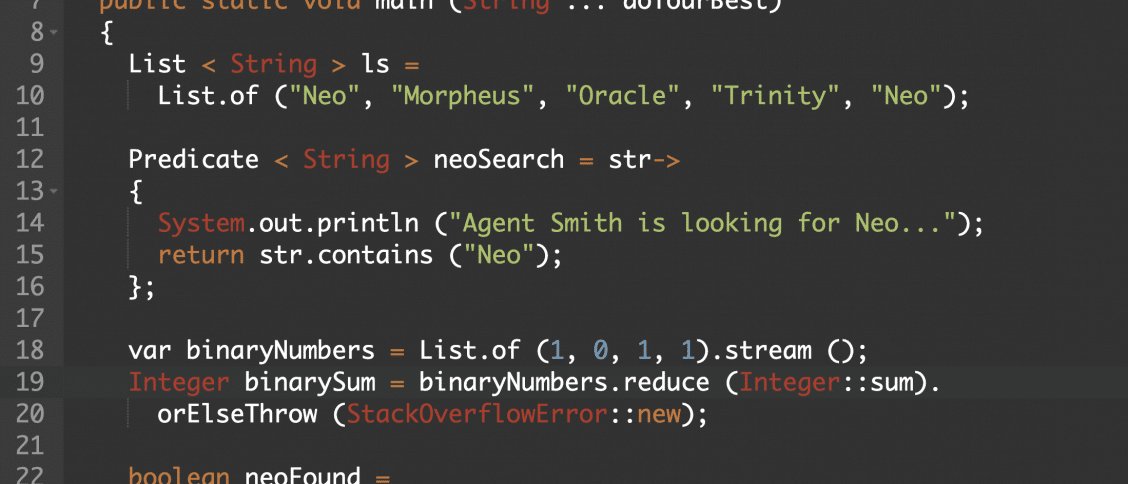
        List<String> ls = List.of("Neo", "Morpheus", "Oracle", "Trinity", "Neo");

        Predicate<String> neoSearch = str -> {
            System.out.println("Agent Smith is looking for Neo...");
            return str.contains("Neo");
        };

        var binaryNumbers = List.of(1, 0, 1, 1).stream();
        Integer binarySum = binaryNumbers.reduce(Integer::sum).orElseThrow(StackOverflowError::new);

        boolean neoFound = ls.stream().filter(str -> str.length() >= binarySum).allMatch(neoSearch);
        System.out.println(neoFound);
    }

}
A) Agent Smith is looking for Neo…
false
B) Agent Smith is looking for Neo…
Agent Smith is looking for Neo…
false
C) Agent Smith is looking for Neo…
true
D) Agent Smith is looking for Neo…
Agent Smith is looking for Neo…
Agent Smith is looking for Neo…
Agent Smith is looking for Neo…
Agent Smith is looking for Neo…
true
Explanation:
Here we are simply defining what is the Predicate condition with a Lambda:
Predicate neoSearch = str -> {
  System.out.println("Agent Smith is looking for Neo...");
  return str.contains("Neo");
};
Then we are reducing our List from 1, 0, 1 and 1 to 3 because we are adding all elements basically:
var binaryNumbers = List.of(1, 0, 1, 1).stream();
Integer binarySum = binaryNumbers.reduce(Integer::sum)
.orElseThrow(StackOverflowError::new);
Then here we filter all elements that have the size greater or equals to binarySum and then we use the allMatch function. Note that this function has to have all elements matching to return true. Since the first element is true, the allMatch method from the Stream will go to the next element printing again “Agent Smith is looking for Neo…”, as this method requires all elements to be true, there is no point in continuing the looping so the looping will break.
boolean neoFound = ls.stream().filter(str -> str.length() >= binarySum).allMatch(neoSearch);
System.out.println(neoFound);
To conclude, the output will be:
B) Agent Smith is looking for Neo...
    Agent Smith is looking for Neo...
    false
To fully understand this Java Challenge, you can also watch the FULL explanation video:
That’s it challenger! Keep it up with your Java learning and keep solving the Java Challenges! To see the original article, check it out the following link:
https://javachallengers.com/neo-stream-search-java-challenge/
Found a mistake, or something to add? Edit this page on GitHub

Rafael del Nero
Java Champion, a passionate and creative developer who possesses strong technical knowledge and delivers solid systems focused on Spring and Java EE specifications for cloud applications. More than 10 years' experience developing successful, revenue-increasing …
Discussions on the previous Foojay site
3 comments left on this article in 2021, kept from the previous WordPress version of foojay.io. They are an archive and are closed for replies — use the discussion above to add to the conversation.
The stream does an optimization and drops when it hits false the first time
Hello Rafael
For information, the list in the blog post (List.of(“Neo”, “Neo”, “Morpheus”, “Neo”, “Neo”)) is not the same as the one in the video (List.of(“Neo”, “Morpheus”, “Oracle”, “Trinity”, “Neo”)). So the output is not the same too.
Regards.
Hello David, thanks for your comment. I just fixed this Java Challenge to the right values in the List.of method. It should be fine now! I also added the written explanation.